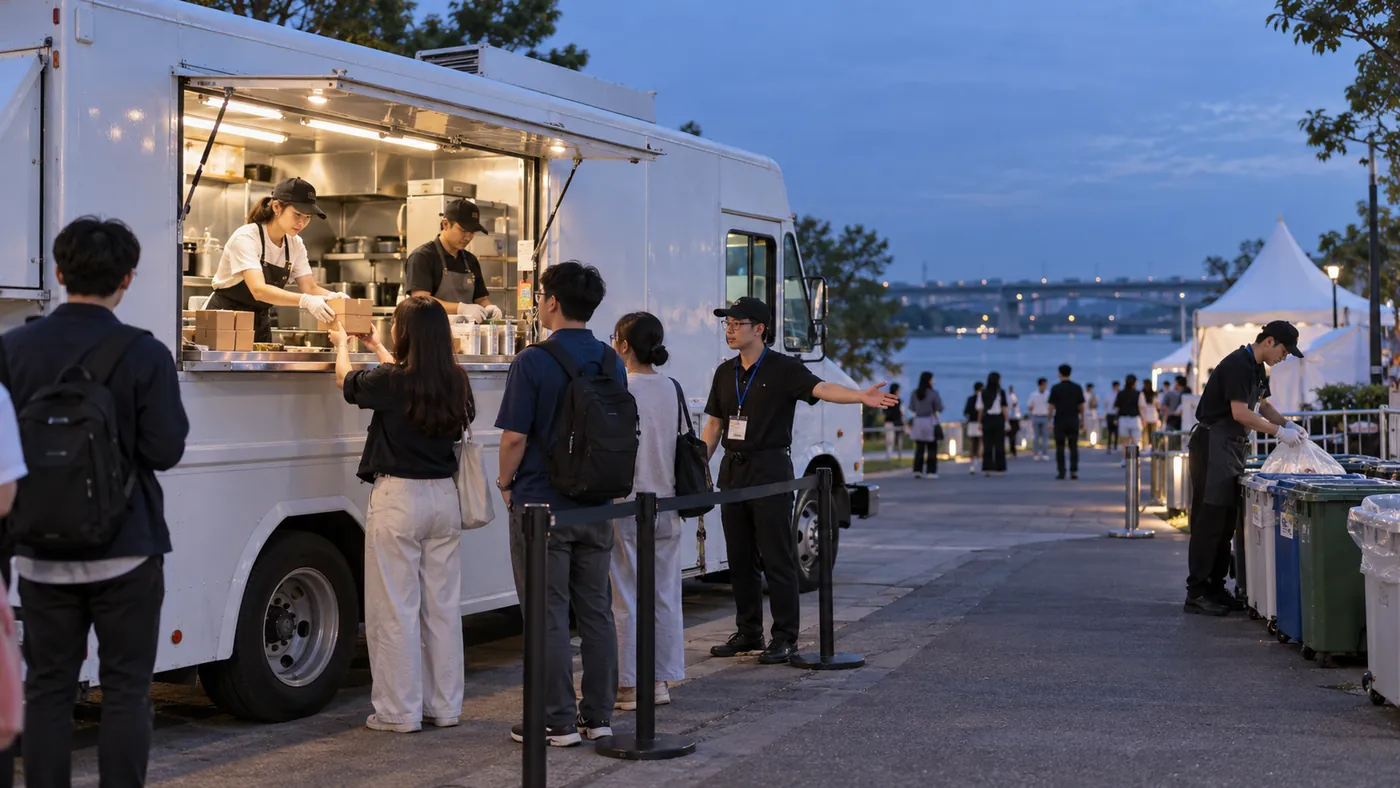
At a large outdoor festival, the food-and-beverage (F&B) zone is more than an ancillary facility: it is a core element shaping how long visitors stay and how safely crowds are distributed. Seoul Metropolitan Government’s recruitment notice for food trucks at the 2026 Seoul International Fireworks Festival, with operations around Mulbit Stage in Yeouido Hangang Park on 4–5 September, clearly shows what festival planners and F&B operations leads should cross-check first when agreeing on-site contracts.
The notice has two central conditions. First, at least four staff dedicated to ordering, payment, queues and customer service must be present at all times, completely separate from the cooking staff. Second, even if ingredients run out early and everything sells out, traffic controls make it strictly impossible for vehicles to leave before the event ends.
1. What having four non-cooking staff on site at all times means: a queue bottleneck becomes a safety hazard
At smaller local events, cooking staff often also take payments and manage queues. At a fireworks festival drawing hundreds of thousands of people, however, this creates a critical bottleneck.
- Physically separating duties: the four staff beyond the cooks specified in the notice cover order taking, card payments, queue movement control, customer service and shift relief.
- Preventing interference with pedestrian routes: walkways beside a river or waterside stage have limited width. Once an ordering queue spills into the walkway, pedestrian congestion develops and can become the trigger for crowd-crush incidents. When selecting food trucks, planners should treat the ability to provide operating staff who can control each truck’s own queue as a mandatory eligibility criterion, alongside the appeal of the menu.
2. A mandatory stay after an early sell-out… The blind spot in F&B budgeting
The participation fee is around KRW 200,000 per day, as a contribution to electricity, waste and shared facilities. Yet the practical costs that planners and participating operators can easily overlook arise from the mismatch between when sales end and when vehicles can depart.
Full traffic controls around Yeouidong-ro and Wonhyo Bridge, together with bus diversions, mean food trucks cannot simply leave when they finish selling.
- Additional costs from an extended stay: if vehicles and staff remain tied to the site after an early sell-out, further resources go into shift teams waiting on standby, keeping the truck’s generator or site power connection available, and staff storing and controlling odours from cooking waste on site.
- Preventing communication risks: when agreeing the contract, the F&B operations lead should communicate more than just the selling hours of 13:00–22:00. The expected time when unloading and actual vehicle departure become possible after traffic controls end should be specified in a structured breakdown to prevent friction on site.
3. How to prepare a four-stage food-truck timeline for a large festival
When placing orders and reviewing quotations, the F&B zone lead must distinguish the following four stages and reflect them in the timeline.
| Stage | Actions | Checks and management |
|---|---|---|
| [Stage 1] Advance vehicle access and setup (before traffic controls begin) | Bring vehicles in, assemble them and complete their placement in designated areas before the local police traffic cordon takes effect | Connect the temporary power distribution board, complete hygiene and fire-safety checks, and attend advance safety training |
| [Stage 2] Peak sales and route management (13:00 until sales end) | Keep the cooking team and dedicated queue staff strictly separate in their duties | Check the backup wireless LTE router in case the card terminal loses connectivity |
| [Stage 3] Stay on site after selling out (Holding Period) | Announce the end of sales and deploy stanchions with retractable belts to prevent additional customers joining the queue | Rotate remaining staff through rest breaks, seal and store waste, and keep fire extinguishers in position |
| [Stage 4] Safe vehicle departure after visitors leave (when traffic controls end) | Allow vehicles to depart in sequence only after confirming that pedestrian visitors have left and traffic controls have been lifted | Collect floor protection and inspect for traces of fuel or wastewater leaks, with sign-off before final departure |
Scroll sideways to read every column.
A planner’s note: include waiting time in the quotation form
When commissioning F&B services or recruiting food trucks, the standard quotation form must contain more than just nine hours of sales. Record load-in and setup time, actual selling time, the period remaining on site after a sell-out, and the permitted vehicle departure time separately. Responsibility for power supply and waste disposal in each period should be agreed in writing beforehand.
Selling out is a success for the operator, but trucks and rubbish left unattended on site until departure become safety risks and settlement disputes for the organiser.
Conditions for applying this elsewhere
Where traffic controls prevent departure after sellout, compare training, insurance, waste and shift conditions too.
Information not established
Recruitment targets are not final participation. Actual sales, sellout/departure times and profitability were not disclosed.
Reference material
Have a correction or additional evidence? Request a correction