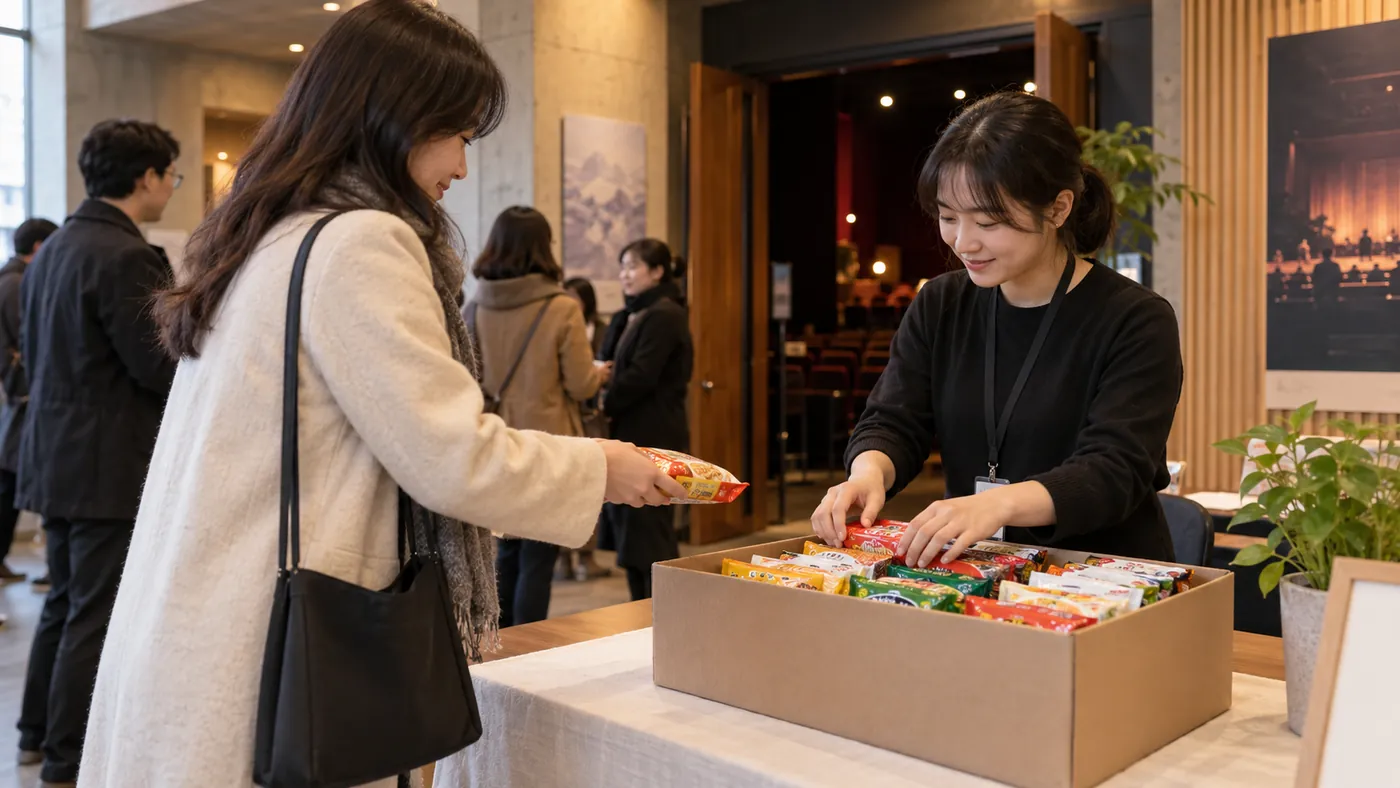
Admission in kind, in which cultural and artistic performances accept daily necessities or food instead of cash for tickets, is an appealing way to share the value of giving with audiences and lower the barrier to entry. The sign-language play 《Disappearing People》, held at the Jeonju Hanbyeok Cultural Center in November 2024, likewise required one packet of ramen with at least three months remaining before its use-by date in place of a cash admission fee.
The Jeonju Cultural Foundation’s subsequent annual report clearly recorded two separate figures for the production: 200 audience members and 316 donated ramen items. On the surface, this is a warm and heartening story, but from a working event planner’s perspective, admission in kind is a sophisticated operation requiring far more demanding logistics and control systems than ordinary paid ticketing. As the queue-management and settlement guidelines in the "Case Article Review" file also show, unless back-end planning first thoroughly decouples the number of collected items from the number of people who attend the performance and prevents bottlenecks at the reception desk, the venue can quickly become chaotic.
1. Decoupling metrics: Do not calculate attendance backward from donated goods
A mistake planning teams often make when writing results reports is to force the number of collected items to match attendance.
- Two independent data pipelines: In the Jeonju case, 316 ramen items were collected, but the audience numbered 200. It is likely that one visitor brought a five-pack bundle or that families donated generously. Reporting that there were 316 audience members because there were 316 ramen items, or interpreting the difference arbitrarily, would seriously distort the statistics. Attendance headcount belongs to audience management, while donated units belong to welfare logistics. Planners must keep these two metrics in separate ledgers from beginning to end, without mixing them, to demonstrate the event’s real results.
2. Physically separating the foyer reception desk: ticketing versus goods inspection
The biggest reason a foyer becomes congested during admission in kind is that ticket issuance and goods inspection are handled at the same counter.
- Managing inspection-time bottlenecks: Ordinary ticketing takes just three seconds to confirm a reservation name or scan a barcode. Admission in kind, however, takes at least 15–30 seconds while the visitor removes ramen from a bag, a staff member visually checks the use-by date and packaging for damage, and the items are packed neatly into a box. To prevent the queue of following visitors from extending outside the foyer, it is essential to decouple the route: first place a ramen inspection and donation collection point at the foyer entrance, then give visitors who pass inspection a token and direct them to a second counter to exchange it for a seat ticket.
3. Setting acceptance specifications in advance and establishing an on-site cut-off rule set
Vague guidance such as “Bring any food you have at home” leads to the worst disputes on site.
- Setting recipient standards in advance: It was a remarkably clever back-end control for the Jeonju Cultural Foundation to specify ramen with at least three months remaining before its use-by date. This is because it identified in advance the items that the receiving welfare organization, such as a food bank, would reject due to distribution and storage constraints and incorporated that information into the audience notice.
- Exception-handling protocol for unsuitable items: When a visitor arrives with expired ramen or a damaged product, staff should not shout “Admission denied” and engage in an argument. A flexible failover manual should be prepared: keep spare ramen nearby so the visitor can make a small donation on the spot and exchange it for replacement ramen to gain admission, protecting the goodwill of the audience.
4. A four-step protocol for admission in kind
When designing admission to a performance or event around a donation of goods instead of cash, the practical team should follow these four steps.
| Step | Operating standard |
|---|---|
| [Step 1: Confirm product specifications in writing with the receiving organization] | Consult the recipient in advance, determine acceptable items such as packaged ramen, the minimum remaining use-by period, and excluded items such as cup noodles or individually damaged products, and prominently announce these criteria on the booking page. |
| [Step 2: Establish a two-step reception route] | To prevent congestion in the foyer, physically separate the in-kind donation reception desk and the performance ticket-issuing desk completely and guide visitor flow between them. |
| [Step 3: Log a single packaging unit] | Prepare standard boxes in advance, for example boxes holding 30 items, and pack and count in real time so that the number of packets and the number of boxes are not mixed when goods are received. |
| [Step 4: Reverse-logistics handover and official receipt sign-off] | Immediately after the performance, move goods left in the foyer to secure storage. After delivery to the final recipient, obtain a donation receipt bearing the receiving organization’s official seal and close the settlement report. |
Planner’s note: Warm generosity is completed at the most clear-eyed inspection desk
The applause of an audience filling the auditorium and the boxes of ramen piled high in a corner of the foyer give a planner a deeply warm feeling.
But the success of an in-kind donation event is not measured by the height of the boxes stacked in the foyer. It is complete only when every packet of ramen in those boxes reaches the tables of neighbors in need in intact condition, before its use-by date, without a single omission or loss. The planner’s cool attention to detail, quietly checking use-by dates with a magnifying glass at the foyer entrance so the audience’s warm goodwill can lead to the full fruits of giving, is the most dependable back-end support for an event with admission in kind.
Conditions for applying this elsewhere
For events that accept goods instead of cash for admission or combine a performance with a collection. Confirm acceptable products and condition with the recipient before announcing the offer.
Information not established
The report records 200 attendees and 316 donated ramen items. Reasons for the difference, session-level attendance or repeat visitors, actual reception layout and inspection or exceptions, delivery date and receipt are not confirmed.
Reference material
- Jeonju Cultural Foundation · 2024 annual report, printed p.70: production-specific attendance and ramen donations
- Jeonju official tourism website · Disappearing People: 14 November 2024 date, venue, use-by requirement and booking instructions
- IEUM, Korea Disability Arts and Culture Center · Performance date and admission details
Have a correction or additional evidence? Request a correction