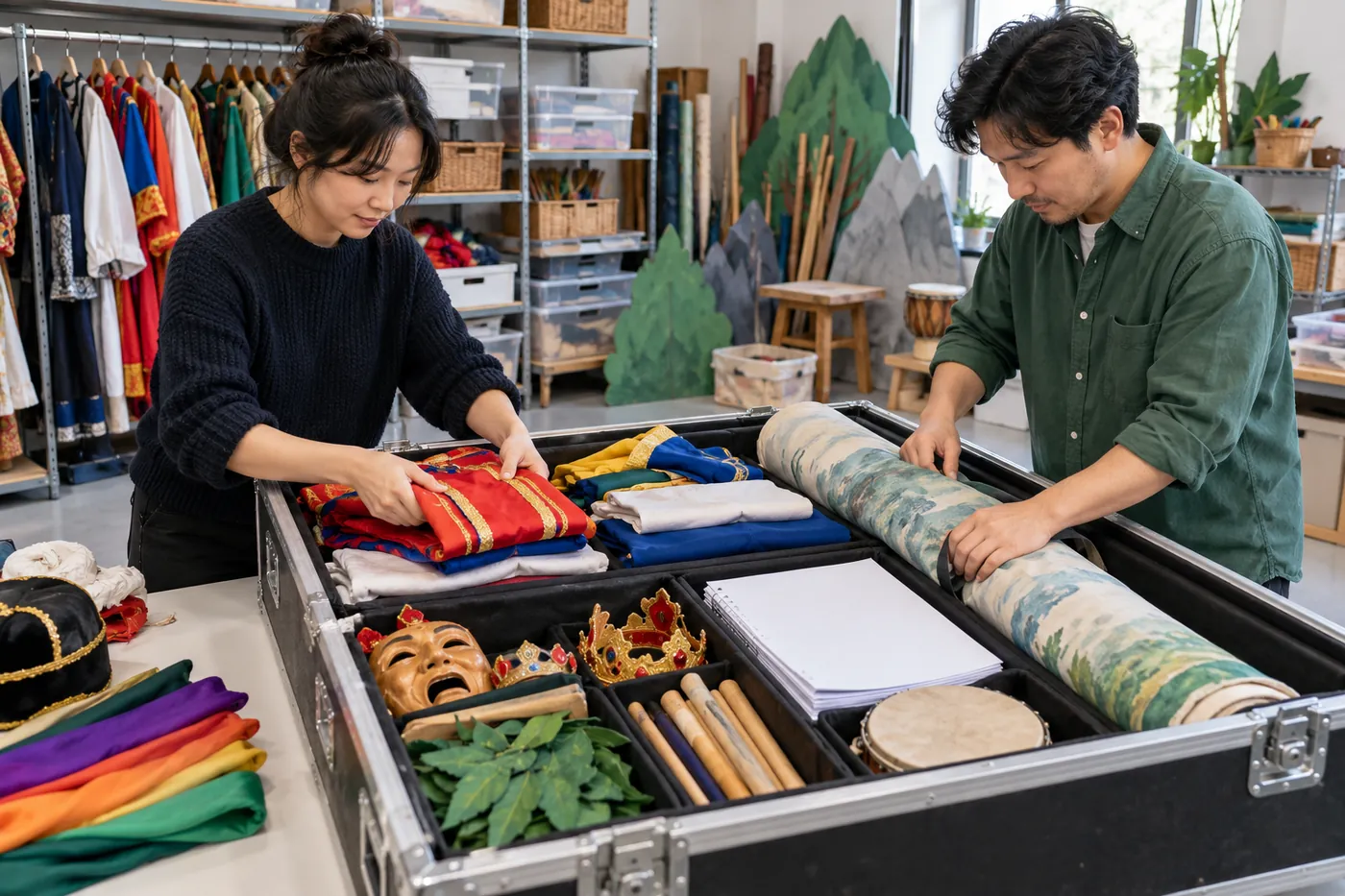
Public institutions and corporate ESG departments increasingly plan remote kit programmes that lend schools and other recipient institutions boxes of costumes and props, rather than dispatching an instructor. The Jangkkijeon and Heungbujeon performance kits offered by the National Theater of Korea’s Performing Arts Museum in the second half of 2026 follow this model.
From an event planner’s practical perspective, however, packing materials into a box and sending it by courier marks the beginning of a substantial logistics operation. As the procurement and hand-over principles in "Case Article Review" emphasise, a programme that must run smoothly without a single organiser’s staff member on site needs a timeline and manual designed even more carefully than the contents of the box.
1. Separate the hand-over of software—the script—and hardware—the box
If recipients only begin reading the script and assigning roles after opening a box full of materials, the activity can stall.
- The importance of asynchronous preparation: The National Theater of Korea provides applicant institutions with a script PDF before sending the physical kit, allowing them to select the types and sizes of costumes—medium or large—in advance. From an operational perspective, this is an effective cut-off mechanism. Send the script, the programme’s “software”, first so the receiving institution can finish casting and taking measurements. Only then deliver the matching “hardware”—costumes and props—to prevent the serious logistical losses of returns and exchanges caused by costumes that do not fit.
2. Decouple the timeline: the loan period is not the usable activity time
The promise of a “17-day loan” can give the receiving institution a misleading impression.
- Work backwards from lead time: According to the National Theater of Korea’s guidance, those 17 days include postal dispatch and collection. Planners should clearly separate the stages within the overall loan period: [delivery date – local preparation days – performance or activity date – repacking day – return collection date]. If these are explained as one undifferentiated period, a recipient may schedule its performance for day 17 and miss the return deadline.
3. Assign local responsibilities and manage compliance
There is no professional instructor waiting at the destination to run the activity when the box arrives.
- Clarify who runs the programme: The organiser should confirm in writing that it only lends the materials, while a designated person within the receiving institution, such as a teacher, is responsible for operating the performance.
- Agree rights to the resulting material: The permitted uses of activity reports and photographs required after the programme are equally important. A requirement to submit a report does not automatically grant unrestricted permission to use photographs showing students’ faces in the organiser’s publicity. To prevent legal disputes, obtain separate, clearly defined consent for photograph use at the application stage.
4. A four-stage protocol for lending remote activity kits
When planning a participatory programme delivered entirely through shipped materials, without on-site staff, the practical team should follow these four stages.
| Stage | Operating standard |
|---|---|
| Stage 1: Distribute the digital manual—the software—first | Before shipping the hardware, send the script or instructions as a PDF or video link so the receiving institution can assign internal responsibilities and complete casting. |
| Stage 2: Calculate and communicate the usable window | Exclude the round-trip courier time of approximately 4–5 days from the overall loan period, then clearly show the remaining usable activity days and cut-off dates in a calendar infographic. |
| Stage 3: Provide packing and repacking guidance | To prevent components being omitted from the return, include a photograph of the original arrangement inside the box and a checklist for recipients to cross-check when repacking. |
| Stage 4: Obtain separate sign-off for likeness rights in submitted results | Require a separate likeness-use consent form when photographs are submitted with the activity report, addressing the legal risks of using them in the organiser’s subsequent publicity. |
Planner’s memo: the manual outside the box determines whether a remote programme succeeds
With sufficient budget, anyone can fill an attractive box with colourful costumes and props. What turns its arrival into a smoothly unpacked kit and a successful children’s performance is the planner’s precise timeline design.
When the planner cannot be there, their operational control must be carried by the carefully prepared sheet of paper packed with the box. Who must read the script, when they must do so, and on which day the box must be sealed again and placed outside for collection: these unembellished instructions, specified down to the second, are the operational foundation that keeps the programme running smoothly even where its organisers cannot see it.
Conditions for applying this elsewhere
Use where a receiving institution can lead the activity and confirm age group, costume sizes and delivery eligibility.
Information not established
Instructor dispatch, item counts, actual use, participation and educational outcomes were not verified.
Reference material
Have a correction or additional evidence? Request a correction