The attendee experience remains the first priority
According to Amex GBT, improving the attendee experience is the top priority identified by professionals across all regions. Respondents felt that as AI-generated content becomes more common, attendees increasingly seek experiences created directly by people. The attendee needs they anticipated were personalised experiences (35%), social activities and networking (31%), and hands-on, participatory sessions (31%). These figures reflect professionals’ perceptions of attendee expectations, rather than a direct survey of attendees.
Bigger budgets do not necessarily mean more room to spend
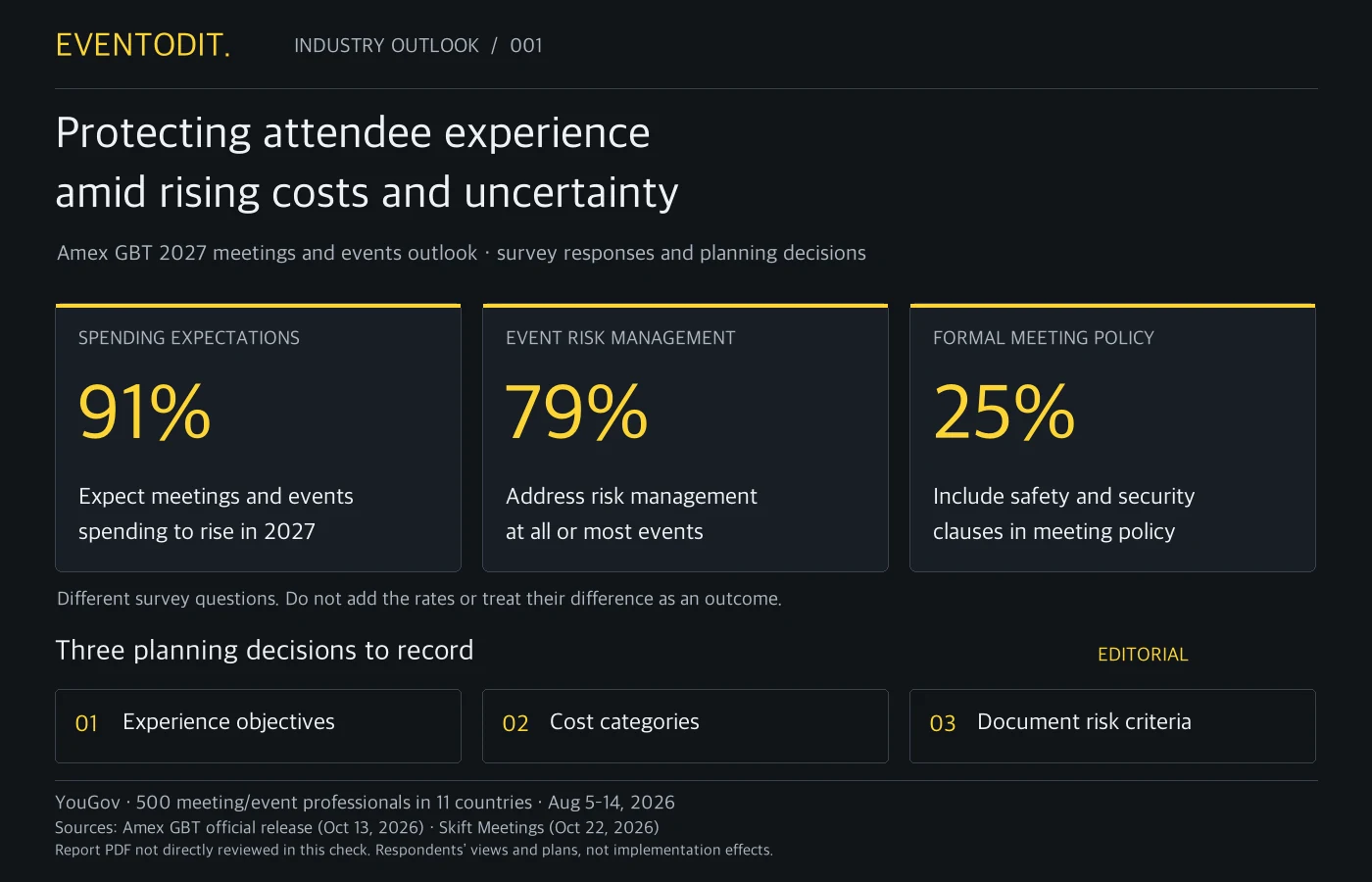
Some 91% of respondents expected meetings and events spending to rise in 2027. Skift’s analysis suggested that much of the increase could simply cover higher costs. The share expecting cost per attendee to increase was 91% for product launches and 84% for conferences, including trade shows.
Approaches to reducing costs are also changing. Some planners are reducing attendance or adjusting food and beverage arrangements. Audiovisual production, however, is seen as difficult to cut because of its important role in attendee engagement. Skift concluded that the aim is to identify spending that does not contribute to the event’s objectives, rather than simply cutting costs.
Why planners are reconsidering destinations and formats
Amex GBT’s press release said geopolitical uncertainty was changing the way meetings are held. Some 39% of professionals had changed destinations or cities, 37% had increased virtual meetings, and 30% had reduced meeting sizes or changed venues. According to the same Skift article, cost pressures are also prompting clearer interest in second-tier cities. An Amex GBT executive explained that planners were sourcing these cities for their lower costs more often than before.
Meanwhile, only 22% said they had reduced the number of meetings because of geopolitical uncertainty. Planners are moving beyond responding after a crisis occurs towards building plans that allow a change of direction from the outset. Geopolitical conflict is not the only source of uncertainty: extreme weather, transport disruption and infrastructure problems can also unsettle an event.
79% manage risk, but only 25% include it in policy
Risk management and compliance ranked among the top three priorities for 2027. Some 79% of respondents said they applied risk management practices to all or most events. According to Skift, however, only 25% explicitly included safety and security provisions in their formal meetings policies. This indicates a substantial gap between working practices and policy documents.
That gap matters during a crisis. Without criteria in policy, applying a consistent level of action during an actual emergency becomes difficult. Planners can consider documenting risk management criteria and triggers for changing plans, such as moving venues, switching to virtual delivery or reducing scale. The report suggests that consolidating spending, attendee data and supplier performance with one provider can help establish standards. Since that proposal is connected to Amex GBT’s services, it should be assessed against other approaches.
AI is a tool for supporting decisions on site
In their AI plans, 34% of respondents said they would use it to give on-site staff insights for personalised service. Event information and communications accounted for 32%, engagement tracking for around one third, logistics optimisation for 30%, and venue sourcing for 24%. The lowest planned use was in a significant decision area such as venue sourcing, illustrating how the pace of technology adoption differs by task.
These figures concern intended uses in 2027, rather than actual implementation results. The response percentages for individual uses must not be added together and treated as an overall adoption rate.
EVENTODIT recommends defining the situations in which on-site staff need information, and what information they need, before choosing an AI tool. For example, an information-desk employee may need a participant’s advance registration status and question, rather than their entire record. Planners should also check whether staff can review and correct information produced by the tool. Cost comparisons should include operating staff, training and review time alongside implementation costs. If attendee information is used, the purpose of collection, access permissions, retention periods and applicable local privacy requirements should be checked first.
Three checks for planners
- Attendee experience goals: First define the experience you want to protect.
- Separate cost categories: Distinguish spending that contributes to the attendee experience from spending that does not.
- Document risk criteria: Set out the triggers for changing location, format and scale in policy documents.
AI can help put these three elements into practice, but it does not set the objectives for you.
Source scope and limitations
This article is based on Amex GBT’s press release and Skift Meetings coverage. The findings are the responses and plans of the professionals surveyed, and cannot be treated as figures directly applicable to the entire global industry or Korean companies.
Information not established
The full report was not reviewed in this check. The country-by-country sample composition, detailed figures by sector, AI adoption rates among Korean companies and actual effects have therefore not been established.
Reference material
- Amex GBT · “Meetings professionals refuse to compromise on attendee experience in 2027” · press release, October 13, 2026
- Skift Meetings · “Bigger Meeting Budgets, Tighter Scrutiny: What Planners Expect in 2027” · October 22, 2026
- Amex GBT · 2027 Global Meetings and Events Forecast · report PDF (Not accessed or directly reviewed in this check.)
Have a correction or additional evidence? Request a correction