An acquisition announcement is different from completion
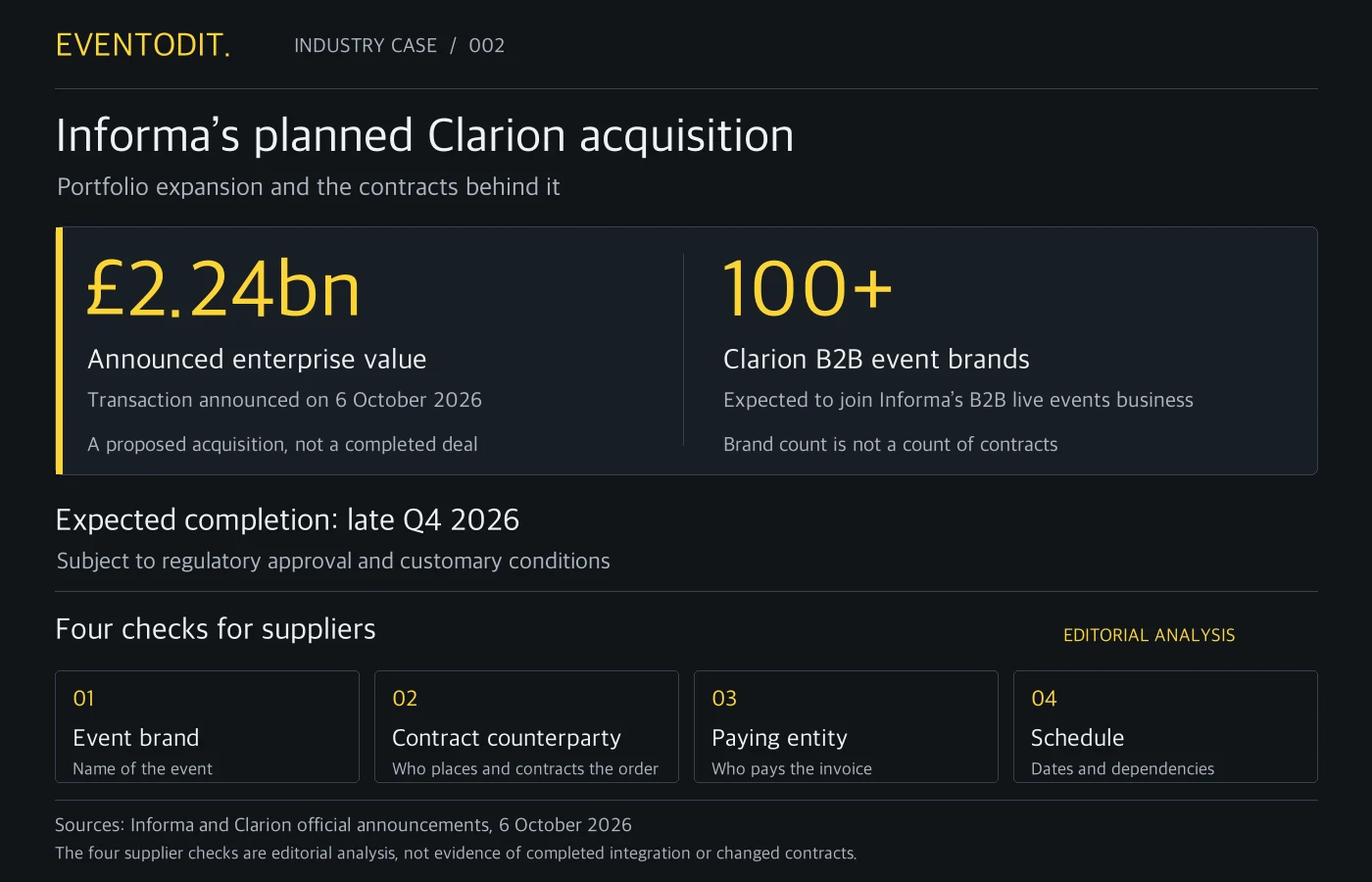
On October 6, Informa announced plans to acquire Clarion. The transaction has an enterprise value of £2.24bn, equivalent to 11.1 times Clarion’s expected 2027 EBITDA. The company expected the transaction to complete in late Q4 2026, subject to regulatory approval. As the combination has not yet been completed, suppliers need to distinguish the announced plan from actual changes after completion.
The number of brands indicates scale. However, more brands do not necessarily mean a corresponding increase in the number of event editions or contracting entities. Suppliers reading this transaction need to consider not just market size but which business relationships could expand.
Shared operating capability matters more than collecting event names
Informa identifies operational efficiency, procurement, shared services, event delivery and the reduction of duplicate head-office costs as sources of synergies from this acquisition. It has outlined approximately £50m in annual operating synergies. Its plans also include expanding data and digital services to create revenue synergies. This points to an emphasis on the ability to operate a portfolio through shared systems, beyond owning multiple events.
In its announcement on the same day, Clarion said business would continue as usual for customers, exhibitors, sponsors, partners and suppliers. Informa also said the first three to six months after completion would focus on delivering already committed 2027 plans and budgets, followed by closer integration of the businesses. The acquisition announcement alone therefore does not establish that purchasing methods or contractual terms across all events will change at once.
More brands do not necessarily mean more diversified customers
This section is the editorial team’s analysis of the public announcements from a sales perspective. It is not a finding about how individual contracts have changed.
Even when a supplier works across several events, brand-level revenue alone may not reveal the concentration of its business relationships if final decisions sit within the same customer group. The same brand can also involve different local entities, agencies and purchasing structures. It is therefore useful to assess sales reach separately from concentration in contracts and payment relationships.
Agencies and suppliers can compare their work through four lenses: event brand, actual purchaser and contracting party, payer, and timetable. If one customer’s decisions affect several projects together, sales plans and staffing commitments can be discussed on the same basis.
Portfolio proposals gain value when their scope is clear
Offering the same service across several events can allow a supplier to design shared equipment and production specifications, repeat training and local partner networks together, reducing the effort of explaining everything from scratch each time. This is an option only when contract scope and delivery conditions have been confirmed.
The more locations a proposal combines, the clearer it needs to be about what varies with site conditions. Unless a common quotation specifies whether it includes transport, accommodation, local labour, night work and responses to changes, an apparently convenient quotation can omit delivery costs. The strength of portfolio selling lies in explaining what can be standardised and what needs individual pricing, rather than offering a blanket discount.
Consider the working-capital timetable alongside prospective sales
Securing staff or equipment in anticipation of an expanded customer portfolio means paying costs in advance. Expected allocations must be distinguished from confirmed orders. Requests from several events do not mean that delivery dates and payment receipts will be evenly spread.
Alongside total contract value, suppliers need to compare labour, transport and sub-hire costs paid upfront, when acceptance and invoicing become possible, contractual payment dates, and extra spending caused by changes. If projects cluster in one period, cash may be needed before receipts arrive, separately from eventual profitability.
A synergy forecast should not be read as a supplier-price reduction
Informa’s stated synergies are company forecasts. They are not realised savings or targets for reducing individual suppliers’ prices. Operating synergies will take time to reach their full level; approximately one quarter of the target was expected to be realised in the first full year after acquisition. Approximately £50m in one-off implementation costs will also arise separately.
This distinction is also useful when reviewing a partner’s proposal. Combining purchases may reduce procedures, but new reporting methods, system connections, staff training and coordination across regions can create additional work. Where a proposal includes data services, understanding the scope of information to be provided, its intended use and management responsibilities is necessary to estimate staffing and costs. Rather than focusing on the word “integration”, suppliers should ask which tasks will decrease and which will be added.
Separating the academic business and focusing on B2B
Alongside the acquisition, Informa began a process to separate its academic publishing business, Taylor & Francis. The company stated its intention to make B2B live events its core business. After the acquisition, the B2B live events business would span approximately £4.2bn in annual revenue, around 1,000 specialist brands, around 40 market sectors and over 30 countries.
Suppliers can read this as a signal that Informa intends to invest more deeply in exhibitions and events. However, the final outcome of the Taylor & Francis separation is expected to be reported alongside the 2027 full-year results, so it should be understood as a plan at this stage.
Break a large opportunity into specific, confirmed conditions
This transaction shows how competition in exhibitions could extend beyond individual events to an entire portfolio. Some organisers need partners able to support a broad range of locations reliably, while suppliers with deep expertise in a particular field may also find new opportunities.
To turn that possibility into a business plan, confirmed contract scope, local delivery capability and a workable payment structure need to follow. Suppliers can compare the costs and resources involved in preparing a common offer across several brands while maintaining existing customer relationships, or focusing on a specific field or region. Defining a role they can reliably deliver matters more for connecting contracts to execution than simply following scale.
Conditions for applying this elsewhere
This analysis is based on an international organiser’s public announcements. It does not assume that Korean trading terms or individual contracts will change.
Information not established
Transaction completion, regulatory approval results, realised synergies, individual supplier prices, payment terms and actual changes to operating procedures have not yet been established. The details of the October 27, 2026 trading update were also not checked for this article.
Reference material
- Clarion Events · “CLARION EVENTS TO JOIN INFORMA” · official announcement, October 6, 2026
- Informa PLC · “Growth, Focus and International Expansion” · strategic announcement, October 6, 2026
- Informa PLC · “Nine-Month Trading Update” · October 27, 2026 (Access was blocked during this review; the document was not directly checked.)
Have a correction or additional evidence? Request a correction