Additional responsibility and the increase in workload need separate examination
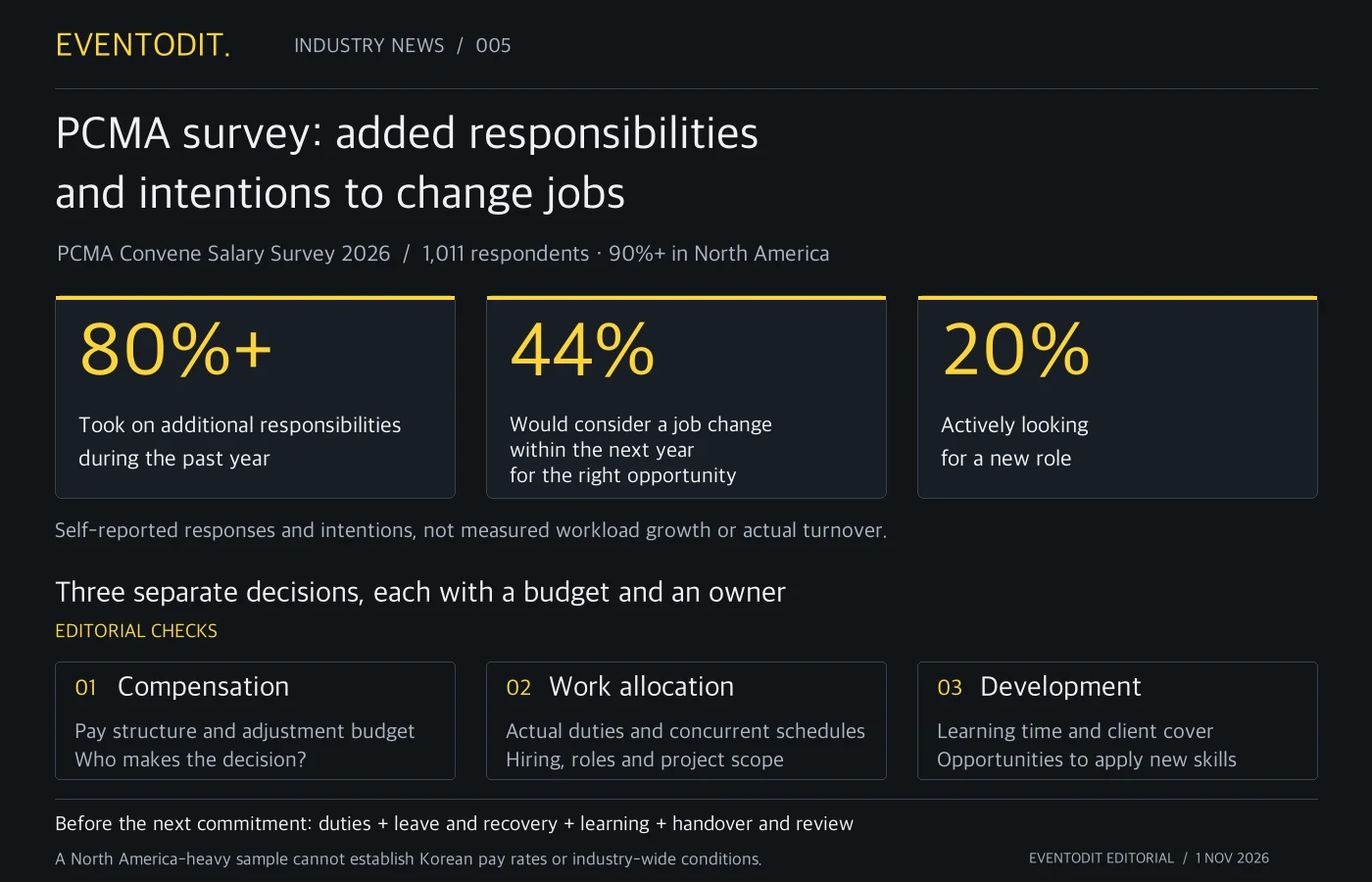
At least 80% of respondents said they had taken on additional responsibilities over the past year. Reasons included organisational growth, restructuring, staff reductions and long-standing vacancies. Only 17% reported no change.
Working hours were also long. Nearly half reported working 41–50 hours a week, while about a quarter worked 50 hours or more. Around 40% considered their workload difficult to sustain, and about 10% considered it completely unsustainable. Over the past year, 41% had taken 10 days of leave or fewer. Groups taking less leave also reported greater work strain.
These figures are respondents’ own assessments, rather than measurements of actual working hours. Even so, planning needs to account for the possibility that work not recorded as revenue — proposal revisions, client reporting, supplier coordination and post-event administration — can increase even when event numbers stay the same.
Managers need to examine the work assigned concurrently, beyond whether an individual is coping. List the actual work from proposals to post-event administration, and identify overlapping schedules, final checks concentrated on one person, and the work of passing on client changes. This makes it possible to compare additional recruitment, role adjustments and a reduction in the scope of projects accepted.
Compensation and work allocation cannot substitute for one another
About two-thirds of respondents said their compensation had not kept pace with the cost of living over the past year. While 56% expected a pay increase in the following year, most had already received one over the preceding year. Continuing dissatisfaction with compensation can therefore be read as a sign that pay increases alone do not resolve employees’ burdens.
The report’s central diagnosis is that organisations may have resolved where work happens, but not how it is distributed. Higher compensation does not automatically change an unmanageable allocation of work. Conversely, more training or control over schedules does not establish that compensation concerns have been resolved. Giving each measure its own budget and responsible person clarifies what it is intended to improve.
What Korean businesses can take from this survey is a set of questions for internal review, rather than a pay scale. Decisions need to follow an examination of actual job scope, required skills, working conditions and the company’s compensation system. Converting North American respondents’ dollar salaries into Korean won to set an appropriate rate does not account for these differences.
Job-change intentions raise staffing questions rather than establish a turnover rate
Asked about changing jobs in the next year, 44% said they would consider a move for the right opportunity. Another 20% said they were actively looking for a new position, while one-third had no plans to change jobs. Higher compensation was the leading reason to consider a move, followed by career growth opportunities and work–life balance. Leadership quality, organisational culture, workload and flexibility also featured prominently.
These figures are not actual departure rates. Nor do they predict that the same proportion of staff will be absent from the next event. The editorial team recommends reading the findings as a prompt to check whether critical work is held by one person, rather than as a basis for scoring individual employees’ likelihood of leaving. Other team members should be able to understand agreed client conditions, suppliers’ scope of work and unresolved changes. Handover preparation is an operating cost that keeps work moving during leave or job changes, rather than a procedure for suspecting employees.
However, simply demanding more records can make handover an additional burden. Decide which records can be reduced, where time for organising them will sit, and who will secure time for the receiving person to review them.
How development support is provided matters
Employer support for professional development was reported by 88% of respondents with no plans to change jobs and 73% of those actively seeking a new role. This difference alone does not establish that training support prevented departures. The groups have different characteristics, and the data do not demonstrate causation.
Development support nevertheless requires management decisions. Paying course fees while leaving workloads unchanged can push learning into employees’ evenings. The actual scope of support becomes clear only when a company decides whether learning time is included in the work schedule, who covers client requests during it, and whether staff will receive work in which to apply what they learn.
Respondents’ choices for what would most improve their working experience beyond compensation followed similar themes: adequate staffing, manageable workloads, clear career paths, meaningful advancement opportunities, stronger leadership, flexibility, professional development and recognition. How a company explains and implements these measures shapes whether employees can envisage a next role.
AI promises efficiency but can also raise expectations
Generative AI use was almost universal in this survey. Some 96% of respondents used AI in some form, and 70% used it at least weekly. While 60% expected AI to improve productivity, half expected it to reduce repetitive work. Around one-third, however, were concerned that AI would raise work expectations without increasing compensation. Job insecurity was reported by 14%.
These findings show that AI does not automatically reduce staffing burdens. Whether efficiency leads to sustainable working practices or higher expectations depends on how a company sets its work standards. When considering AI adoption, decide which work will receive the time saved and how the resulting work will be assessed.
Work scope also guides the choice between permanent and external staff
The survey results cannot establish which staffing arrangement is more efficient. The survey did not compare the costs or performance of alternatives. It is clear, however, that different kinds of event work can require different staffing arrangements.
Onsite work concentrated in short periods creates different staffing needs from year-round client management and planning. External staff can share the onsite burden, but do not automatically resolve the work of carrying forward client context or coordinating changes. Assigning more work to existing staff can also bring the opportunity cost of projects that can no longer be accepted, alongside insufficient recovery time.
An event count alone is therefore insufficient for deciding whether to add staff. Compare the work to be performed, the skills required, simultaneous time needs and the responsibility retained internally for checking the work.
Check usable capacity before accepting the next project
The management question raised by this survey is whether employee satisfaction is treated only as a benefits issue or as a condition for delivering the next assignment. Compensation adjustments, work reallocation and development support are choices that cannot substitute for one another.
Before proposing the next project, a company can review current responsibilities and confirmed schedules alongside leave and recovery time, learning time, and time needed for handover and final checks. The remaining capacity can then inform the proposed scope and staffing. Explaining in advance what can be provided and what cannot yet be promised helps align staffing plans with sales commitments more clearly than expecting someone to absorb additional work after it arrives.
Conditions for applying this elsewhere
At least 90% of respondents in this sample were based in North America. Do not directly generalise these international responses to Korean pay, working hours or employment conditions.
Information not established
The actual data-collection period, valid response counts for individual questions, sampling and weighting methods, actual departure rates, causal effects of development support, and comparative costs and productivity were not established.
Reference material
Have a correction or additional evidence? Request a correction