The Audience Placed Their Bodies in Water Instead of Auditorium Seats
Paragorgia is a work newly created in 2026 for Borealis’s annual program Music for Sea Bathing. Benedicte Maurseth performed on Hardanger fiddle and voice, while Håkon Mørch Stene handled percussion, synthesizer, and electronic sounds. The work explores the diversity of life beneath the sea.
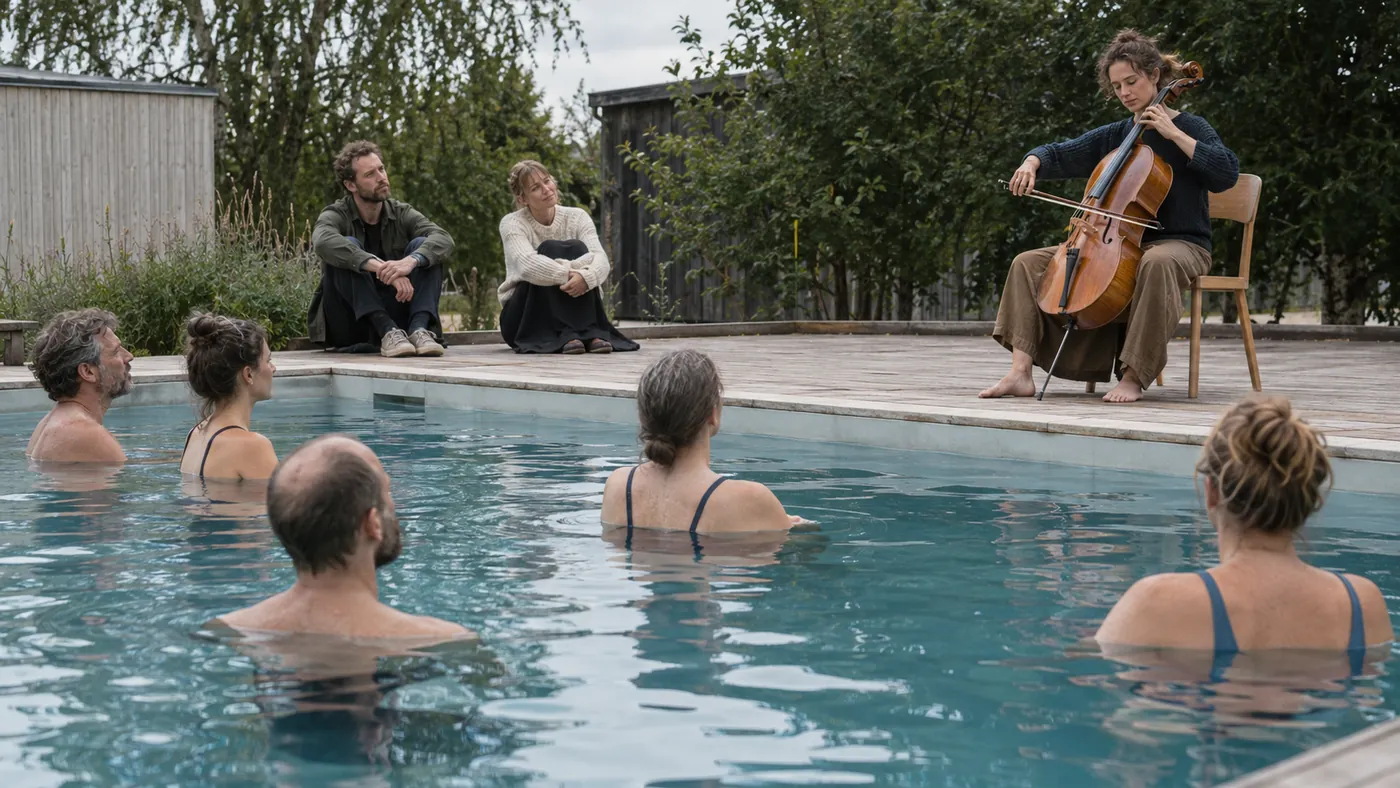
Official photographs document a performance scene bearing the work’s title. The audience in the photographs is in the pool, looking toward the performers at its edge. There is also a record of the performer playing in the same way at a previous performance, providing evidence that this performance was indeed held in this way.
The editorial team focused on the audience’s bodies rather than the shape of the seating. When the environment in which the body is placed while listening to music changes, the venue becomes part of the way the work is experienced, beyond a backdrop that contains it.
Water Was a Material That Connected the Theme with the Audience’s Actions
The work’s description explains that it sought to create a relationship between the audience moving in the water and the subject of the music.
When we think of moving a performance to another venue, it is easy to imagine placing the same stage and chairs in a new location. This performance is different. The environment was chosen so that the audience could encounter the work’s theme through their own posture and senses. A performance that shows water in a background video and one that the audience listens to with their bodies actually immersed in water are entirely different experiences.
This case also poses a question for other festivals. What connection will you create between the subject of a work and the audience’s actions? When actions such as walking, leaning, and staying connect with the content of a work, changing the venue takes on meaning beyond decoration. This, however, is the editorial team’s interpretation. It is not material in which the organizers evaluated the effects of this performance.
There Are Several Listening Positions Within the Same Performance
The official photographs show that the performers and the audience in the water do not share a flat seating area at the same height. The water’s edge, areas close to its surface, and the surrounding dry spaces appear together in one scene. These photographs show spatial relationships; they are not measurements of how the sound differs from one position to another.
At a performance where the audience moves freely, it is difficult to express a “good spot” as a seat number. What becomes visible when the body is lowered, and how the movements of the person next to you change your experience, also become conditions of the work. This is why you need to check in person, from the actual listening positions, before confirming the venue.
If you think of a site visit only as an administrative procedure, you will miss a great deal. It should be seen as a small rehearsal to check whether the experience the planner imagined also holds up at that venue. This is a principle for application that the editorial team drew from this case.
Reaching the Entrance and Participating in the Work Are Different
According to the access information at the time of the performance, there was no wheelchair lift at the entrance and no lift in the pool. The doorways to the accessible toilet and changing room were 90 cm wide, and there were no shower facilities. Service dogs could remain in the grass area above the pool, but the information stated that sound and sightlines were restricted there.
This information shows that even a creative experience has boundaries. Being able to pass through the entrance does not guarantee participation in the water. Watching the performance from another position is also an option, but we cannot say in advance that the experience is the same as the original.
| Published condition | Question posed by the editorial team | What to confirm with the venue |
|---|---|---|
| Entrance and pool entry facilities differ | What participation is possible after arrival | Ways to participate outside the water and the support required |
| Changing room doorway width and differences in shower facilities | Does the experience connect from preparation through to viewing | Actual routes of use and each participant’s needs |
| Restrictions on sound and sightlines depending on the position | Does the core of the work remain in another position | An accurate explanation of how the experience differs by position |
Scroll sideways to read every column.
The questions and items to confirm in this table are the editorial team’s proposals for application. The 90 cm doorway width must not be used as a Korean standard or a determination of suitability.
For Events in Korea, Adapt the Relationship Between the Audience and the Work Rather Than the Pool
If you draw on this idea for a festival or brand performance in Korea, there is no need to copy the swimming pool itself. First, consider which audience actions make the work clearer. For example, imagine presenting a work about plant growth and care in a garden. The relationship between the work and the space changes depending on whether the audience views it while passing by or stays beside it for a while. This is a hypothetical plan for explanation, not an actual Borealis program.
The more you propose a new sensory experience, the more you also need to design for differences in ways of participating. The artist and venue operator should be able to explain together how audience members who find it difficult to adopt the same posture will encounter the work, and what changes in that way of participating. Having an alternative does not mean you can say it is exactly the same as the original experience.
If you actually use water or a special environment, you need separate reviews by the venue operator and the technical, safety, and accessibility staff. Photographs from this case or information about an overseas facility do not determine whether a performance in Korea is permissible. If a venue cannot preserve the work’s core action, choosing to change the space or the way people participate can also be part of the creative process.
Conclusion
This performance went beyond where the audience sits and used the bodily state in which they listen as a material for planning. Dimensions and positions to check during a site visit should also connect to whom the experience will be offered and how. The creativity of using an unfamiliar venue does not become persuasive simply by proposing a new sensory experience. It gains strength when the differences and limitations of that experience are explained accurately.
Conditions for Applying This to Other Events
- Refer to this case when planning an event in which the work connects directly with the audience’s posture, movement, and way of staying in a place.
- Confirmation by the venue and relevant staff is required. Do not use measurements from an overseas facility as common standards in Korea.
Information Not Confirmed
- We did not confirm site visit records, distances and water depths at each position, acoustic measurements, facility use records from the day, or records of support for individual participants.
- We did not conclude from photographs alone that all audience members were floating in the water or heard the same sound.
- We did not evaluate audience satisfaction, a sense of connection with nature, or effects on production costs.
- We did not conduct on-site reporting, use the facilities ourselves, or obtain a review by external experts.
Sources
Next tasks and related resources
Related practical guides
Venue Survey and Load-in
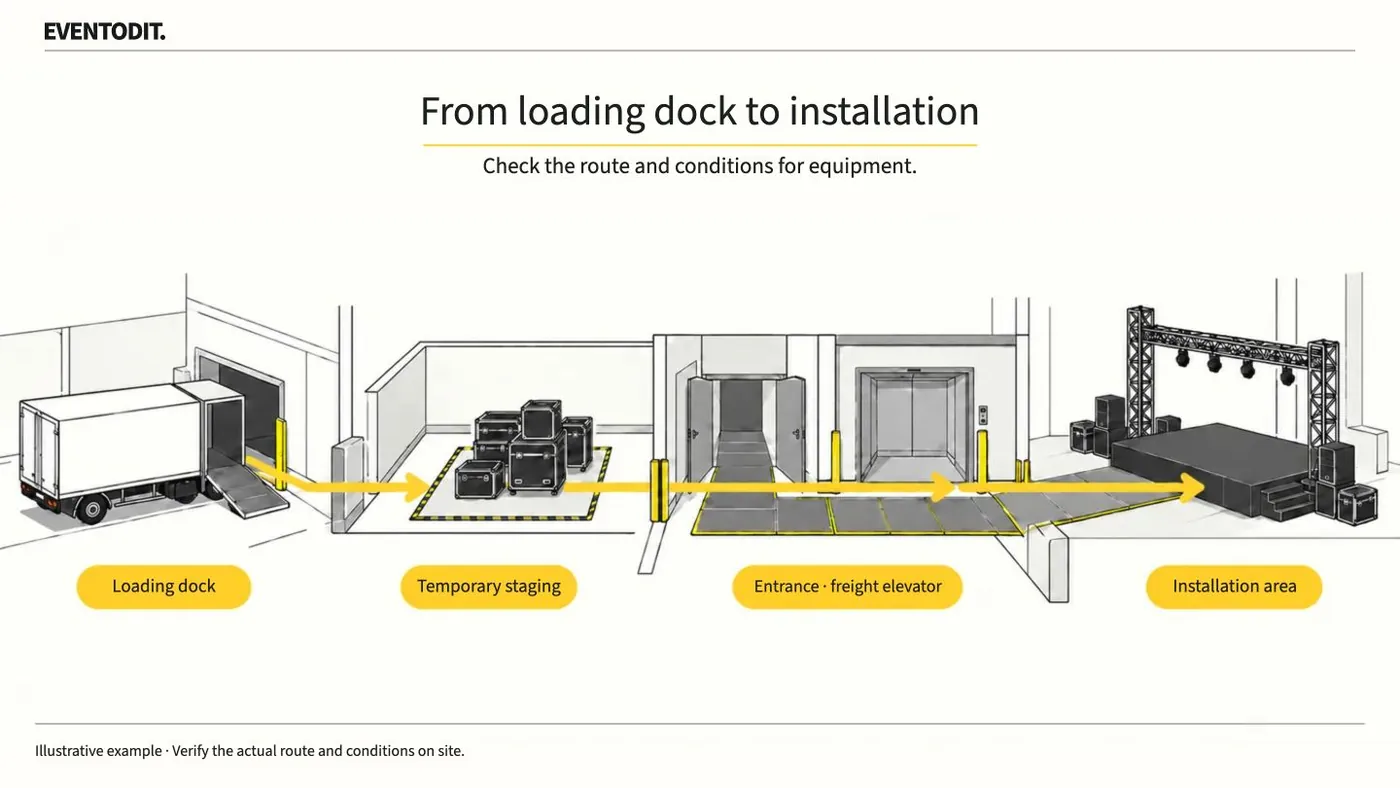
Check the route equipment will actually travel and the routes visitors will use. Mark questions for the facilities and technical teams on the plan and assign a person and deadline to resolve each one.
Read guideHave a correction or additional evidence? Request a correction