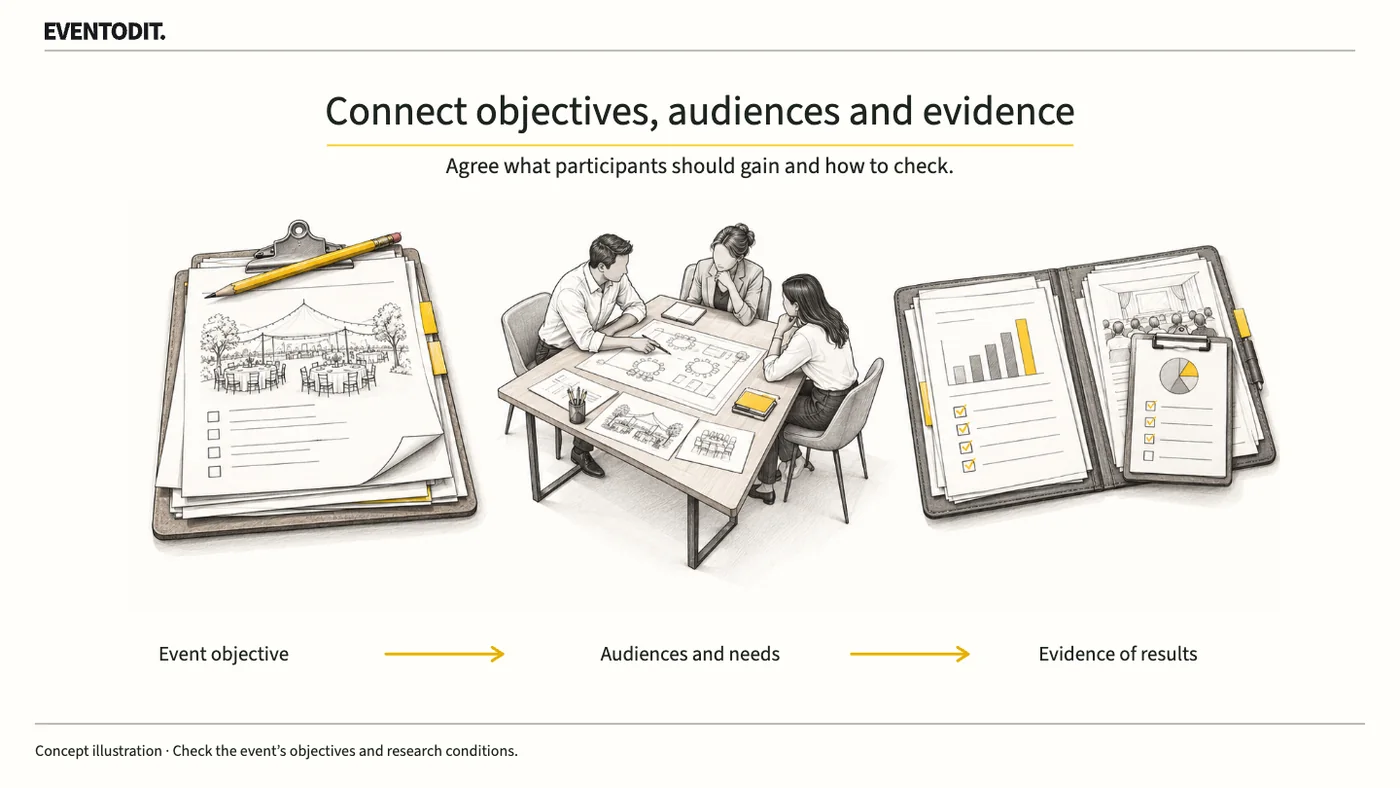
Turn the organiser’s request into a participant outcome
The planning lead asks the commissioning team why the event is needed and what change they want to see afterwards. If the organisation wants to introduce a product, specify which information participants should understand or whether they should request a follow-up conversation. A training event may focus on learning; an exhibition may focus on relevant business conversations. Record the priority and decision-maker for each objective, and agree which one takes precedence if objectives conflict.
Identify each group and its needs
Separate general attendees, hosted buyers, speakers, exhibitors and operational staff. Ask each group about its purpose, schedule and language, access to movement and information, and conditions needed for meetings or presentations. Tell the relevant teams what support can be provided, who owns it and what is still undecided.
Korea Tourism Organization’s sustainable MICE guide recommends identifying stakeholders, including participants, local residents, agencies and suppliers, and using previous satisfaction results, interviews or surveys to hear their views. For a first event, ask prospective participants directly and distinguish what they said from the planning team’s assumptions.
Define the result and evidence for each objective
The US CDC’s programme evaluation guidance recommends deciding the evaluation question before choosing what information to obtain, from whom and when. An event team can apply this principle to its objectives. Registrations and entries describe operational volume; a post-session question or request for a follow-up meeting may provide evidence relevant to a particular objective.
For each indicator, record its population, period, counting unit, treatment of repeat entries, data source and owner. Distinguish the views of consenting respondents from those of all attendees. If the people surveyed before and after differ, do not assume a change was caused by the event. Do not assume an observed outcome was caused by the event.
Fictional example: a buyer meeting event
This is a hypothetical plan for illustration, not an actual event result. The organiser wants relevant buyers and businesses to begin follow-up discussions. The planning lead asks registrants about their interests and obtains meeting topics and language requirements from exhibiting companies.
On-site staff record meetings that take place; afterwards, the research owner asks consenting participants whether they intend to continue discussions. Meeting counts are reported from operating records, while follow-up intent is reported separately with the respondents and survey timing. An intention to continue does not mean a contract was signed.
Approve the plan and hand it to the next teams
The planning lead brings together the objectives, audiences, needs, desired results, data owners and collection times for the organiser’s approval. Give the audience and eligibility criteria to the recruitment owner, mobility, language and access requirements to operations, and collection methods and timing to the research owner.
Check data collection, access, retention and deletion against the event’s circumstances and applicable local requirements. Record unresolved decisions with an owner and deadline instead of presenting them as settled.
Scope
This is EVENTODIT’s practical proposal informed by Korea Tourism Organization’s sustainable MICE guidance and the US CDC’s general programme evaluation guidance. CDC guidance is not an event-specific regulation; check the event’s own research design and applicable data-protection requirements separately.
Use the original records and supporting templates
Start with the goal, audience group and intended participant behaviour in the [metric definition and trial-count record](/en/templates/metric-definition-dry-run.html). Define the result, unit, source, deadline, duplicate rules and unknown status; have two owners count fictional records independently and compare. Agreement on a goal is separate from approval of a measurable definition. Use the [event evaluation definition sheet](/en/templates/evaluation-definition.html) within its scope for later review and interpretation of actual evidence.
Conditions for applying this elsewhere
Check participation needs and applicable privacy conditions; distinguish consenting respondents from all attendees.
Information not established
No specific event’s goals, participant needs, results or applicable data-protection conditions have been verified.
Reference material
Have a correction or additional evidence? Request a correction