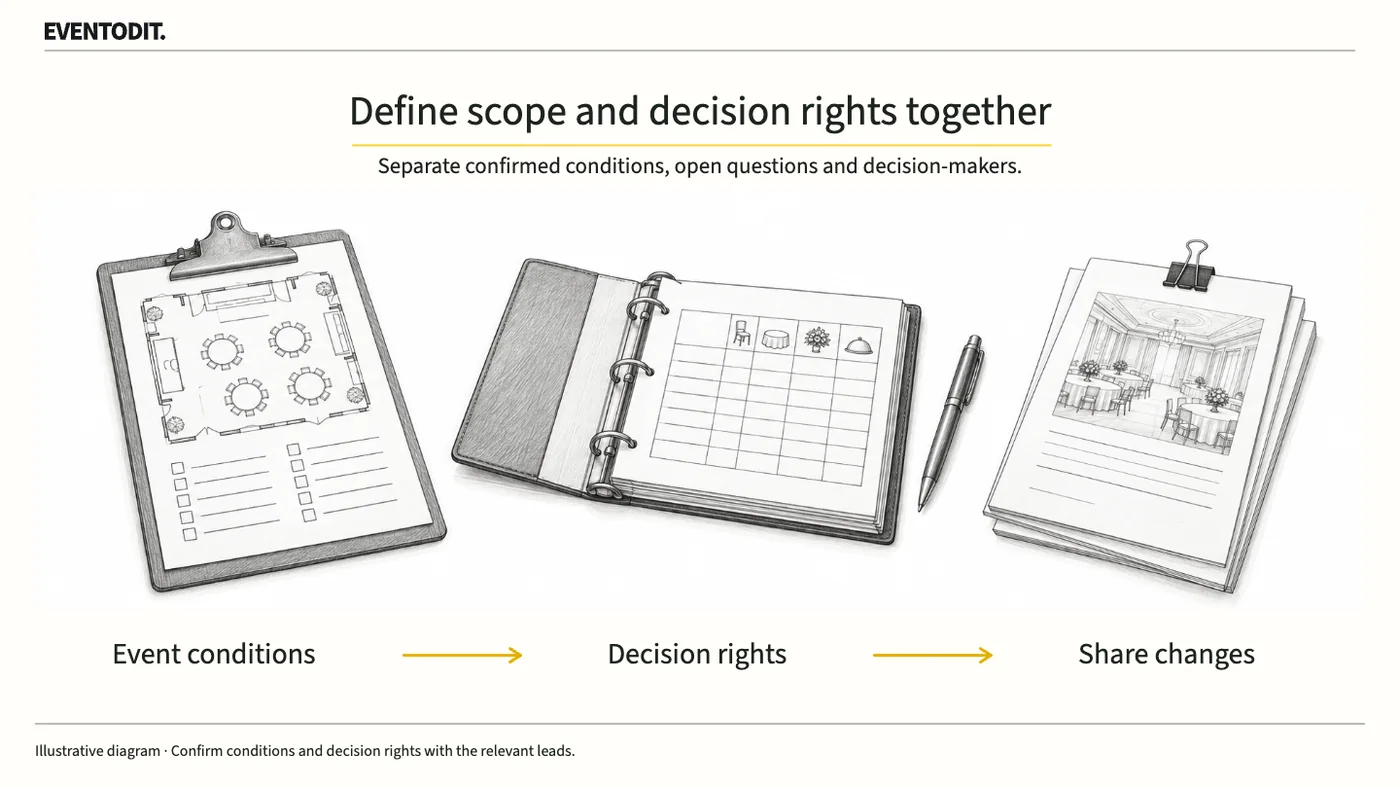
First, define the time and work included
Listing only the hours when guests are present can leave out venue access and supplier responsibilities. The event lead should list proposed dates and spaces for delivery and setup, rehearsal, admission and operation, guest departure, dismantling and site restoration. If dates are not fixed, mark them as proposals and name the person and deadline for checking them against the venue’s permitted hours.
Distinguish the areas and equipment included with the venue, services the organiser must arrange separately, and items excluded from this event. For example, confirm with each contractor who handles work inside the exhibition venue and who handles transport outside it before assuming one company does both. Gather venue, staffing, cost, brand, security, power and accessibility requirements together. Technical safety must follow conditions verified by qualified people in the relevant discipline.
The UK Health and Safety Executive (HSE) advises organisers to identify event scale and type, audience and workforce, location and duration, and to consult venue management. This is UK event safety guidance. Check the actual venue’s conditions and the relevant authorities separately for the legal responsibilities and permissions applicable to an event in Korea.
Mark conditions as confirmed, assumed, unverified or excluded
Collect conditions in one record without presenting them as equally certain. Confirmed means verified by someone with the relevant authority; an assumption is a temporary planning condition; unverified means a response is still needed; and excluded means the item has been left out of this event’s scope. Record who confirmed or must check each condition, its basis and the deadline. Do not turn an assumption into an approval before a response is received.
The following is a fictional example. The people, dates and approval states are not records of a real event.
| Item | Current status and record | Next check |
|---|---|---|
| Venue use | Venue and operating hours are unverified | The venue contact confirms setup, operation and dismantling windows to the planner |
| Budget | Record the ceiling under budget review as a planning assumption | The budget approver confirms included costs and the change-approval process |
| Participant information | Registration and event information are included in the planning scope | The communications lead confirms accessible formats and distribution channels |
| Participant transport | Transport outside the venue is excluded from what the event provides | State the exclusion in participant information and separately check access routes to the venue |
Scroll sideways if needed to read every column.
Seoul’s guidance on temporary use of city parks lists an event plan, installation and restoration plans, and safety-management documents among application materials. It also says that detailed plans and safety issues may be reviewed after permission is granted. This is guidance for the relevant parks: confirm the application process and actual approval conditions with the park authority.
Assign roles for each decision, not just a list of people
The event lead should identify the organiser, commissioning and funding departments, participating teams, venue contact, safety and technical leads and suppliers, as well as residents or businesses who may be affected. A large attendee list does not mean everyone approves every issue. For each decision, distinguish who decides, who reviews, who acts and who receives the outcome, and record contact details and deputies.
Do not assume the same person can approve a budget increase, change the event schedule and stop or resume site work. Check the contracts and delegated authority with the actual decision-makers. Internal approval does not replace any venue permission or authority approval that is required. If a safety issue arises, follow the event’s safety plan and the relevant authority and venue instructions; the site lead should confirm who must be notified immediately and which procedure applies.
The UK HSE recommends consulting venue managers, transport contacts, adjacent sites, service providers and, where relevant, local residents. The people and methods involved should reflect the risks and local conditions of the event. The role separation and recording method above is an EVENTODIT editorial recommendation for applying this principle during event preparation in Korea.
When something changes, send its impact and approval status together
When the budget, hours, venue areas or programme change, the requester should record the change and reason and send the expected effects on cost, schedule, safety, contracts and participant information to the responsible people. Mark effects not yet known as unverified and assign an owner and a deadline. Hold implementation until required reviews and approvals are complete; in an urgent safety situation, follow the event safety plan and instructions from relevant authorities first.
Once an authorised person decides, record the time and scope of the decision and update the procurement conditions, venue information and operating schedule consistently. Confirm that suppliers and participating teams received the change, and carry unanswered questions into the next meeting or handover.
Completion: The event lead has checked the dates and times, scope, exclusions and status of conditions; identified decision-makers for cost, schedule and safety; assigned owners and response deadlines for open questions; and shared the record with the people involved. That record does not itself constitute a contract, permission to use a venue or safety approval.
Use the form for the next handover
Use the [Event scope, conditions and authority log](/en/templates/scope-authority-register.html) for the records described here. The XLSX contains Blank, Example and Instructions sheets. Write your event in Blank; the fictional example is a guide to what to enter.
Record each scope inclusion, exclusion and condition on a separate row. Mark its status and link the evidence and check time.
The planning lead hands approved scope and unresolved items to procurement, venue and operations leads. Do not mark a change fully communicated until receipt is confirmed.
Conditions for applying this elsewhere
Verify actual venue terms and organisational authority; safety decisions require qualified personnel.
Information not established
No event-specific contracts, legal permissions, technical conditions or authority have been checked.
Reference material
- Seoul Parks · Temporary place use guidance · application, review, installation and reinstatement conditions
- UK HSE · Getting started: planning and safety management for events in the UK
- UK HSE · Working with others to ensure crowd safety at events in the UK
- Julia Rutherford Silvers · The Processes of Event Management (2013) · general evaluation, selection, coordination and documentation principles
Have a correction or additional evidence? Request a correction