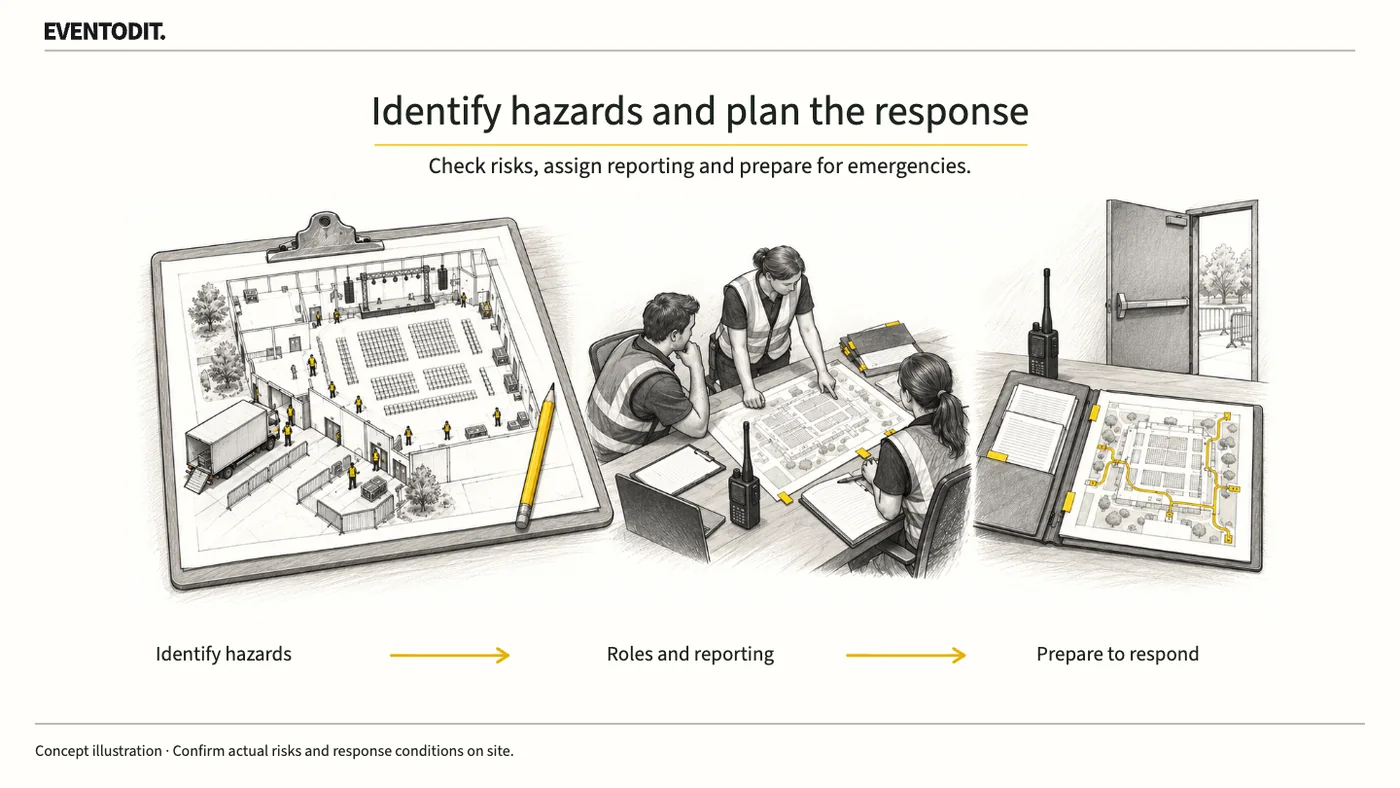
Identify hazards by event phase and location
The organiser’s safety lead gathers the event brief, site plan, build-up, operation, departure and dismantling schedules, and contractors’ work plans. Consider possible effects on participants as well as installation and dismantling crews, suppliers and nearby pedestrians.
A loading entrance shared by vehicles and pedestrians, a narrowing entrance, an exhibit installation area, temporary power and outdoor structures can create different hazards. The UK Health and Safety Executive (HSE) also advises reviewing hazards in the actual site, including crowd movement, places where vehicles and pedestrians meet, entrances and temporary structures. This UK guidance is not a statement of Korean legal requirements.
Record both the hazard and existing controls
For each hazard, record where and when it could arise, who might be affected and the controls already in place. First consider ways to reduce the risk, such as separating spaces or changing work sequences, then assign a person and deadline to verify each agreed action.
If it is unclear whether existing measures reduce the risk sufficiently, or if an action remains incomplete, record it as under review or incomplete. Suitably qualified people should confirm applicable operating conditions and inspections for structures, electrical systems, fire safety and other specialist areas. Do not declare the event safe or invent limits based on a general checklist.
For each hazard, the safety lead reviews the likelihood and who or what may be harmed with the relevant owners. After considering existing controls, identify what risk remains and agree the priority, owner, deadline and recheck time for further action with suitably qualified leads. If information or assessment is incomplete, record it as unconfirmed; do not invent a risk score or treat it as safety approval.
Separate observation, reporting, protective action and decision authority
Agree in advance with the venue, organiser and suppliers how an observer reports a hazard and to whom, where staff should guide people, and who has authority to stop or restart operations. Identify alternative contacts and communication methods if an assigned person cannot be reached.
If people face immediate danger, help them move to safety promptly in accordance with the agreed emergency procedures and on-site instructions, and contact the appropriate local emergency services when necessary. Do not delay urgent protective action while waiting for an approval reply. If responding authorities take control, follow the applicable incident command arrangements and their instructions.
Prepare stopping, evacuation and restart arrangements for the site
Korea Tourism Organization’s MICE safety manual advises coordinating venue and event emergency plans and checking reporting, warnings, evacuation, medical support, contact lists and staff training. The organiser should confirm emergency exits, available evacuation routes, support for people who need assistance and public warning methods with venue management.
Agree stopping and restart conditions with the relevant specialists in light of the specific hazard, facility operating conditions and directions from relevant authorities. Do not confirm a restart before checking that the hazard has been addressed, routes, communications and operating staff are ready, and whether the venue or relevant authorities need to confirm the position. UK HSE also advises checking that risks have been reduced and consulting relevant agencies and checking staff and services before restarting.
Check reporting and response plans for each scenario
The event lead should compare the plans needed for this event with the venue, suppliers and relevant authorities rather than assume every incident follows the same procedure. The following are examples of what to check, not a substitute for the event’s actual alarm, evacuation or restart procedures.
- Weather: Agree who observes and reports the forecast and site conditions, and who checks operating limits and decisions to stop or resume operations involving the structures.
- Fire: Confirm discovery and reporting, visitor guidance, and contact and handover to fire services.
- Power failure: With the electrical lead, check emergency lighting, communications and visitor guidance, and the contact route for recovery decisions.
- Structural concerns: Confirm who reports the concern, protective measures for the affected area, and the route to the structural lead for assessment.
- Medical incident: Agree how to contact and hand over to on-site medical staff and emergency services.
- Security incident: Confirm reporting, visitor protection and contact routes between the safety lead, security staff and relevant authorities.
For each scenario, agree how observations are reported and who takes necessary protective action and guides visitors. Identify when authorities need to be contacted or given control, who decides whether operations should stop or resume, and the backup contacts. Also plan support for disabled people and children and the arrangements for communication and assembly. For immediate danger, do not wait for an approval response before taking protective action under the agreed emergency procedures and on-site instructions. Do not invent numerical alarm, stop, evacuation or restart thresholds: follow the venue’s approved plan, the instructions of the relevant authorities and the assessment of suitably qualified leads.
Fictional example: a queue beside a loading entrance
This hypothetical situation illustrates a working method. The team identifies a possibility that loading vehicles and waiting visitors may share the same space because build-up and queueing overlap. The safety lead tells operations, the logistics contractor and venue management the location and expected time, then agrees how to separate vehicle work and visitor waiting.
The operations lead communicates the agreed routes and staff positions to relevant teams and checks that the separation is in place on site. If it remains incomplete, they record this and report it to the decision-maker. If there is immediate danger, they follow the agreed emergency procedures to protect people.
Rehearse before opening and review changes
The operations lead walks through the site plan and a scenario with the assigned staff, checking who observes, reports, guides and decides. Check that radios and emergency announcements can be used and test the alternative contact if a person is unavailable.
If the schedule, site layout, exits, structures or suppliers change, review the related hazards and response plan again. Record the owner, deadline and verification result for problems identified in rehearsals or site checks, and communicate them to the teams that need them.
Scope
This is EVENTODIT’s practical proposal informed by Korea Tourism Organization’s MICE safety manual and UK HSE event-safety guidance. UK guidance is not a Korean legal standard. Check current law, venue rules, required consultation and specialist safety decisions separately for the event.
Use the form for the next handover
Use the [Risk, protective action and response responsibility log](/en/templates/risk-response-register.html) for the records described here. The XLSX contains Blank, Example and Instructions sheets. Write your event in Blank; the fictional example is a guide to what to enter.
Record where, when and whom a risk affects, with evidence. Ask the relevant lead to verify current controls and remaining risks.
The safety lead sends control evidence and open items to operations, venue and supplier leads. The next shift receives the applicable plan version and contacts.
Conditions for applying this elsewhere
Verify the event, venue and local requirements with the people responsible; overseas guidance is not Korean law.
Information not established
Specific site conditions, authorities and actual event outcomes have not been verified.
Reference material
Have a correction or additional evidence? Request a correction