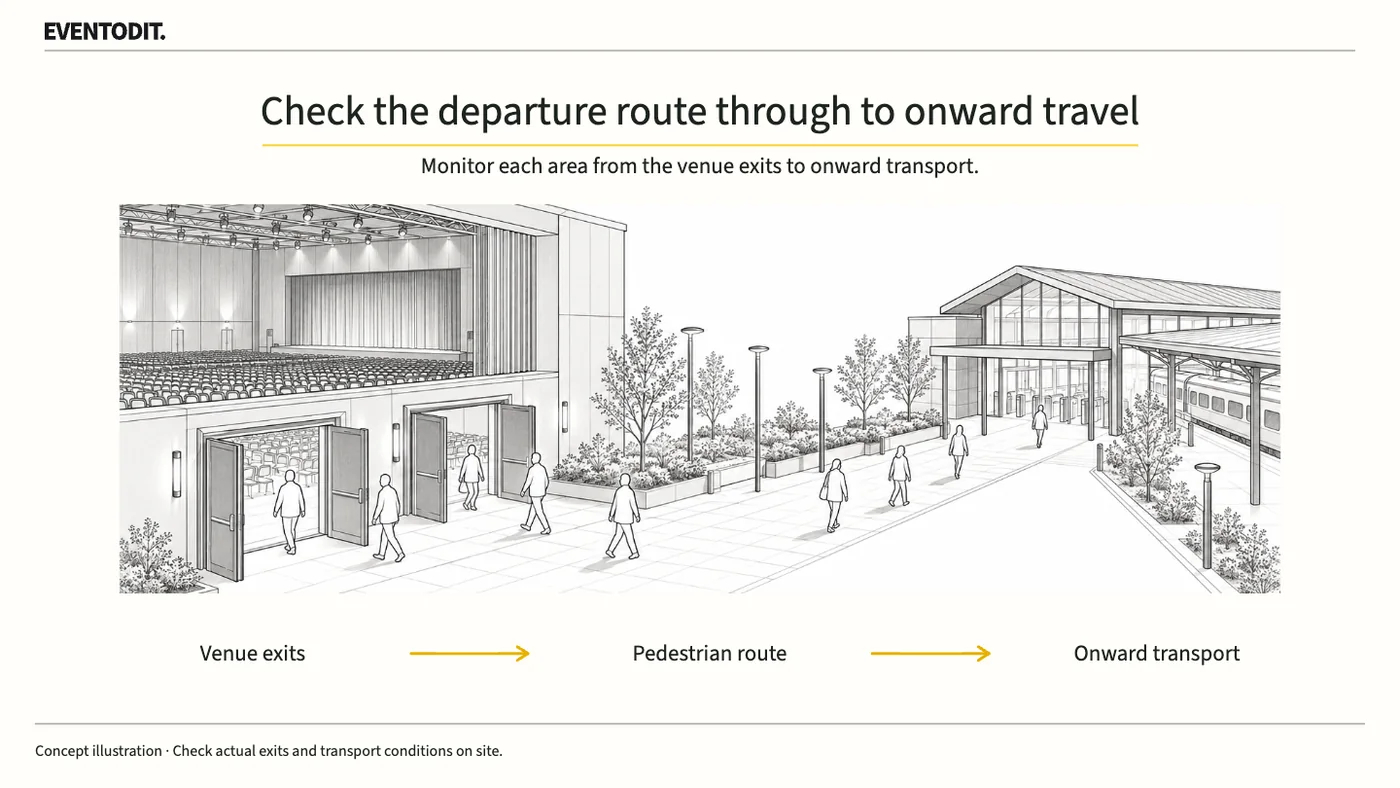
Follow the departure route beyond the venue
The operations lead should check more than the end time of the performance or programme. With the venue operator, trace how people move from audience areas through exits to stations, bus stops and car parks. Mark entrances, stairs, narrow passages, crossings and places where pedestrians meet vehicles, based on the actual surroundings. Decide who will report conditions in each area and who will pass off-site concerns to the appropriate contact.
Compare the end time with transport arrangements
The transport lead should compare the planned end of the last programme, the exit opening plan, last services and car park hours against the latest information from each operator. Agree in advance what routes and information to give visitors if the event runs late or a station or stop becomes crowded. Do not announce extra trains, road closures or exit changes as confirmed unless the responsible transport operator or authority has agreed them. The UK Health and Safety Executive (HSE) also recommends consulting police, highway authorities and transport providers about movement outside a venue as appropriate to the event’s scale and complexity.
Check guidance and access at each exit
The on-site lead should tell stewards which exit they cover and how to report, then check that announcements, signs and online information give consistent directions. Confirm with the venue that the exits and assistance needed by wheelchair users, people who move more slowly, and people travelling with children are actually available. A sign alone does not establish that a route is usable: recheck lighting and the condition of the route at the time visitors are leaving.
Report bottlenecks while people are moving
Each area lead should observe the agreed locations, such as stairs, exits and routes towards stations, and immediately report obstruction, pressure, movement against the flow or a risk of falling to the event lead. Include the location, observed condition, time and support needed. The safety lead shares the situation with relevant authorities and acts under the agreed venue plan. Do not improvise by confining people to one point or blocking an exit; follow the site emergency plan and instructions from the responsible authorities.
Coordinate departure and dismantling
The operations, venue and installation leads should identify where audience routes intersect with equipment transport or vehicle routes and agree when shared areas can be handed over for work. Do not introduce vehicles or equipment into areas where visitors remain without the checks and coordination required by the site plan and venue lead. A selected clause in Geumnarae Art Hall’s venue contract provides for separate video and photography equipment to be removed after the audience has left. It is a venue-specific contractual option, not a universal rule for all events or equipment.
Hand over the final area checks
Area leads should check and report conditions within their assigned areas, including seating, spaces around toilets and waiting areas. Hand over any outstanding assistance or lost-property work with an owner and follow-up contact. The event lead and venue contact agree what was checked, what remains unresolved and when staff can stand down. Do not infer that every area is empty from cameras or a single location’s report. Record the check time, action and handover outcome for the next event plan.
Scope and conditions
For selected events under enhanced monitoring in autumn 2026, Korea’s Ministry of the Interior and Safety planned checks of bottlenecks at entrances, stairs and alleys and joint on-site monitoring with relevant agencies until visitors dispersed safely. The announcement does not prescribe identical staffing or procedures for every event. HSE material is UK event safety guidance, not a Korean statutory standard. Follow the actual site plan and confirm departure, transport and emergency arrangements with the authority, venue operator and transport operator responsible for the event.
Use the form for the next handover
Use the [Audience exit, transport and area handover log](/en/templates/exit-transport-handover.html) for the records described here. The XLSX contains Blank, Example and Instructions sheets. Write your event in Blank; the fictional example is a guide to what to enter.
Assign route IDs from audience space to outside transport and link operating-time evidence. Record actual observation times for remaining people, assistance and route condition.
Operations sends released areas and remaining support to venue and load-out leads. Confirm receipt by transport or lost-property owners when work continues.
Conditions for applying this elsewhere
Verify the event, venue and local requirements with the people responsible; overseas guidance is not Korean law.
Information not established
Specific site conditions, authorities and actual event outcomes have not been verified.
Reference material
- Korean Ministry of the Interior and Safety · Crowd safety measures for the autumn event season · announcement, 3 September 2026
- UK Health and Safety Executive · Put crowd controls in place
- UK Health and Safety Executive · Assess crowd safety risks and identify hazards
- UK Health and Safety Executive · Event site transport
- Geumnarae Art Hall and Gallery rental rules · selected venue contract clause, p. 18
Have a correction or additional evidence? Request a correction