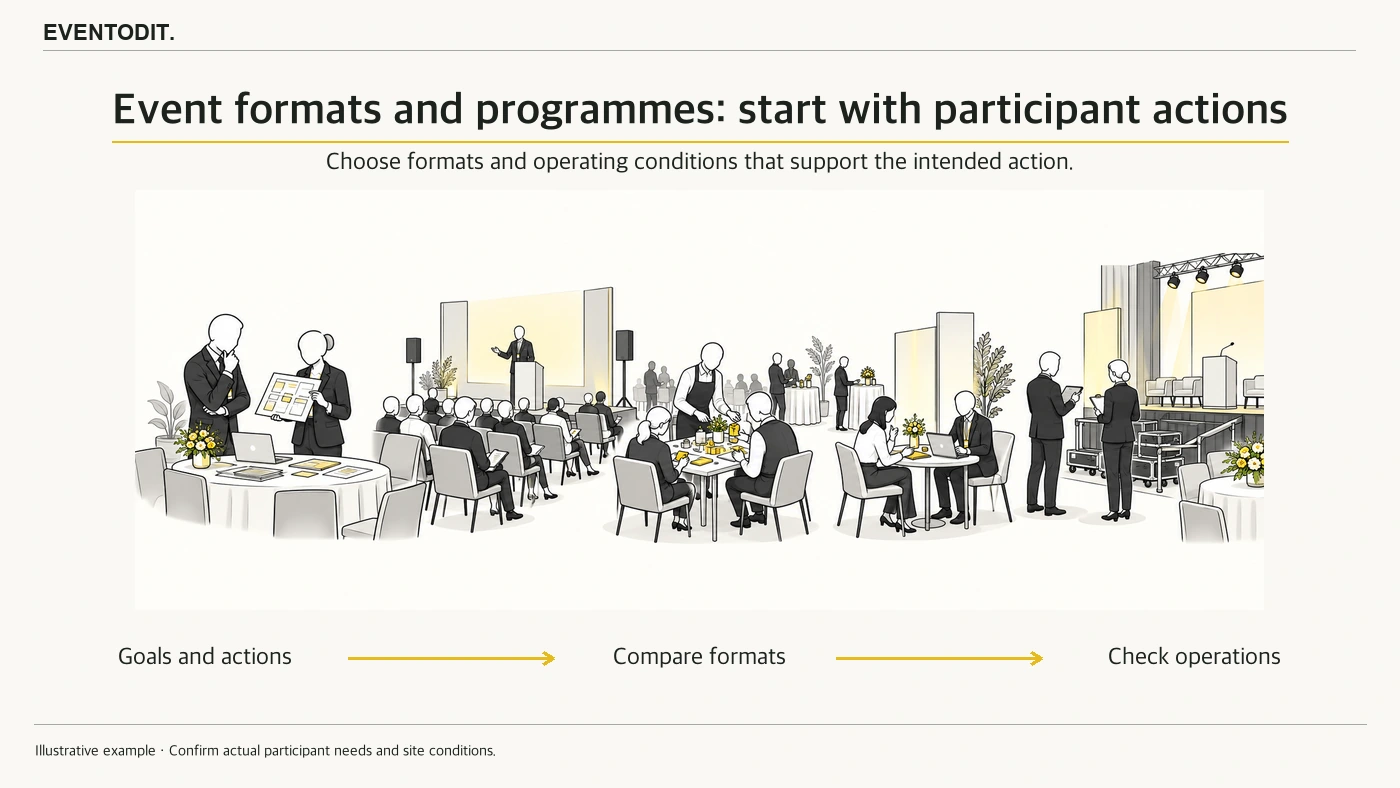
Turn the objective into an action participants can take
First agree what change the organiser wants after the event, then describe what each participant group must do to move towards it. If the objective is product understanding, consider whether listening to a presentation is enough or whether participants need to inspect a product or ask questions. If the objective is finding partners, consider exhibition browsing and a specific meeting appointment separately. Summarise in one sentence how participants will experience that action. Ask whether the theme, space and delivery support the sentence in practice, and decide what needs to change if they do not.
General attendees, hosted buyers, speakers, exhibitors, operating staff and online participants may use the same programme for different reasons. Review results or participant feedback from previous events where available; mark needs not yet investigated as the planning team’s assumptions. Check languages, movement and information access, available participation times and support needs early.
Compare talks, activities, meetings and ways to participate
Compare what participants can actually do and the operating conditions for each candidate format using the same criteria. This editorial comparison helps a decision; no format guarantees an outcome. Check participant feedback and actual venue conditions, and adapt the table to the event.
| Format | Main participant action | Conditions to check before deciding |
|---|---|---|
| Talk or panel | Listen and ask questions | Speakers, question collection, sightlines, captions and interpretation |
| Activity or workshop | Make something or practise | Capacity per session, facilitators, materials and participation support |
| Exhibition or one-to-one meeting | Explore products and discuss with a counterpart | Exhibitors, meeting space, booking, waiting and movement |
| Combined online and in-person | Watch remotely or attend on site | Time zones, broadcast, remote questions, accessibility and outage alternatives |
Scroll sideways if needed to read every column.
Compare options across staffing, technical operation, production and rights, language support, participant movement and the time required, as well as venue hire. Do not treat unconfirmed costs as zero or unverified conditions as available. If the event combines online and in-person participation, specify separately which sessions and question opportunities each group can access.
Look at how real events structure their programmes
The Korea MICE Association’s KOREA MICE EXPO 2026 brochure describes different programmes, including exhibition booths, business meetings and a conference. For domestic buyers it presents pre-matched meetings, advance information and on-site programmes. These are plans announced for that event; they do not establish actual meeting outcomes or participation conditions for another event.
SXSW EDU in the United States invited the public to review and vote on 2027 programme proposals. Final sessions are selected using public votes alongside advisory-board and staff reviews. The questions this case raises are whether to offer participants a choice, and who has the authority to make the final decision. Do not assume the same selection process is appropriate for every event.
Build the programme around each goal and check what is missing
For each programme item, record its audience, participation requirements, capacity, owner, space and time, languages, equipment and staffing, estimated cost, rights holder and prerequisite decisions. One shared talk can serve several groups while only some attend meetings or activities. Check whether simultaneous sessions can really share space, people and broadcast equipment, and leave time for movement, waiting and breaks.
For example, at a fictional corporate event intended to help participants understand a new product and connect with potential partners, the organiser could combine a shared presentation, a product activity and booked meetings. The presentation and activity are for the whole audience and meetings for applicants, but if activity staffing, per-session capacity or meeting-partner availability is unknown, mark those conditions unverified. Ask the organiser how much of the goal can still be achieved if meetings are removed.
Programme design record
Record each programme’s intended participant action and operating conditions on one line, and separately assign an owner and deadline for unresolved items. Adapt this editorial example to the event.
| Programme | Intended action | Audience | Capacity | Time and space | Language and access | People and equipment | Cost and rights | Unconfirmed items | Decision |
|---|---|---|---|---|---|---|---|---|---|
Scroll sideways if needed to read every column.
Test the conditions for in-person and online participation
At the venue, confirm the actual access routes and sightlines, entry and departure, meeting-room capacity and accessibility support with venue management and the safety lead. The UK HSE similarly advises reviewing available space and entry and movement conditions alongside the event audience, size and format. This is UK safety guidance; confirm specific safety and facility requirements for an event in Korea with the venue and relevant authorities.
If online participation is offered, the planner and technical team should test the picture and sound in the conditions people will actually use, arrangements for captions or interpretation when needed, question collection and outage instructions; assign owners and deadlines to unresolved issues. The related Korea Tourism Organization survey covered online participants in meetings and conventions hosted in Korea in 2021. Do not generalise that population to all events or current participant preferences.
Completion criteria
Record the following and confirm actual operating conditions and outstanding decisions with the relevant teams before choosing the format. Where participant or operations feedback has not been obtained, record it as an assumption or unconfirmed.
- Organiser’s objective and audience, and the intended participant action
- Chosen format and reasons, and whether participant feedback was incorporated
- Each programme’s owner, capacity, time and space, cost and accessibility support
- Owner and confirmation or decision deadline for unresolved items
- Relevant teams’ confirmation of actual conditions and outstanding decisions
Final check before use: Before choosing a format, compare participant actions, operating conditions and actual feedback, and confirm the owners and deadlines for unverified items.
Scope and limitations
This is an EVENTODIT practical proposal informed by the KOREA MICE EXPO 2026 brochure, SXSW EDU’s 2027 PanelPicker information, UK HSE venue-design guidance and the Korea Tourism Organization’s 2021 online and hybrid survey overview. Do not apply these cases or overseas guidance unchanged to another event or as a Korean legal standard.
The audience composition, budget, venue conditions, decision authority and actual outcomes of a particular event have not been established.
Use the form for the next handover
Use the [Participant actions, format and programme operating plan](/en/templates/programme-format-design.html) for the records described here. The XLSX contains Blank, Example and Instructions sheets. Write your event in Blank; the fictional example is a guide to what to enter.
Describe the intended action first and test whether theme, space and delivery support it. Record why the format is chosen and link actual feedback or untested assumptions.
Planning sends programme conditions and outstanding decisions to show, venue, technical, access and recruitment leads. Reflect their operating confirmations in the final programme.
Conditions for applying this elsewhere
Verify the event, venue and local requirements with the people responsible; overseas guidance is not Korean law.
Information not established
Specific site conditions, authorities and actual event outcomes have not been verified.
Reference material
- Korea MICE Association · KOREA MICE EXPO 2026 brochure · Planned exhibition, meetings, conference and participant-specific programme
- SXSW EDU · PanelPicker community proposals, voting and review for 2027
- UK HSE · Venue and site design · UK guidance on audiences, capacity and circulation
- Korea Tourism Organization · 2021 survey of online participants in online and hybrid meetings and conventions · Study population and scope
Have a correction or additional evidence? Request a correction