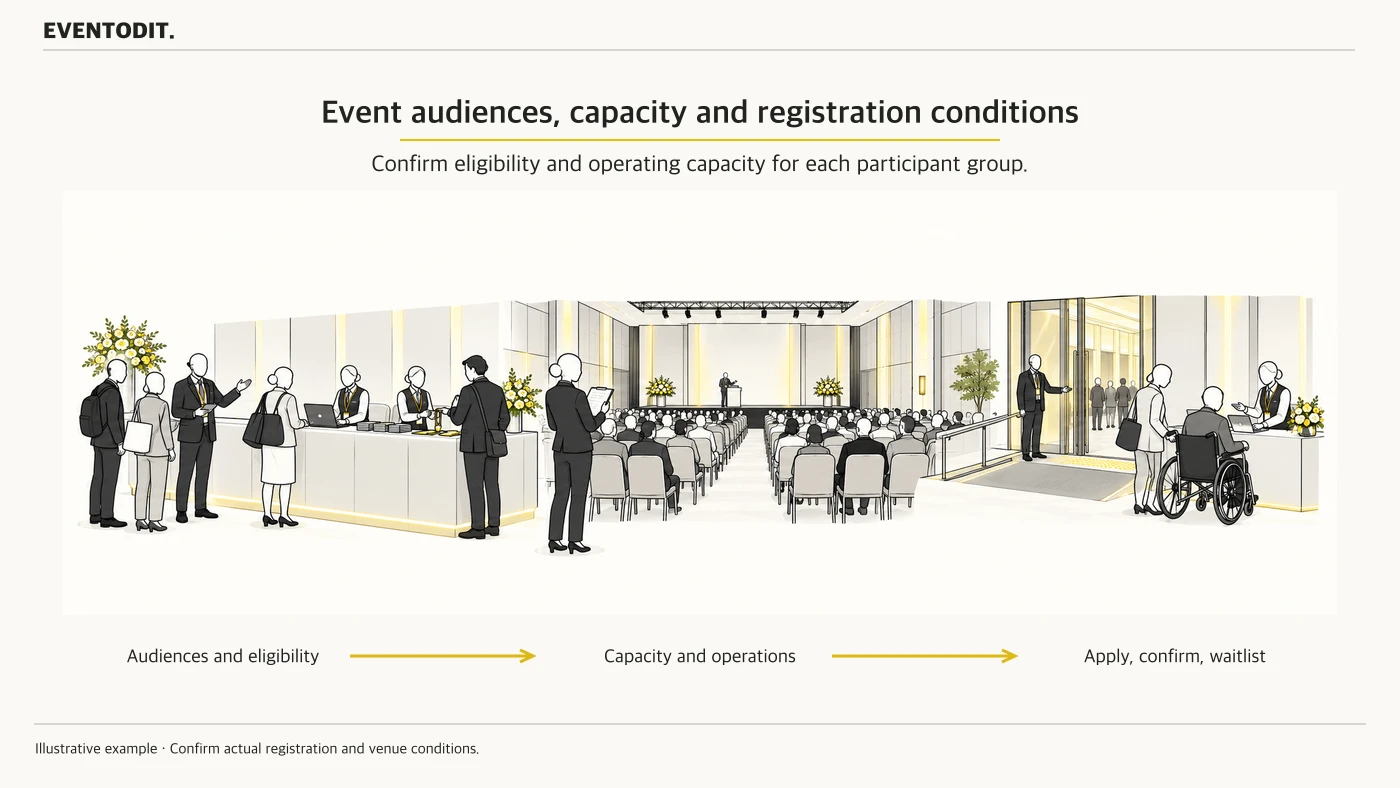
Define participant groups and their reasons for attending
The recruitment lead starts with the event objectives and identifies the groups needed, such as general attendees, hosted buyers, speakers and exhibitors. Record the actions and programmes available to each group and the travel, language and accessibility support needed.
One person may be both a speaker and an exhibitor representative. Distinguish roles and registration types, and agree in advance how duplicate registrations are handled and counted. Exhibition admission may require a separate meeting application, and speaker confirmation does not automatically include every paid programme. Set activity eligibility and inclusions before issuing invitations.
Separate application, eligibility checks and confirmation
For each group, agree the application period, information needed, person responsible for checks and how results will be communicated; tell applicants in advance. Do not mark a person confirmed while required eligibility or payment conditions remain unchecked. Some registrations are confirmed immediately, so adapt statuses to the actual registration route.
| Status | Meaning | Evidence to record |
|---|---|---|
| Applied | The applicant submitted information | Receipt record and time |
| Eligibility or conditions under review | Required eligibility or payment conditions are being checked | What is checked, owner and deadline |
| Confirmed | Participation or meeting confirmed after required checks | Decision and confirmation notice sent |
| Capacity waitlist | No place is currently available | Waiting position, criteria and notice |
| Cancelled | Applicant or organiser cancelled | Reason and processing time |
Scroll sideways if needed to read every column.
Separately verify whether a confirmation notice was delivered, whether the person actually entered and whether the meeting occurred. Do not combine eligibility or payment review with waiting for capacity.
The 2026 ISSA SHOW ASIA KOREA visitor information distinguishes entry routes for advance registrants, invitation holders and on-site registrants. IMEX Frankfurt’s 2027 hosted-buyer information describes eligibility and programme and meeting conditions. These apply to those events and do not establish the same eligibility, benefits or obligations elsewhere.
Set capacity from actual operating conditions
Venue management and operations check each programme’s available space and permitted capacity, session and changeover times, staff, equipment, accessibility support, evacuation and entry routes. Do not confirm capacity from seat count alone.
Specify which limits use registration, entry or simultaneous occupancy counts, and record whether invited guests, speakers and staff are included in each count. Venue management and the relevant specialists confirm permitted conditions and safety-related counting. Record the basis, provisional or confirmed status, responsible owner and check time.
Manage waiting lists and cancellations at capacity
Before recruitment opens, decide whether to close applications or accept a waiting list at capacity. Tell applicants how cancelled places are offered, who is responsible, how and when non-response is handled, and who can change the waiting-order criteria.
Update confirmed numbers and capacity waitlists consistently for each session. When a status changes, record the actual time and owner and pass the information to the relevant operations team.
Compare the recruitment page and notices
State eligibility, date, time and venue, fee and inclusions, application and confirmation methods, waiting-list arrangements and contact routes consistently in the invitation and registration page.
Explain verified routes, accessible toilets and the language, captioning or sign-language support actually provided, along with how to request additional support and who will respond. Do not present unconfirmed support as available.
VisitEngland’s event-access guidance recommends giving concrete information about the visitor journey, accessible facilities and support. It is UK guidance, not a Korean legal standard. Check the actual venue and event requirements separately.
Fictional example: business meetings and public sessions
This fictional event illustrates the workflow. General attendees seeking public sessions and buyers seeking business meetings are recruited separately. A lead checks buyer eligibility and meeting availability before confirming a meeting application; public sessions use their own capacity and waiting-list process.
Speakers receive arrival, material-submission and access-support information separately from presentation confirmation. Operations checks each session’s space and staffing with the venue, and recruitment hands over waiting and confirmation status. Applying or receiving confirmation does not establish actual attendance or a completed meeting.
Checklist before recruitment opens
This is an editorial example; adapt the owners and checks to the event. Record owners and deadlines for unconfirmed items in the notes.
| Check | Owner | Verified | Notes |
|---|---|---|---|
| Document eligibility and application routes by group | Recruitment | ||
| Record capacity counting rules and evidence | Operations | ||
| Set waiting, cancellation and non-response rules | Recruitment | ||
| Confirm session space, staff and access support | Operations and venue | ||
| Compare invitation and registration page conditions | Communications | ||
| Check personal-data collection, retention and deletion | Recruitment and administration | ||
| Record unresolved conditions and decision deadlines | Planning lead |
Scroll sideways if needed to read every column.
Manage changes and personal information
When conditions change, record the change and affected groups and obtain approval from the authorised person. Communicate consistent information to applicants and relevant teams, update the invitation and registration page together, and record the change time and owner.
Check the purpose of collecting applicant information, access permissions, retention and deletion against applicable privacy requirements and event agreements. Collect only necessary information and, once its purpose ends, check applicable retention obligations before handling it under the established procedure.
Final check before use: Before opening recruitment, compare group eligibility and application and confirmation routes, capacity evidence and waiting and cancellation rules, actual accessibility support, and owners and deadlines for unresolved items.
Scope and limitations
This is EVENTODIT’s practical proposal informed by public participant guidance from ISSA SHOW ASIA KOREA and IMEX Frankfurt and VisitEngland’s event-access recommendations. Do not transfer one event’s eligibility or benefits as confirmed conditions for another; check the venue, safety and privacy requirements applicable to the actual event.
The eligibility, capacity, venue conditions, decision authority and actual outcomes of a particular event have not been established.
Use the form for the next handover
Use the [Recruitment eligibility, session capacity and status plan](/en/templates/recruitment-capacity-plan.html) for the records described here. The XLSX contains Blank, Example and Instructions sheets. Write your event in Blank; the fictional example is a guide to what to enter.
Separate groups and sessions and record activities, eligibility and confirmation requirements. Have venue and operations confirm capacity and inclusion of staff and speakers.
Recruitment sends session conditions and status definitions to operations, communications and registration. Actual attendance and meeting outcomes are handed to separate on-site record owners.
Conditions for applying this elsewhere
Verify the event, venue and local requirements with the people responsible; overseas guidance is not Korean law.
Information not established
Specific site conditions, authorities and actual event outcomes have not been verified.
Reference material
Have a correction or additional evidence? Request a correction