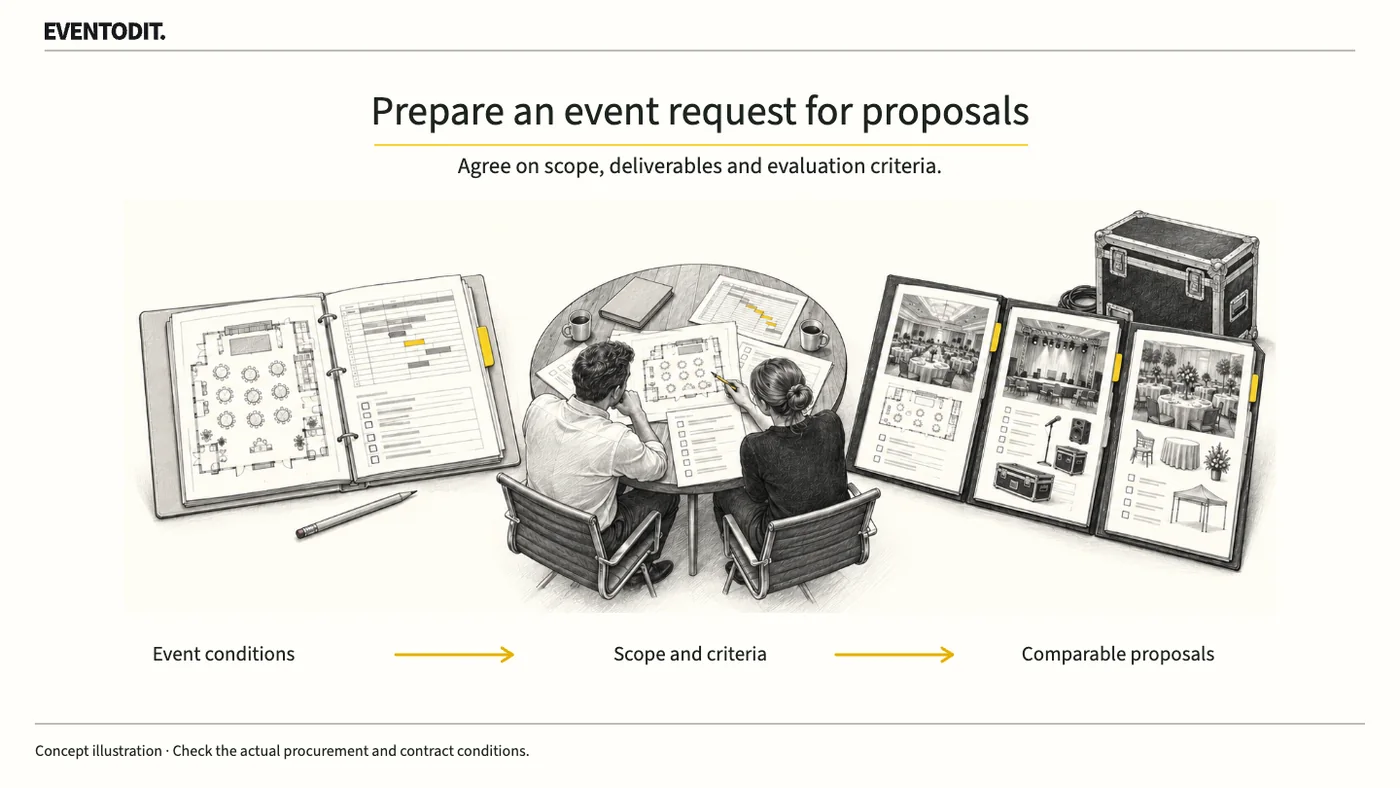
Start with the buyer’s problem and event conditions
A request for proposals (RFP) tells suppliers what the buyer needs and the terms for responding. It is different from the proposal a supplier prepares in response.
The buyer records the event purpose and audience, whether the venue and date are confirmed, the expected scale and budget conditions. If existing space or equipment will be used, explain who provides it and under what conditions. Do not present undecided items as facts; record who will decide them and when.
Separate supplier work from the buyer’s responsibilities
Review planning, venue coordination, production, delivery and installation, rehearsal, operation, dismantling and reporting. Record the owner of each task and what is included or excluded. For stage and video equipment, distinguish supply from installation, testing, on-site operation, dismantling support and compliance with venue conditions.
Explain conditions that may change costs, such as late work or an extended schedule, and consider asking suppliers to separate the basic scope from optional items. Discuss safety, accessibility, electrical and structural review with the relevant specialists for the event and venue. Confirm specific safety standards and responsibilities against the contract and applicable law.
Describe deliverables and how they will be checked
Do more than name each deliverable: explain when and in what form it is due, to whom it is submitted and what will be checked. For example, an operating schedule might need task order, responsible people and a contact route for changes. A final report might need to identify the agreed research scope and missing information.
New Zealand Government Procurement guidance explains how to document the purpose, scope, deliverables, timing and verifiability of requirements. This is an overseas public-procurement writing reference, not a statement of the legal process for a Korean procurement.
Align supplier questions with evaluation criteria
Decide what you need to compare, then request the information needed for that decision. To assess operational capacity, you might ask about proposed staff, roles, actual availability and how they would respond to a schedule change. Ask suppliers to state quantities, units, tax treatment and options on a consistent basis.
New Zealand procurement guidance recommends aligning the requirements, evaluation criteria and supplier response questions. The UK Department for Culture, Media and Sport’s event management buyer guide also describes developing requirements and criteria before evaluating proposals under its own framework. Do not apply overseas procedures or scoring weights unchanged to a Korean purchase.
Plan questions, amendments and use of proposals
State the proposal deadline, question channel, how answers will be shared and submission format. When conditions change or questions are answered, establish a way for participating suppliers to receive the same information in time, consistent with the relevant process. Review contract terms, how additional work and costs will be discussed, and retention and permitted use of proposal materials with the contracts lead.
If a site visit is needed, state the venue, date and time, registration method and whether attendance is mandatory. Explain how questions and answers from the visit will be shared with participating suppliers under the applicable procurement process.
The Korean Ministry of Culture, Sports and Tourism’s MICE fair-trade guidance discusses disputes involving unclear scope and use of proposal content. It was published in 2018, so current contract and intellectual-property conditions must be checked separately. Do not assume a single rule about using an unsuccessful supplier’s proposal.
Fictional example: commissioning a corporate seminar
This fictional example illustrates how to write the requirements. The buyer asks a supplier to operate the seminar venue, play presentation files, guide participants, and support rehearsal and dismantling. The buyer handles the venue booking; the supplier provides video equipment.
The buyer states the basic operating hours and rehearsal support scope, and asks separately for proposed conditions if the schedule is extended. The document names who will receive and check the operating schedule and equipment check results and when. This is an illustrative requirement, not an actual contract or market price.
Check the document and owners before sending
The buyer checks that the purpose and scope, deliverables and checks, pricing assumptions, evaluation criteria and question and submission dates do not conflict. Ask the venue lead to confirm available hours and supplied facilities, technical and safety leads to confirm site conditions, and the contracts lead to check the applicable process and contract terms. Record unresolved items with an owner and deadline rather than treating them as settled.
Scope
This is EVENTODIT’s practical proposal informed by the Korean ministry’s 2018 MICE fair-trade guidance and public-procurement guidance from New Zealand and the UK. Do not treat overseas public-procurement rules or older guidance as current Korean law. Public buyers should check the institution’s current rules and the specific notice and contract; private buyers should check the terms of their own transaction.
Use the form for the next handover
Use the [Buyer scope, deliverable and evaluation-question design](/en/templates/buyer-rfp-specification.html) for the records described here. The XLSX contains Blank, Example and Instructions sheets. Write your event in Blank; the fictional example is a guide to what to enter.
Give each requirement an ID and distinguish buyer, supplier and excluded work. Specify the output, format, timing and responsible acceptance method.
The buyer sends the approved requirement log to RFP, pricing and evaluation authors. Share post-issue answers and changes with participating suppliers through the same official record.
Conditions for applying this elsewhere
Verify the event, venue and local requirements with the people responsible; overseas guidance is not Korean law.
Information not established
Specific site conditions, authorities and actual event outcomes have not been verified.
Reference material
- Ministry of Culture, Sports and Tourism (2018) · Fair trade guidance for the MICE sector (Korean)
- New Zealand Government Procurement · Putting your tender documents together
- New Zealand Government Procurement · Documenting your requirements
- UK Department for Culture, Media and Sport · Event Management Framework buyer guide
Have a correction or additional evidence? Request a correction