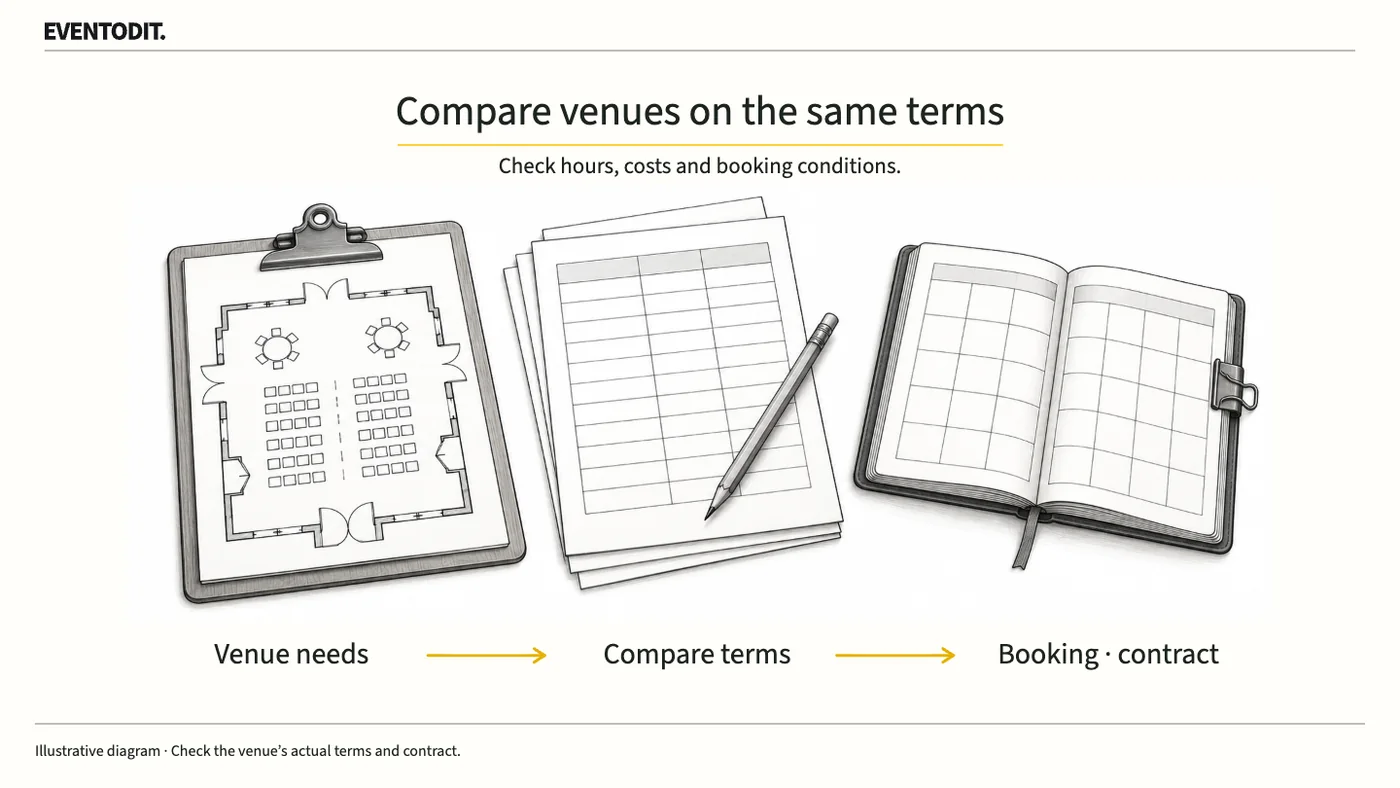
Send the same event requirements to every candidate
The planning lead should first describe the event’s purpose, expected participants and operational staff, and the meeting, exhibition and waiting areas needed. Do not provide the event day alone: ask each venue about the separate dates and hours needed for deliveries, setup, rehearsal, attendance, dismantling and restoration. Use the same criteria to check public transport and accommodation, loading and vehicle waiting areas, the actual accessible route for wheelchair users, and availability of any rooms and guest accommodation required.
Send the venue contact the event outline, hours of use and technical, safety and accessibility needs; request actual availability and a response deadline. Do not treat the maximum capacity in a venue brochure as the permitted capacity for this event. Confirm the relevant conditions and proposed stage, circulation and seating arrangement with venue management and the safety lead.
Inspect the surroundings during the hours of use
Where possible, visit at the time and along the routes the event will actually use. Follow the route from the entrance through registration, meeting rooms and toilets to the exit, and separately trace the equipment route from loading bay to installation position. Ask whether another event or shared-space use overlaps, and record restrictions on vehicles, parking, storage and working hours as well as noise conditions that may affect nearby businesses or residents.
For outdoor spaces check weather and sunlight; indoors check natural light, temperature, background noise and connectivity at locations where the programme requires them. Do not guess network performance or available power from appearance: ask the facilities and technical leads how these will be tested and under what conditions they can be used. The UK HSE advises considering access routes, existing structures and ground conditions, and nearby transport and emergency facilities. This is UK guidance; separately check legal requirements applicable to the event in Korea.
Compare the same hours and included costs, not just floor area
For every candidate, compare the areas included; setup, operating and dismantling hours; electricity, heating and cooling, internet, cleaning, security and any required suppliers using the same categories. Record tax and pricing units alongside the figures. If overtime, night work or ancillary-service charges are unknown, mark them unverified. Do not add an unknown charge as zero and present the total as confirmed.
The following is a fictional comparison; it does not describe real venue prices or conditions.
| Item | Venue A | Venue B | Next check |
|---|---|---|---|
| Hours of use | Setup hours awaiting reply | Setup and dismantling hours confirmed | Ask the Venue A contact again for permitted hours |
| Participant access | Entrance-to-toilet route to be checked | Entrance-to-meeting-room route to be checked | Walk the actual routes at both venues |
| Included equipment | Chair inclusion unverified | Chair provision confirmed | Ask Venue A about quantity and terms |
| Extra costs | Electricity and cleaning unverified | Electricity included; cleaning unverified | Request each venue’s costs, taxes and units |
Scroll sideways if needed to read every column.
US exhibition services provider Freeman explains that electricity, food service or rigging can be separate services supplied by a venue or designated providers at some events, and recommends checking the relevant exhibitor manual. This describes particular US exhibition arrangements; it does not mean the same suppliers or charges apply to venues in Korea.
Check a provisional hold separately from the contract
What a venue means by a provisional hold and how long it lasts may vary. Ask the venue contact how long the dates will be held, the expiry time, how confirmation works, and the purpose and return conditions of any deposit; keep the response. If internal approval or another site visit could run past the expiry, ask about an extension before it expires. Do not assume that communication about a provisional hold is final venue approval or an executed contract.
Before contracting, compare the actual agreement and its attached rules for the areas and hours, deposits, balances and taxes, separate services and overtime charges, rescheduling, cancellation and refund conditions, restoration and damage handling, and facility handover and return. If wording is unclear or documents conflict, seek written clarification from the other party and, where necessary, review by your legal team. The outcome depends on the contract, circumstances and applicable rules.
Pass the decision and open questions to the next teams
The person selecting the venue should retain each venue’s conditions and response time, the scope of costs used for comparison, and open questions with their owners and deadlines. Share the reason for the selection and any unconfirmed costs, and pass the contracted areas, delivery and dismantling conditions to production, operations and safety leads. If a response promised by the venue contact has not arrived, keep that item pending rather than marking it complete.
For example, the Kimdaejung Convention Center’s exhibition-hall guidance describes application routes by event type, rental calculations, and a payment process for reservation, contract, interim and final payments and a deposit. The guidance applies to that venue. Confirm the actual application schedule, any changes and the applicable contract terms with the centre. Completion means candidates were compared using the same conditions, and owners were assigned to open questions, the booking deadline and contract checks before the result was shared with the relevant teams.
Use the form for the next handover
Use the [Venue comparison, provisional booking and contract terms](/en/templates/venue-comparison-terms.html) for the records described here. The XLSX contains Blank, Example and Instructions sheets. Write your event in Blank; the fictional example is a guide to what to enter.
Send the same people, areas and hours to every venue and identify differences in replies. Check fee periods, units, tax and extras; retain unknown costs and follow-up.
The selection owner sends agreed areas and hours and unresolved costs to contracting, production and operations. Contracting checks that rules and quote versions match the final agreement.
Conditions for applying this elsewhere
Verify the event, venue and local requirements with the people responsible; overseas guidance is not Korean law.
Information not established
Specific site conditions, authorities and actual event outcomes have not been verified.
Reference material
- Kimdaejung Convention Center · Exhibition hall rental procedure · Application, rental calculation and payment guidance for this venue in Gwangju
- Seoul City Parks · Temporary venue use · Operating, installation and restoration review for the relevant parks
- UK HSE · Venue and site design · UK guidance on capacity, access and site conditions
- Freeman · Quick Guide: The International Exhibitor · Show-specific manuals and exclusive services at US exhibitions
Have a correction or additional evidence? Request a correction