Part 1. Proposal and Planning Lead
"Define clear deliverables instead of making a vague promise of smooth operations."
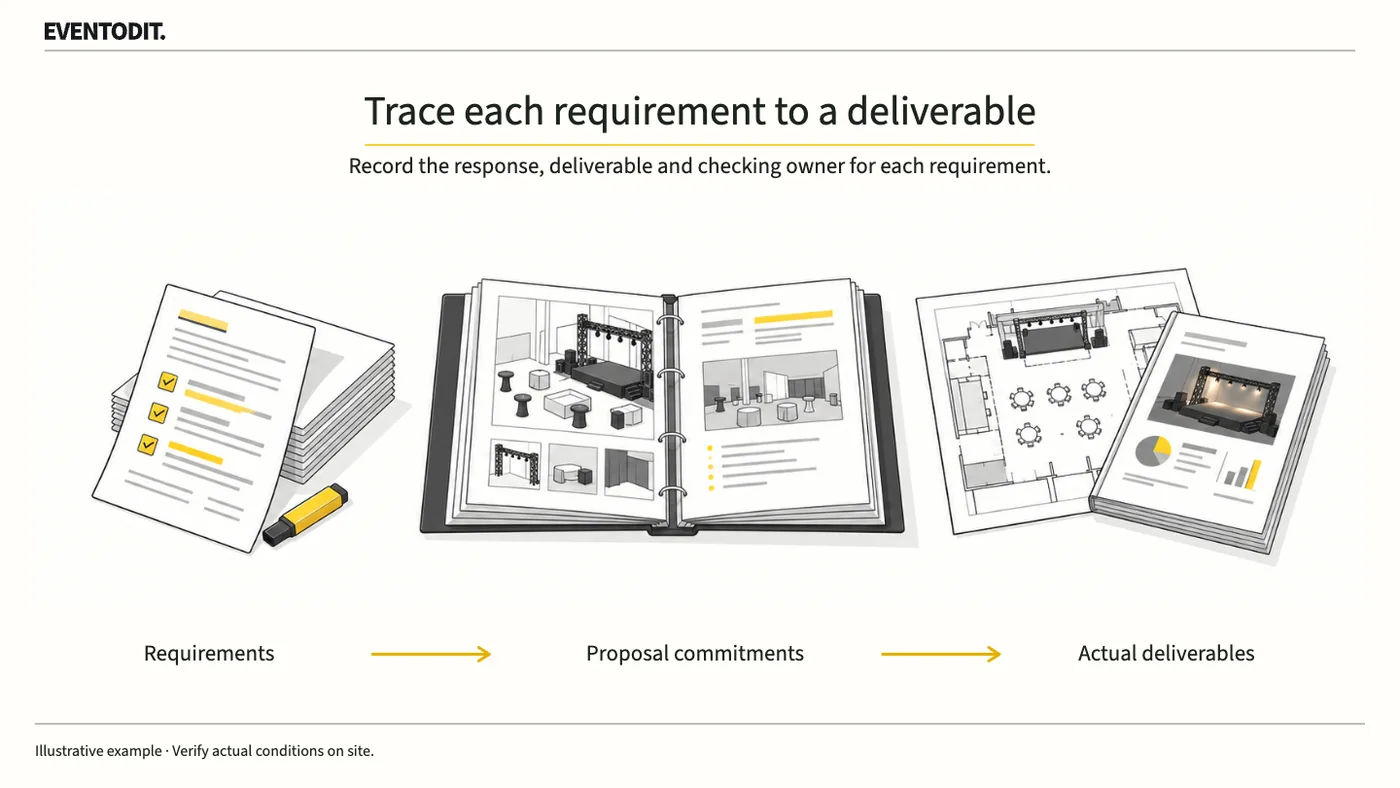
- Break down requirements and define deliverables: Divide a broad requirement such as 'registration operations and reporting' into smaller tasks, including building the registration system, on-site assistance and preparing aggregate data. Clearly specify concrete deliverables that can be agreed, such as an on-site operating schedule, staff deployment plan and final report, and the person responsible for checking them to prevent omissions.
- Document and incorporate official change history: If the client's correction notice or official answers to questions change a requirement, distinguish these carefully from verbal explanations. Record links between the revised original wording, the person who confirmed its interpretation and the proposal pages affected.
- Trace both ways to prevent omissions and excess scope: Before submission, check from the original requirements through to the proposal for missing items. Then cross-check the proposal's promises against the original to find unnecessary commitments that were not requested or excess work that was not included in the costs.
- Original and change historyDocument, page, requirement ID and official changes
- Proposal responseResponse page and promised execution scope
- Deliverable and checkDelivery format, checking owner and evidence
- Final reconciliationResolve omissions, conflicts and unknowns before submission
Check administrative and price-submission requirements on separate lists.
Part 2. Bid Administration and Document Editing
"The completeness of a proposal's content and compliance with administrative requirements are separate matters."
- Independently check administrative requirements first: Bid eligibility, required submission documents, file formats and deadlines operate separately from proposal content. Completing the proposal response matrix does not mean eligibility has been met, so check these items thoroughly on a separate list.
- Specify the exact location in the requirements response matrix: One deliverable or document may satisfy several requirements. Rather than copying the same document name into multiple rows, specify the exact section or field that demonstrates each requirement so evaluators can find it easily.
- Do not invent quantitative targets: When the original request for proposals does not specify a numerical target for a requirement, do not invent a performance figure during editing and present it as an evaluation criterion.
Part 3. On-site Delivery and Operations
"After award, execution should follow an agreed commitment register rather than the proposal alone."
- Hand over work using the proposal commitment register: Once the award is confirmed, obtain the response matrix from the planning team, including the original source location, proposal location, deliverables and unresolved items. The delivery team should use the item numbers in the matrix to identify and carry out the specific work and budget promised in the proposal.
- Confirm the handling and transfer scope for sensitive data: When conducting registration and similar work, do not assume that the original attendee list containing personal information must automatically be delivered to the client. Establish in advance the lawful scope of aggregation and data transfer consistent with the contract terms and purpose of collection.
- Establish final obligations from the executed contract documents: Changes to the notice may have removed or reduced an original requirement. Carefully compare the final submitted proposal and budget with the executed contract documents to establish the final obligations to be performed on site.
Final check before use: Before final submission of the bid documents and handover to the delivery team, check that all RFP requirements and administrative conditions are reflected in the proposal and deliverables without omissions.
Conditions for applying this elsewhere
Use after collecting the notice, RFP, attached forms and corrections as of the same baseline. Follow the actual notice for submission requirements and evaluation criteria.
Information not established
No particular tender's eligibility, scoring or submission format is addressed. Confirm clarification applicability and document precedence with the contracting authority.
Reference material
- Gotel and Finkelstein (1994) — An analysis of the requirements traceability problem: public UCL text and bibliographic record reviewed. Tracing origins, implementation and verification; not event-bid outcome research.
- Julia Rutherford Silvers — The Processes of Event Management (2013): task dependencies, change communication and record principles. Event-management knowledge, not Korean statutory standards or a specific certification textbook.
Have a correction or additional evidence? Request a correction