First decide who will join the performance site visit
The planning coordinator brings the scene sequence, viewing stops, walking routes, times, and areas of use together on one plan. Ask the performance team how the performers move, how large the props are when opened out, what distance they need from the audience, and what access support is required.
It is helpful for the performance team, site operator, and venue manager to visit together. Technical, safety, and accessibility staff check their own fields. The planning coordinator gathers their answers rather than deciding every field's suitability or granting permission on their behalf. For anyone unable to attend, send the location numbers, questions, required materials, and reply deadline.
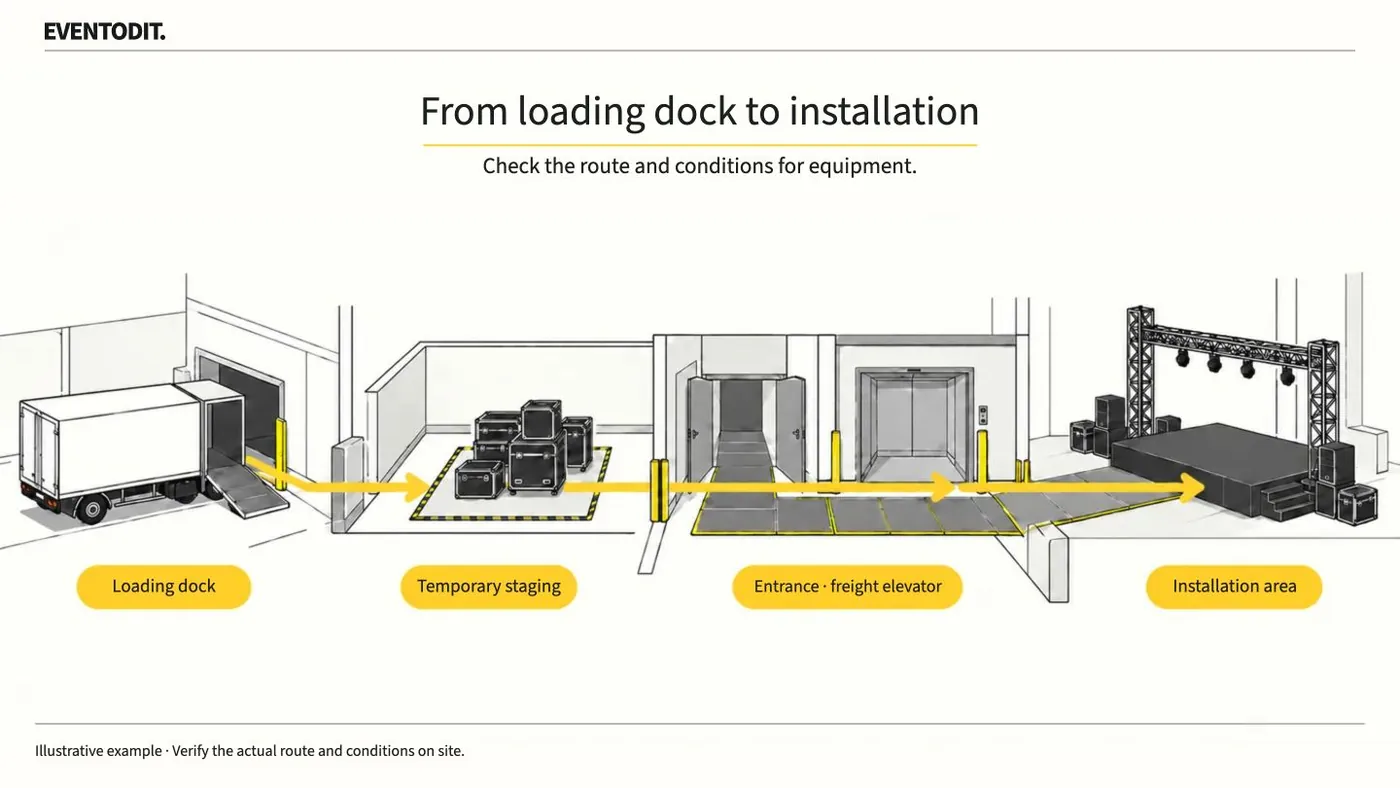
Equipment access matters such as power, fixing equipment in place, and unloading are outside this article's scope. Record these in the separate equipment access survey materials and pass them to the relevant staff.
Give stopping points and movement sections different numbers
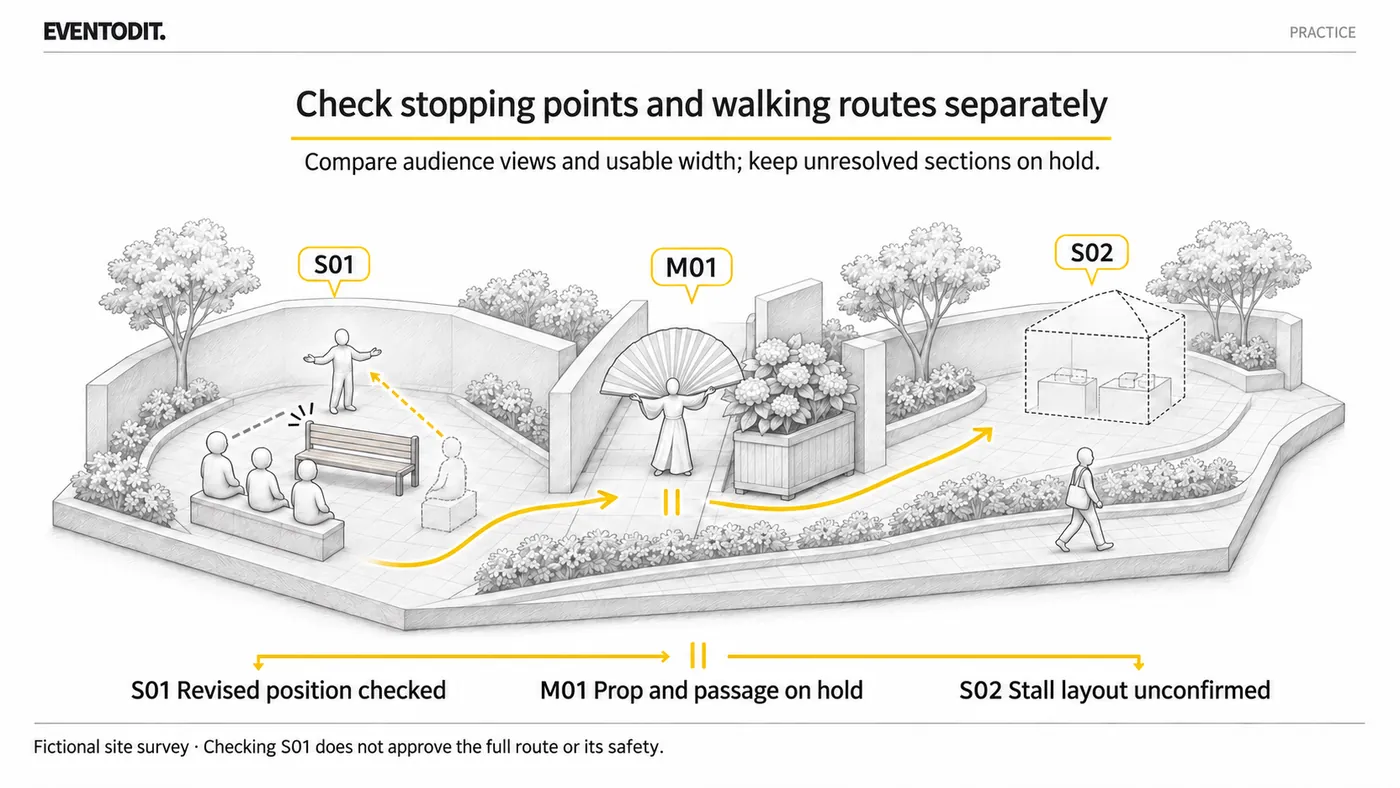
Number places where people stop to watch S01, S02, and so on. Give the walking sections between scenes separate numbers such as M01 and M02. At each stopping point, mark both the audience area and the path for people continuing through. For each movement section, consider the whole period from the people at the front setting off until the audience at the back reaches the next point. Include the start, finish, and route back.
The UK's HSE advises visiting the site and anticipating situations such as people gathering near entrances or changing direction suddenly. The numbering and recording method in this article is an editorial method developed with that principle in mind.
Measure the width people can actually use, rather than relying on a line on a plan
The width drawn on a plan is different from the space people can actually pass through. Record all obstructions, including planters, items outside shops, and doors that open into the route. Record the two measurement endpoints, units, and time alongside the photograph number. Temporary facilities not yet in place have not been measured; leave them as items for which information must be requested.
The performance team checks the space required when props are actually opened out or turned. Look for changes in floor level, slopes, gaps, and overhead projections. However, the planning coordinator must not use a width measurement to determine floor loading, structural safety, or capacity. Refer items needing specialist checks to the relevant person.
Check from audience positions too. See how the scene looks from the back and from seated positions, as well as the front row. Where access needs arise, check directly with the people concerned and the relevant staff. Briefly sitting down yourself and finding no difficulty is not enough.
Observe passing traffic at the relevant time and confirm permission to use the site
It is helpful to visit at a similar time to the performance. Record shop operations, delivery vehicles, audiences for other events, and light and shade. Do not assume that the number of people seen on one visit will be the same on the event day. Obtain venue information for times you have not observed, and return if necessary.
Permission to use a park or street is not established by drawing a line on a plan. Seoul's guidance on temporary use of parks also explains that permission may be revoked if actual operations differ from what was approved. Confirm with the managing authority the boundaries for stationary viewing, waiting, and movement. Do not block public passage without permission to make the survey easier.
Use a fictional site record to separate observations from decisions
The following is a fictional moving performance in a park, created for explanation. All dates, dimensions, replies, and judgments are assumptions, not an actual site or safety standards.
| Location | What was checked | Current assessment | Next action |
|---|---|---|---|
| S01: A scene watched from a stopping point | Movement was obscured from behind a bench. A different position within the same area was checked again. | Recording the revised position is complete. Use of the whole route remains unconfirmed. | The operations coordinator adds the revised position and photographs to plan v2. |
| M01: Connecting section | Width on the plan: 3.0 m. Actual passing width with planters in place: 1.6 m. Opened-out prop width: 1.8 m. | On hold with the current prop and route. Authority to move the planters is also unconfirmed. | The venue representative replies about permission to move the planters, and the performance team replies with an alternative prop proposal, by 15:00 on 13 November. |
| S02: Next stopping point | Empty during the visit, but the layout of a stall due to be installed at 14:30 is unconfirmed. | Review of the viewing area and connecting section is on hold. | The operations coordinator obtains the stall plan and sets a time to recheck conditions after installation, by 15:00 on 13 November. |
Scroll sideways if needed to read every column.
At M01, the actual passing width is narrower than the prop. Do not assume that turning the prop will let it pass. The performance team must demonstrate the actual movement and check the space it requires. Do not turn these figures into a general passage-width standard.
This record does not conclude that the whole moving performance may go ahead immediately. Only S01's revised position has been checked. M01 and S02 remain on hold. Do not issue participant information before the entire route is confirmed.
Hand over only the scope checked, and revisit changed areas
The survey lead separates observations into three groups: the scope of use already checked, places to recheck after changes, and places on hold because answers are missing. The actual decision-maker makes the decision. Writing a site record does not create permission to use the site or a safety approval.
Revisit the connecting sections before and after a changed point, rather than checking that point alone. Changes to props, audience direction, or temporary facilities can alter turning space and sightlines that previously appeared workable. For unchanged areas, record the evidence showing what remains the same.
Lifting a hold requires all necessary replies, revised documents, and recheck results. Permission to move the planters does not also resolve the temporary-facility issue at the next point.
Check that the receiving staff's documents match
Include location numbers, photograph directions, measurement references and units, observation times, changes, and holds on the plan. Keep earlier versions and identify which version is in use.
Receiving staff check that their own layout plans and running notes show the same locations and statuses, then reply. For example, if M01 is on hold but the running notes say “move through here,” handover is not complete. Also assign someone and a time to check changed areas after installation. If an unexpected hazard arises on site, follow the agreed stopping and reporting procedures.
Practitioner checklist
- Are stopping points and movement sections identified with separate numbers?
- Has the space required for the props when actually opened out been checked?
- Are the width on the plan and the actual remaining width recorded separately?
- Has the scene been checked from seated audience positions and from the back?
- Are observed times and times not yet observed recorded?
- Does every item on hold have an owner, a required reply, and a deadline?
- Do the receiving staff's documents reflect the same changes and holds?
Conclusion
A site survey for a moving performance does more than check whether a path connects. It checks how performers and other members of the public share the space as audiences stop to watch and then walk again. Hand over what has actually been checked, what needs another look, and what remains on hold so that the conditions for putting on the performance are clear.
*The locations, dimensions, replies, and judgments in this site record are fictional examples created for explanation.*
Conditions for applying this elsewhere
Use this when planning street or park performances that share space with the public. Actual use permission, passage management, safety, access and technical conditions require confirmation by the relevant site and personnel. The related load-in material concerns unloading, equipment movement, power and fixing; it does not replace this audience-route record.
Information not established
This does not verify a real site’s dimensions, capacity, professional survey or permission compliance. Fictional records are not statutory widths, staffing standards or operating results. Do not apply overseas guidance or an older toolkit’s legal or numerical provisions as general Korean standards. No field reporting, expert review or actual reader-use validation was conducted.
Reference material
- UK HSE · crowd risks and site suitability · updated 2025-04-04 · checked 2026-11-06
- UK HSE · circulation and viewing areas · updated 2025-04-04 · checked 2026-11-06
- Jane Austen Festival · 2026 promenade route and access information · publication date not shown · checked 2026-11-06
- Seoul Metropolitan Government · temporary use of park space · publication date not shown · checked 2026-11-06
- ISAN · Access Toolkit · published 2009 · printed pages 14 and 46 · checked 2026-11-06
After reading, complete the next task
A referenced plan, photographs, measurements and observation times; revisions, holds, owners and deadlines; recipients’ comparison replies
Related practical guides
Venue Survey and Load-in
Check the route equipment will actually travel and the routes visitors will use. Mark questions for the facilities and technical teams on the plan and assign a person and deadline to resolve each one.
Read guideHave a correction or additional evidence? Request a correction