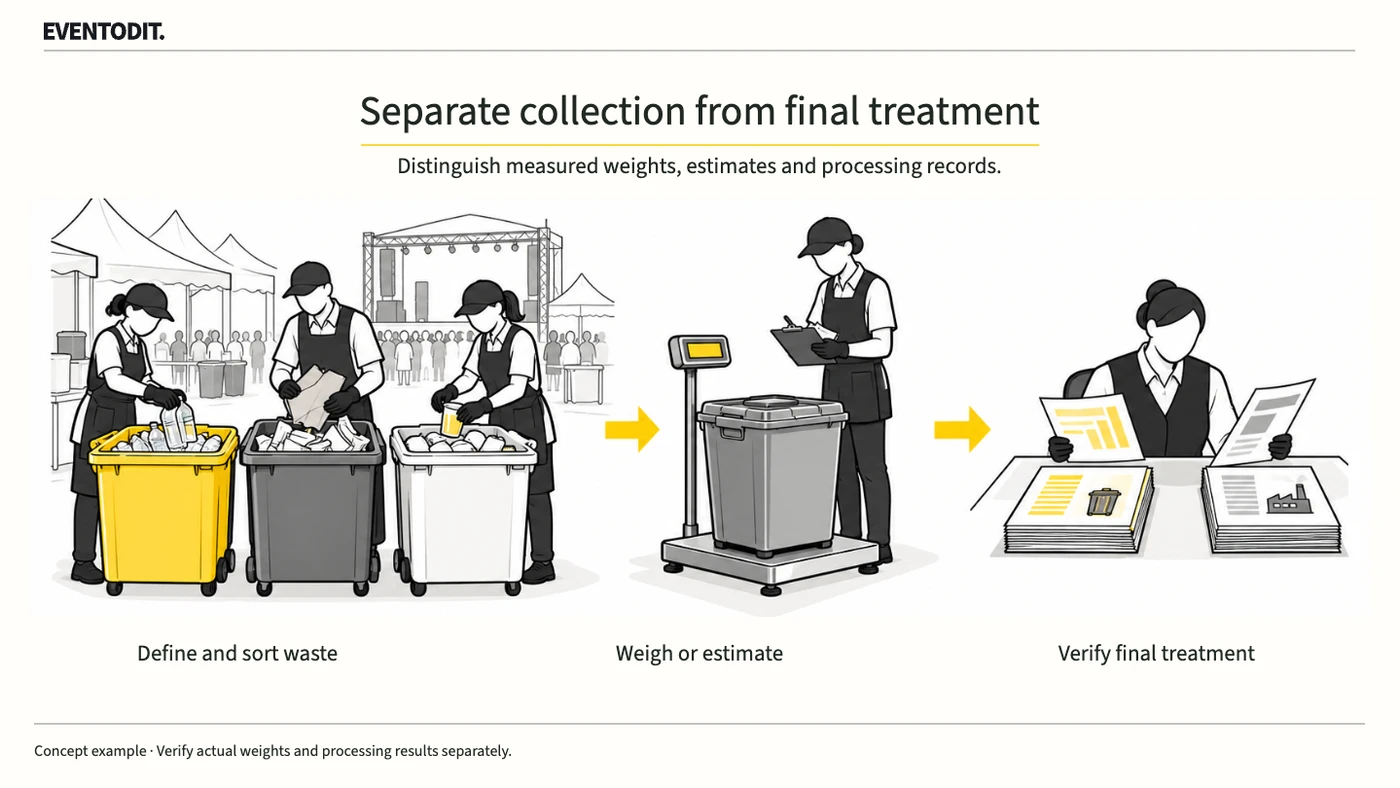
Part 1. Environmental and cleaning procurement lead
“Do not report a mixed collection total as the event’s measured weight. Define the boundary and identification method first.”
- Agree source records and identification before contracting: Specify how event waste will be identified, how weighing and conversion will be distinguished, the basis for allocating mixed loads, and what treatment evidence will be provided and when. A single recycling percentage after the event is difficult to verify.
- Define the waste boundary: Agree which installation, event and dismantling periods and locations are included. Set a method with the cleaning and waste contractors to separate ordinary venue waste and material from other events.
- Link event identification to weighing: ICC Sydney’s AWRE 2022 case describes uniquely QR-identified bins and scales used for daily reporting. Choose an identification and weighing method suited to the venue; installing a particular system does not itself prove accuracy or waste reduction for another event.
- Keep overseas guidance in context: Green Industries SA and US EPA sources illustrate reporting and conversion methods. Do not treat overseas coefficients or treatment categories as Korean legal requirements; verify applicable law, contracts and facility conditions separately.
Part 2. On-site collection, weighing and allocation
“A vehicle weighbridge ticket is not an event-specific measurement. Separate the mixed load from its allocation.”
- Distinguish the vehicle total and event attribution: A ticket for waste collected from several sites measures the combined load. If an event share is allocated by area or bin count without separate event weighing, label it an estimate and retain the formula and inputs.
- Record conversion conditions: For volume-to-weight estimates, retain container volume, actual fill level, material and mixture, compaction, coefficient source and units. The EPA 2016 factors are secondary-source references, not established densities for Korean event waste.
- Preserve original units and conversions: Even when reporting in kilograms or metric tonnes, retain original units and calculations. One metric tonne is 1,000 kg; do not assume an English-language ton means a metric tonne. Extra decimal places do not eliminate estimation uncertainty.
- Mark unsupported quantities unknown: Do not enter an unsupported event share of a mixed total as zero or allocate it arbitrarily. Mark the event weight unconfirmed and assign an owner and deadline for supporting evidence.
| Evidence received | Value to identify in the report | Follow-up |
|---|---|---|
| Individual weighing linked to the event | Measured event weight | Container inclusion, units and measurement time |
| Mixed-site weighbridge ticket | Measured combined load | Event separation or allocation evidence |
| Apportioned combined load | Estimated event-attributed weight | Formula, inputs and period |
| Volume multiplied by a factor | Volume-derived estimated weight | Material, compaction, factor source and units |
| Combined total without allocation evidence | Event weight unconfirmed | Request supporting records |
Scroll sideways if needed to read every column.
Part 3. Reporting, settlement and review
“Collection and final treatment are separate stages. An intermediate depot receipt does not establish completed recycling.”
- Separate collection from treatment results: Report material collected for recycling separately from material with a confirmed final treatment outcome. Do not treat an intermediate depot receipt as proof of completed recycling.
- Prevent double counting between stages: When a collector’s outgoing record and processor’s incoming record describe the same material, do not add them together. Link weighing tickets, collection records and final treatment reports using available identifiers and boundaries; identify the stage represented by each figure.
- Keep rejects and contamination unconfirmed when unknown: If the provider has not confirmed sorting rejects or contamination, do not deduct an invented percentage. Mark the information unconfirmed.
- State the reporting boundary and comparison conditions: Include the periods and locations, material categories, measured versus estimated figures, denominator and treatment methods counted as recycling or landfill diversion. Assign owners and deadlines for missing evidence and compare events only after aligning their boundaries and definitions.
Scroll sideways if needed to compare the branches.
- Event weighing recordsCheck period, origin, container, weight and units.
- Mixed-load allocationConfirm how material was attributed to the event and whether it was estimated.
- Treatment evidenceEstablish the confirmed stage and whether the records concern the same load.
- Find boundary differences and duplicatesCount the same material only once across collection, weighing and treatment records.
- Label measured, estimated and unknown valuesAttach the measurement method and attribution basis to every figure.
- Approve reportable valuesReporting and environment owners review limitations and unresolved items.
Overseas treatment categories and performance targets are not presented as Korean legal standards.
Use the form for the next handover
Use the [Event waste measurement and attribution](/en/templates/waste-measurement-attribution.html) for the records described here. The XLSX contains Blank, Example and Instructions sheets. Write your event in Blank; the fictional example is a guide to what to enter.
Assign one lot ID and link its records at each stage. Distinguish weighing, conversion and allocation and retain units and methods.
Measurement staff hand raw records and methods to reporting. Reporting receives treatment definitions and unresolved quantities together.
Final check before use: Before finalising the event waste report, cross-check the separation of measured and volume-derived estimated weights, allocation evidence for mixed collections and duplicate counting between collection and final treatment.
Conditions for applying this elsewhere
For events receiving collection and treatment records. Foreign measurement guidance is comparative; check applicable local treatment, contractual and environmental-claim requirements separately.
Information not established
No actual event quantities, domestic suitability of factors, treatment results or reduction/recycling outcomes were verified. ICC Sydney's case is an operator self-report.
Reference material
Have a correction or additional evidence? Request a correction