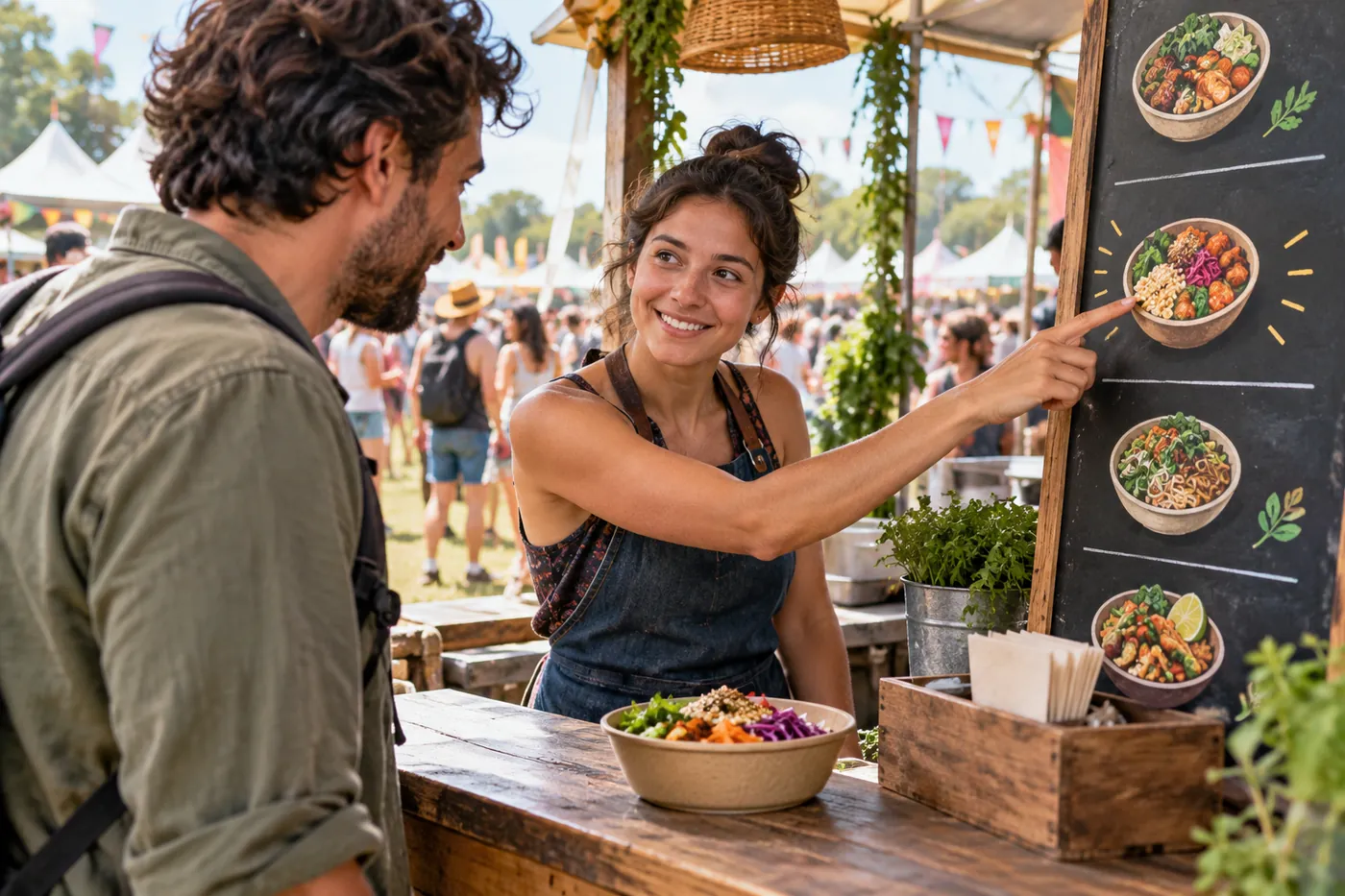
Managing festival food prices means considering both affordable choices for visitors and conditions that traders can sustain. In its official notice of 24 June 2025, Glastonbury announced that 300 stallholders would offer a £6 option. Visitors were advised to look for a sticker and details of the eligible food on each participating stall’s menu board.
For event planners, the useful point is how the scheme identified a choice at a common price. Setting one price across an entire menu and creating a separate affordable option involve different operating decisions. Following the reference standard "Case Article Review", this column distinguishes facts confirmed in the official notice from practical suggestions for other events.
1. Decouple blanket price controls from menu design
Dishes require different ingredients, preparation times and staffing. Before applying a common selling price, organisers need to understand each trader’s costs and service conditions. Lowering a price does not, by itself, secure both visitor satisfaction and trader profitability.
- Design an anchor menu: This column uses 'anchor menu' to mean a reference option that helps visitors begin choosing within their budget. Glastonbury’s official name is the '£6 Offering'. At another event, organisers could agree which dishes will carry the common price while discussing the composition and prices of other items under separate trading conditions.
- Separate the price promise from the P&L: Clearly display the promised price and contents, then assess feasibility with traders using ingredient costs, labour, pitch fees and expected sales. Rather than assume that additional items will cover the margin, review each dish and the stall’s overall profit-and-loss statement separately.
2. Turn visibility into operational support
An affordable dish is difficult to use as an option if visitors cannot find it. The sticker described by Glastonbury identified participating stalls and their eligible food.
- Assign responsibility for signs and information: Organisers can provide a common symbol and wording, while traders clearly show the relevant dish and price on their menu boards. Highlighting participating stalls separately on an official map is another option to consider. That is an application proposed in this column, however, rather than a verified feature of Glastonbury’s £6 scheme.
- Measure the effect separately: Distinguishing the number of stalls displaying the sticker, actual menu availability and units sold makes later operating decisions easier. Providing a sign alone does not establish an increase in visitor traffic or trader profit.
3. Define what the price buys
Trust in a common-price menu depends on the advertised price matching what is served. Before ordering, visitors should be able to understand the dish, serving size, included sides or drinks, and service hours.
- Confirm menu contents in advance: The organiser’s food lead and the stall manager can check the offer and use the same information on menu boards and online. If it differs from the regular menu item, photographs and wording should make that difference visible. The question is whether visitors can make an informed choice, rather than whether a smaller portion is inherently a problem.
- Set responsibilities for stock-outs and replenishment: Traders confirm stock and whether more can be prepared; organisers assign someone to update visitor information when an item sells out or service ends. Where a minimum quantity is needed, agree it with the trader after considering expected demand and food waste. Instead of treating every stock-out as a breach, establish a process for checking whether actual service and information matched the prior agreement.
4. A four-stage protocol for festival F&B price information
The following is a suggested approach for operating a common-price menu across several traders. It does not mean that Glastonbury used these exact procedures or staff assignments.
| Stage | Operating standard |
|---|---|
| Stage 1: Agree the anchor menu and financial conditions | Explain participation conditions when recruiting traders. Review each stall’s costs, staffing and service hours, and confirm feasibility separately from negotiations about other menu prices. |
| Stage 2: Sign off the menu contents | The food lead and stall manager confirm the dish, serving size, included items, price, service hours and expected stock. Compare menu photographs with what will actually be served. |
| Stage 3: Hand over common signs and information | Organisers provide the symbol and wording, and traders identify the eligible dish. If it appears on a map or website, the communications lead checks that the dish, price and conditions agree. |
| Stage 4: Update availability and record results | Traders report stock-outs and likely replenishment times to the operations team, and the information lead updates on-site and online signs. Afterwards, review participating stalls, actual service hours, sales and waste separately. |
Planner’s memo: reasonable prices begin with a promise both sides can keep
Visitors want to find food within their budget, while traders need to cover operating costs and continue trading. Planners can consider both needs when designing an offer that can actually be delivered and information that helps visitors find it.
That means providing an affordable option, showing what the price includes and keeping visitors informed when it sells out. Reviewing the price promise separately from a trader’s P&L, then connecting the people responsible for delivery and information, can turn a common-price policy into a service that can be sustained on site.
Conditions for applying this elsewhere
Use for food programmes offering a common-price option. Review costs and potential waste with each trader; discuss other menu prices under separate trading conditions.
Information not established
The 300 traders were announced before the festival on 24 June 2025. Actual participation, sales, profit, visitor savings, voluntary contractual terms, dedicated map markers and minimum-stock rules were not verified.
Reference material
Have a correction or additional evidence? Request a correction