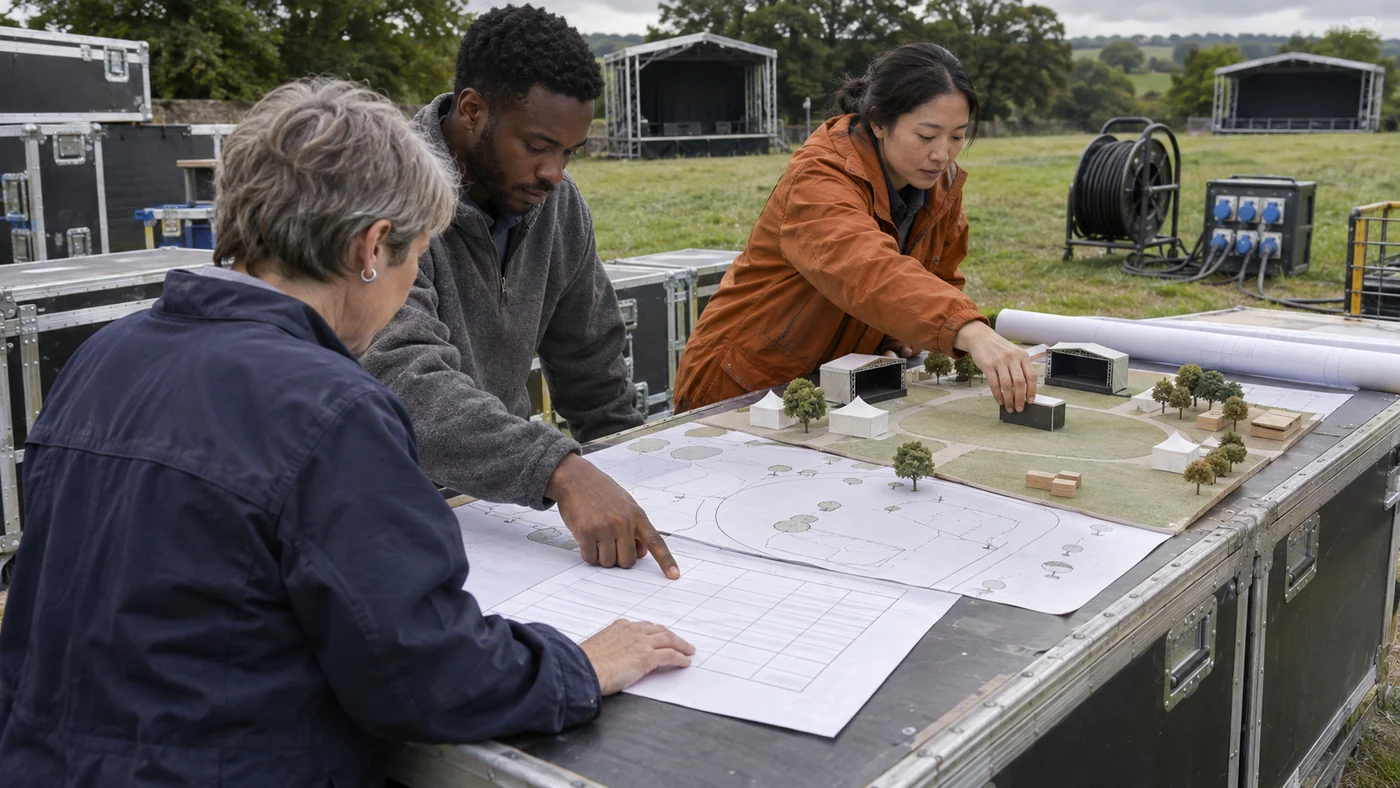
They reviewed the configuration before seeking more money
In March 2025, Greenbelt announced a plan for its spaces in response to rising production costs. This plan was not a way to fill a funding shortfall. It was a reconsideration of the configuration that generated the costs.
The editorial team considers this point important. Operating one more stage also requires performances to fill it, setup and dismantling, electricity, and support staff. That is why decisions based on just one line of a quotation can miss a great deal.
According to the follow-up announcement on September 24, the 2025 festival had ended. However, final installation plans for each space and records of actual implementation were not made public. This article covers only what can be established from the announced choices and the published program. It does not conclude that the plan was implemented as announced or assess how much it reduced costs.
They kept both music stages and reduced the performances audiences could choose from at the same time
According to the March 13 announcement, the two stages, Glade and Canopy, were changed to alternating use, and the music lineup was also reduced slightly. The stages were not removed.
The March 27 program introduction again outlined the plan to use the two stages in separate time slots. This meant acoustic and singer-songwriter performances during the day, with other performances scheduled after the main stage's headline performances. The 2025 lineup page also retains each of the two stages as a venue. However, this material shows the scheduling at the time; it is not a record of what time every performance actually began.
This choice comes at a cost. Audiences have fewer performances to choose from at the same time, and there are fewer opportunities to perform. Because the stages were retained, costs also cannot be calculated as having fallen in proportion to the number of stages.
The editorial team believes the focus should be on how the retained stages are used, rather than on the number of performances removed. Even when stages at the same site are used in turns, their sound must not overlap, audiences must be able to move between them easily, and the next act must have enough time to prepare. If these conditions are not met, alternating schedules are unlikely to provide a way to reduce costs.
They divided spaces according to performance format
The March 27 introduction stated that different performances would be assigned to the new indoor venue Forum and the outdoor venue Commons. This meant placing theatre and late-night comedy indoors, and circus and physical theatre outdoors. They did not fit every performance into a single type of space.
However, replacing a large venue with a smaller one cannot always be assumed to be cheaper. Dividing spaces may require new equipment and support staff. Moving outdoors also changes weather and sightline conditions. The public materials do not state how much these costs increased or decreased.
For other events, too, a plan that only changes the stage size is insufficient. This is because performance contracts and technical preparations vary depending on whether the same work can be presented in another space or the program needs to change. These are conditions for application identified by the editorial team. They are not based on verified records of Greenbelt's internal contract adjustments.
Combining spaces is different from removing programs
The March redesign plan stated that two partner spaces would be combined into a single shared space called Table. The same March 27 introduction also included plans to increase the capacities of Pagoda and Hot House. Not every space was reduced by the same proportion. A venue called Table also remains in the 2025 program.
When costs change, the editorial team distinguishes three choices. These are providing the same experience through fewer units, reducing the amount offered simultaneously, and changing the structure through which costs are covered. The three choices leave different commitments to audiences.
| Choice in the public materials | Commitment that changes | Conditions to check |
|---|---|---|
| Alternating schedules for Glade and Canopy | Use the two stages in turns | Stage changeover time, sound, audience movement, and actual cost reductions |
| Table shared space | Combine separate partner spaces into a shared space for hospitality and conversation | What each partner will be responsible for, operating hours, and support roles |
| Decision to leave Boughton after the 2026 festival | Prioritize sustaining the festival over the long term over repeating it at the same site | Costs and conditions at the new site, relocation plans, and commitments not yet decided |
Scroll sideways to read every column.
The first two rows of the table above are announced plans, while the last row is a board decision made public afterward. This table does not compare savings. Even when spaces are combined, the conditions needed to accommodate different partners' programs and audiences must remain. Removing one tent does not reduce total expenditure by the same proportion.
The use of reserves and the decision to relocate should be considered separately
According to the September 24 Q&A, sales in 2024 fell short of the target, leading to the use of reserves. The board also decided to leave Boughton after the 2026 festival.
The use of reserves and the decision to relocate are not evidence that the 2025 redesign succeeded. The fact that the short-term configuration was adjusted is separate from a judgment that the long-term cost problem was resolved. A relocation plan also does not mean that the move has actually taken place or that costs at the new site have fallen.
Accounting reserves and a contingency allowance in an event budget are not the same thing. It has not been established how much Greenbelt allocated to contingency or the criteria it used to spend it. The editorial team focuses less on whether money is available and more on the fact that they also decided what to change if the same problem recurred even after spending more money. Contingency plans can include choices to change how an event is provided and where it takes place, as well as additional funding.
For events in Korea, compare the amount reduced with the experience that changes
When costs rise at Korean festivals or corporate events, options such as retaining the existing configuration, operating spaces jointly, or scheduling them by time slot can be compared. Simply placing total quotations side by side does not reveal what is lost. The number of programs running simultaneously, the time available to audiences, what partners will be responsible for, and newly required support must all be assessed on the same basis. This is the editorial team's recommendation drawn from the Greenbelt case.
For example, scheduling two programs consecutively in the same space may reduce the burden of providing separate spaces. However, it may increase the need for changeover staff, additional usage time, and audience guidance. Removing equipment or spaces already under contract may also leave cancellation costs. So record separately the costs that disappear, those that remain, and those that arise anew. This example does not reproduce Greenbelt's actual billing records.
The point at which an alternative is chosen also matters. A choice made while performance content and commitments to partners can still be changed differs from a rushed reduction on site after orders have been placed. Removing safety checks or accessibility support because costs have risen cannot be an alternative. Decide on the configuration after checking that the retained program can actually be delivered.
After the event, recording only total expenditure is not enough. You must also record the production units changed, the time and support actually used, and the experiences that could not be provided to judge what to carry forward to the next edition.
Conclusion
Greenbelt's choices in 2025 went beyond deciding where to find the money to cover production cost increases. They redefined the groupings in which spaces and stages would be provided. When costs change, an alternative must be able to explain together the amount reduced, the audience experience that changes, and the support newly required. Announced plans and actual implementation and savings results must be recorded separately so that the limits of an alternative can also be seen when making the next decision.
Conditions for applying this to other events
- Use this as a reference for examining the differences between retaining the configuration, combining spaces, and operating by time slot when production costs change while running multiple temporary spaces and partner programs.
- Do not transfer the UK festival's site, donation, and ticketing structures directly to events in Korea. Check the actual venue, performance, and production contracts, as well as technical, safety, and accessibility support conditions, separately.
Information not verified
- We did not verify the final installation plans for 2025, the actual changeover times for all stages, or the operations and audience records for each space. The lineup page is program material from the time, so we did not use it as evidence of implementation in its entirety.
- We could not verify individual quotations, savings by line item, records of contingency allocation and use, or staffing increases and decreases in the public materials.
- We did not assess whether the redesign improved noise, waiting times, audience satisfaction, or environmental impact.
- We did not analyze whether the planned relocation after the 2026 festival actually took place or what its cost effects were.
- We did not conduct on-site reporting, draw on actual operational experience, or obtain an external expert review.
Sources
- Greenbelt, announcement on rising production costs and the redesign of spaces (March 13, 2025)
- Greenbelt, announcement of the 2025 program plans by venue (March 27, 2025)
- Greenbelt, 2025 lineup and venue information page (publication date not shown)
- Greenbelt, update on finances and board decisions after the 2025 festival (September 24, 2025)
Next tasks and related resources
Related practical guides
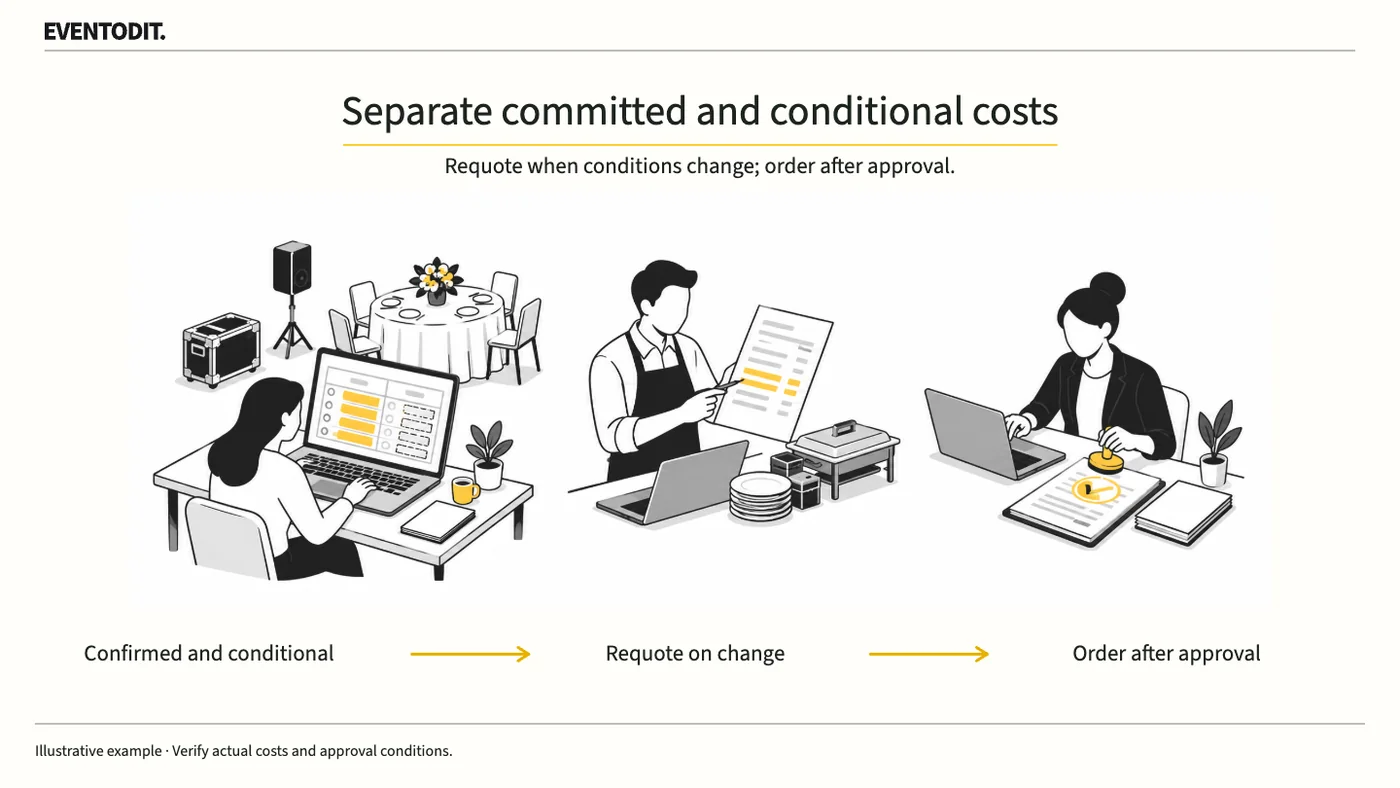
Event Budget and Conditional Cost Management
An event budget contains both committed costs and amounts that depend on decisions still to be made. Mark the difference and update the forecast whenever those conditions change.
Read guideHave a correction or additional evidence? Request a correction