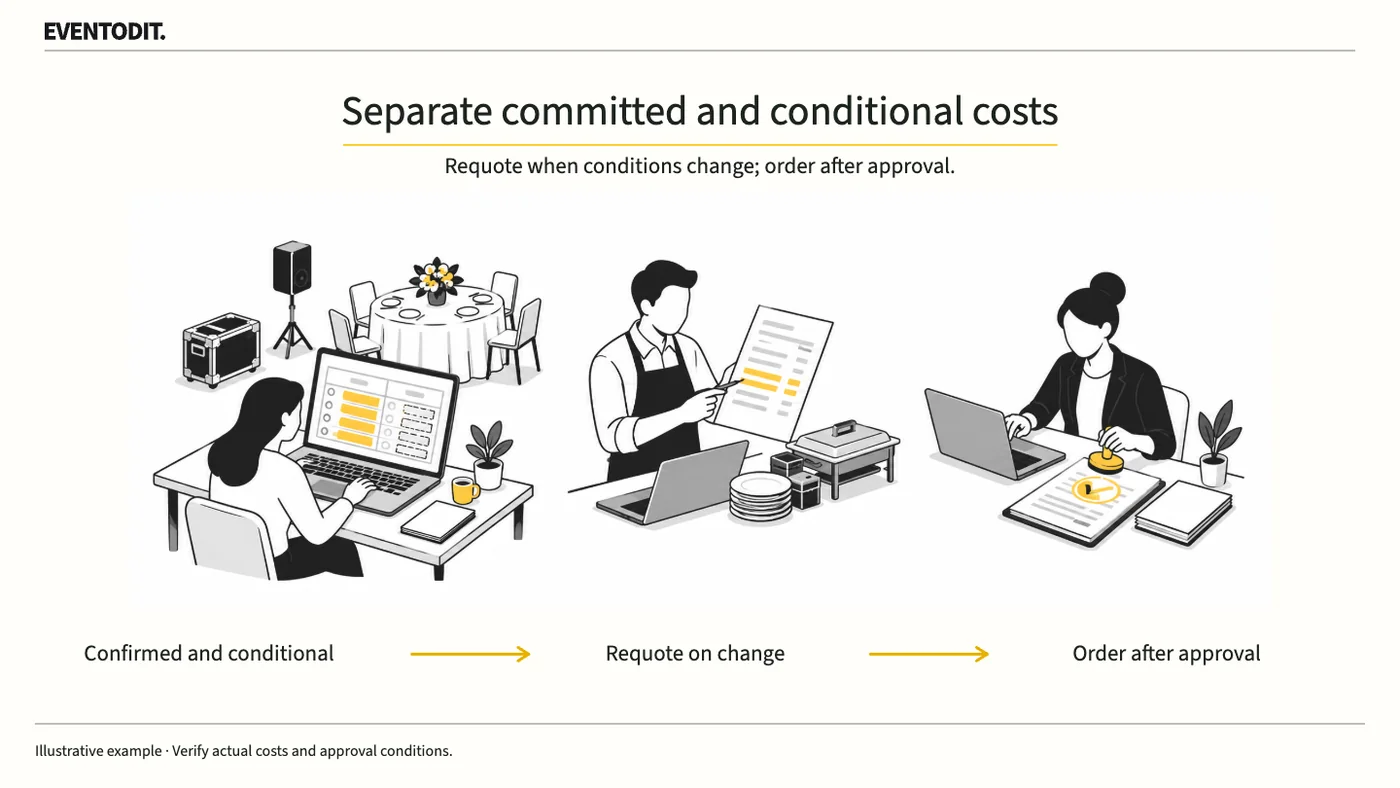
Part 1. Planning and Budget Lead
"Do not report every budget item as settled. Separate conditional amounts."
- Record committed and unresolved estimates separately: Do not mix quotations for items whose output location, operating hours or installation dates may change with amounts settled by contract. Place unresolved items in a separate conditional-cost field and record both the assumptions used in the calculation and the expected range.
- Distinguish the forecast total from the final contract amount: A planning report may temporarily add committed amounts and unresolved estimates to calculate a forecast total. Do not report that figure to management or the client as though it were the final contract amount.
- Break down the weekly budget meeting agenda: Do not look only at the total. Classify budget items as contracted, conditions unresolved or awaiting approval; review the latest quotation date and the next check date, and address risks in unresolved items first.
Part 2. Purchasing and Procurement
"If a condition changes, obtain a revised quotation that includes the resulting costs."
- Request a revised quotation when event conditions change: If the venue, programme or running time changes, do not extrapolate from the old quotation and calculate the cost yourself. Promptly give the supplier the changed quantities, rates and working hours and obtain a formal response on whether the existing quotation can still be honoured.
- Cross-check hidden knock-on costs: Longer operating hours may increase not only equipment rental but also staff meals, additional night-work allowances and parking. Identify the related costs caused by a changed condition and update the forecast total.
- Review the budget using the APM principle: Continually compare the agreed baseline budget with actual expenditure to date and anticipated future costs. Do not add an unsupported fixed contingency percentage simply to hide unresolved costs.
Part 3. Ordering and Contract Lead
"Even when extra cost is unavoidable, do not place the order until internal approval is given."
- Obtain approval before ordering: A working-level finding that site conditions or a planning change require extra spending is not formal approval from the client or internal management. Until final approval is given, do not instruct the supplier verbally to perform the work or amend the purchase order.
- Document objective grounds for change approval: Do not tell the approver only that costs have risen. Clearly document and report the reason for the change, available alternatives, and the effects on the event schedule and quality if the budget is reduced.
- Reflect the final decision in the order: Record clearly whether management approved, rejected or deferred the budget change, and put only approved conditions into the final contract and order documents.
- Check the cost itemConfirm quantities, hours, location assumptions and quotation date
- Update the forecastRecord price and schedule impacts of changed assumptions
Unresolved / unapproved
Approved
- Update ordered scopeCarry approved conditions only into contracts and orders
Final check before use: Before spending the event budget and sending orders to suppliers, check that unresolved conditional costs have been settled and internal approval for additional costs has been completed.
Conditions for applying this elsewhere
Planning stages where quotation, purchasing assumptions and venue conditions may still change
Information not established
No event-specific labour or equipment rates or contingency percentage is provided. Follow organisational approval rules.
Reference material
After reading, complete the next task
A budget baseline separating committed amounts, conditional costs and forecasts
This article’s template
Confirmed and Potential Additional Costs
A budget showing confirmed costs, possible additions and decision deadlines.
Instructions, examples & downloadsRelated practical guides
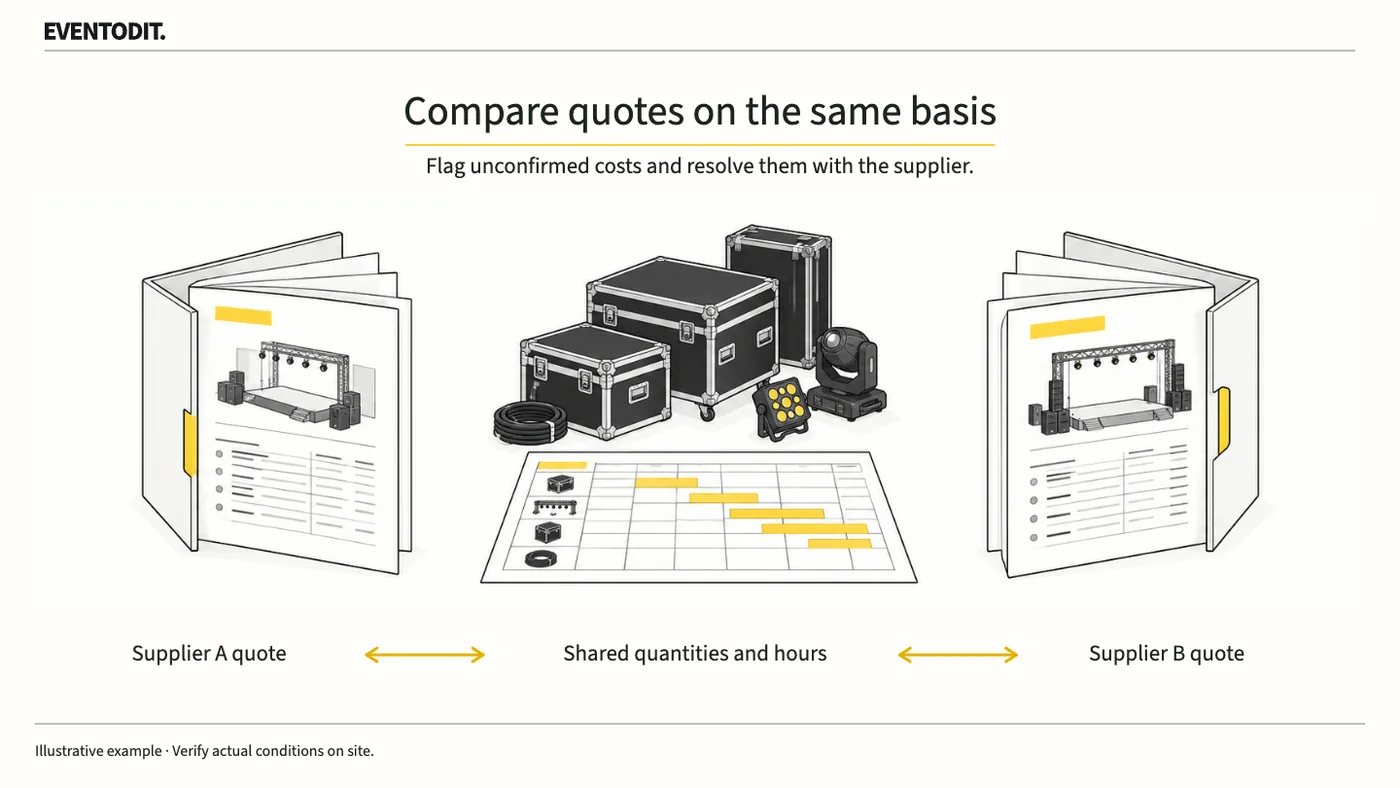
Event quote comparison: match scope, staffing and extra costs
Match equipment, staffing, working hours, tax and transport before comparing event supplier quotes. Ask suppliers to confirm omitted or separately priced costs before ranking totals.
Read guideHave a correction or additional evidence? Request a correction