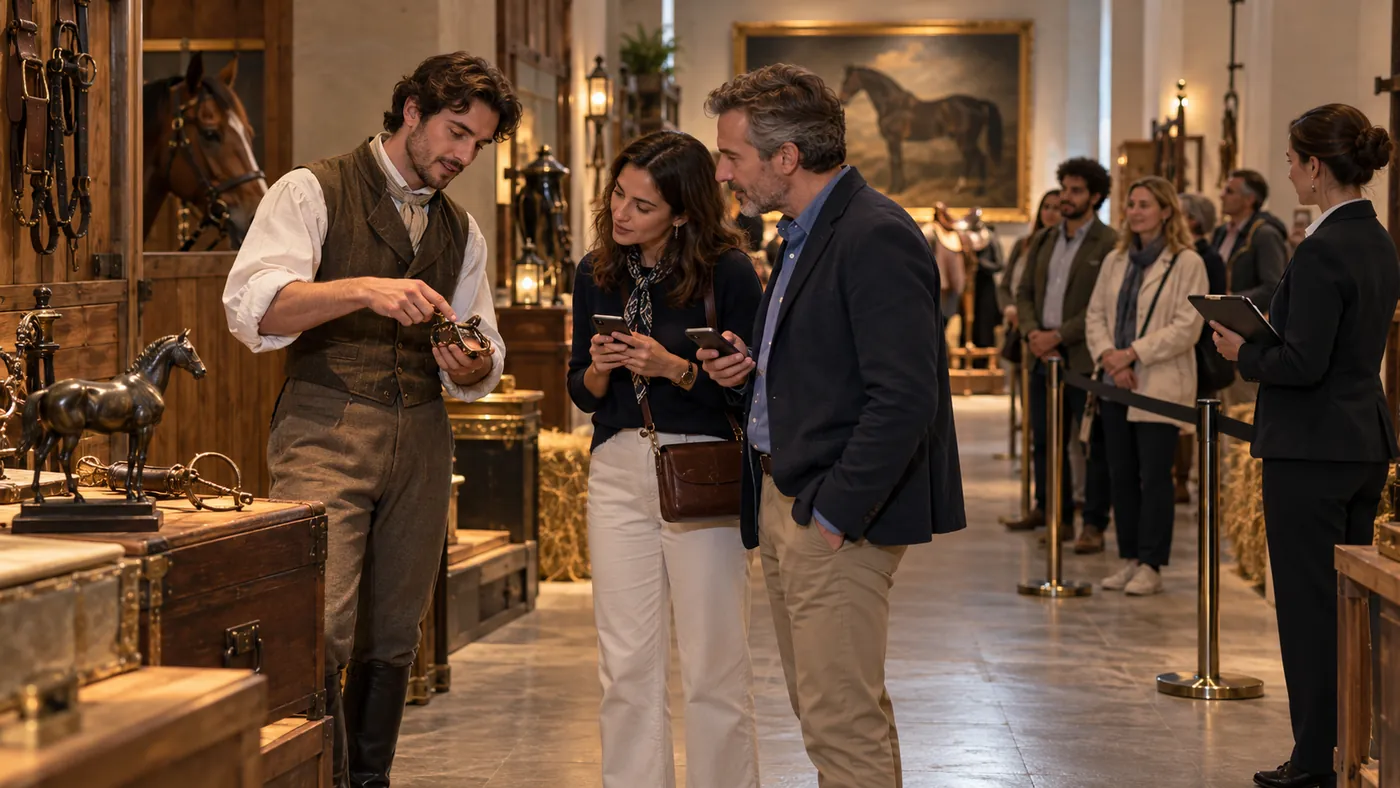
Exhibitions are increasingly moving beyond looking at objects towards immersive experiences in which visitors enter a fictional world and solve puzzles. At Hermès’ Mystery at the Grooms’, held at Seoul’s DDP in June 2026, visitors became detectives and used their phones and QR codes to find 30 missing horses. Some clues were designed to be obtained only through interaction with actors playing the grooms.
Bringing performers into an exhibition is an effective way to deepen immersion. From an event planner’s practical perspective, however, introducing a person into the puzzle-solving process also introduces a substantial bottleneck risk. As the queue and participatory-programme principles in "Case Article Review" explain, a structure that provides hints through human conversation rather than text or a device can quickly bring operations to a standstill without rigorous timeline control and operational design.
1. Decouple the number of characters from throughput
A common planning error is to assume that one groom character requires only one actor.
- Calculate concurrent capacity: A static sculpture can be viewed by 100 people at once, but an actor can converse with only a small number of visitors at a time. The longer it takes for visitors to ask a question, receive a clue through the actor’s dialogue and understand it, the longer the queue around that actor becomes. Planners should calculate how many visitors one actor can serve in an hour—their throughput—rather than simply count the characters, then distribute several actors playing the same role across different areas.
2. Rehearse the complete chain of actions
The interaction does not end simply because an actor has delivered a clue through an impressive line of dialogue.
- Prevent delays to the next action: Immediately after the explanation, visitors need to take out their phones to enter an answer or move to the next device. What happens if the hint is so ambiguous that they remain standing there, unsure what to do? During the dry run, the planning team should check more than the actor’s performance. It should time and sign off the entire chain—[actor delivers the hint → visitor understands → visitor enters the answer on their phone and leaves]—to confirm that it connects smoothly without delays.
3. Establish shift changes and progress hand-over rules
Nobody can perform without rest, so actor changeovers are inevitable.
- Hand over clues without interruption: If Actor A reaches a break while giving a particular group its first hint and Actor B must take over, Actor B needs to know immediately how far that group has progressed through the puzzle. The operations planner should prepare a precise hand-over protocol that passes visitor progress from one actor to the next through staff radios or tablets, keeping the story continuous during shift changes.
4. A four-stage protocol for actor-led puzzle experiences
When planning an experience in which characters within the story provide visitors with mission clues, the practical team should follow these four stages.
| Stage | Operating standard |
|---|---|
| Stage 1: Measure total interaction dwell time | During script readings, measure the total time from delivering the dialogue to the visitor completing the device interaction, then use it to work backwards to an appropriate session capacity. |
| Stage 2: Activate hint escalation rules | If a visitor remains stuck for more than two minutes because they have not understood the dialogue, agree a rule under which the actor stops using metaphorical lines and switches directly to a clear hint to keep people moving. |
| Stage 3: Set a cut-off for the actor’s duties | Place dedicated technical-support staff immediately behind the performance area, with separate responsibilities, so actors do not also take on visitor-service tasks such as resolving phone errors or giving directions. |
| Stage 4: Log bottlenecks rather than correct-answer rates | During the event, focus observation and logging on which actor and which clue keep visitors waiting longest, rather than how many answers they get right. Use the records to adjust hint difficulty for the next session. |
Planner’s memo: a precise timetable protects immersion
Visitors become deeply immersed in an exhibition’s fictional world when they make eye contact and converse with a mysterious groom. That enchanting experience owes everything to thoughtful planning and the actor’s committed performance.
The illusion can break in an instant, however. After spending 20 minutes looking at the backs of the people ahead while waiting for their conversation to end, immersion turns into frustration. To create a magical world on stage, the planner backstage must use a cool, matter-of-fact spreadsheet to control the time consumed by each breath and line of dialogue. The most romantic experience exhibitions run safely on the least romantic timeline calculations.
Conditions for applying this elsewhere
For participatory experiences where a character within the story provides information needed to progress, rather than simply giving directions. Scripts and participant actions need to be tested together.
Information not established
Published material did not establish attendance, session capacity, actor numbers, shift schedules, scripts, hint rules, waiting times, completion rates or sales effects.
Reference material
- Hermès Korea · Official Seoul event information: DDP Art Hall 1,6–16 June, approximately 60-minute free reserved sessions, charged smartphone and age 10-plus conditions
- SPACE · Lee Sowoon, 7 July 2026 original post-event report: QR participation, six rooms, 30 horses and clues involving interaction with actors
- Seoul Metropolitan Council · 11 August 2026 second Urban Planning and Balance Committee meeting: Seoul Design Foundation’s account of hosting the Hermès special exhibition
Have a correction or additional evidence? Request a correction