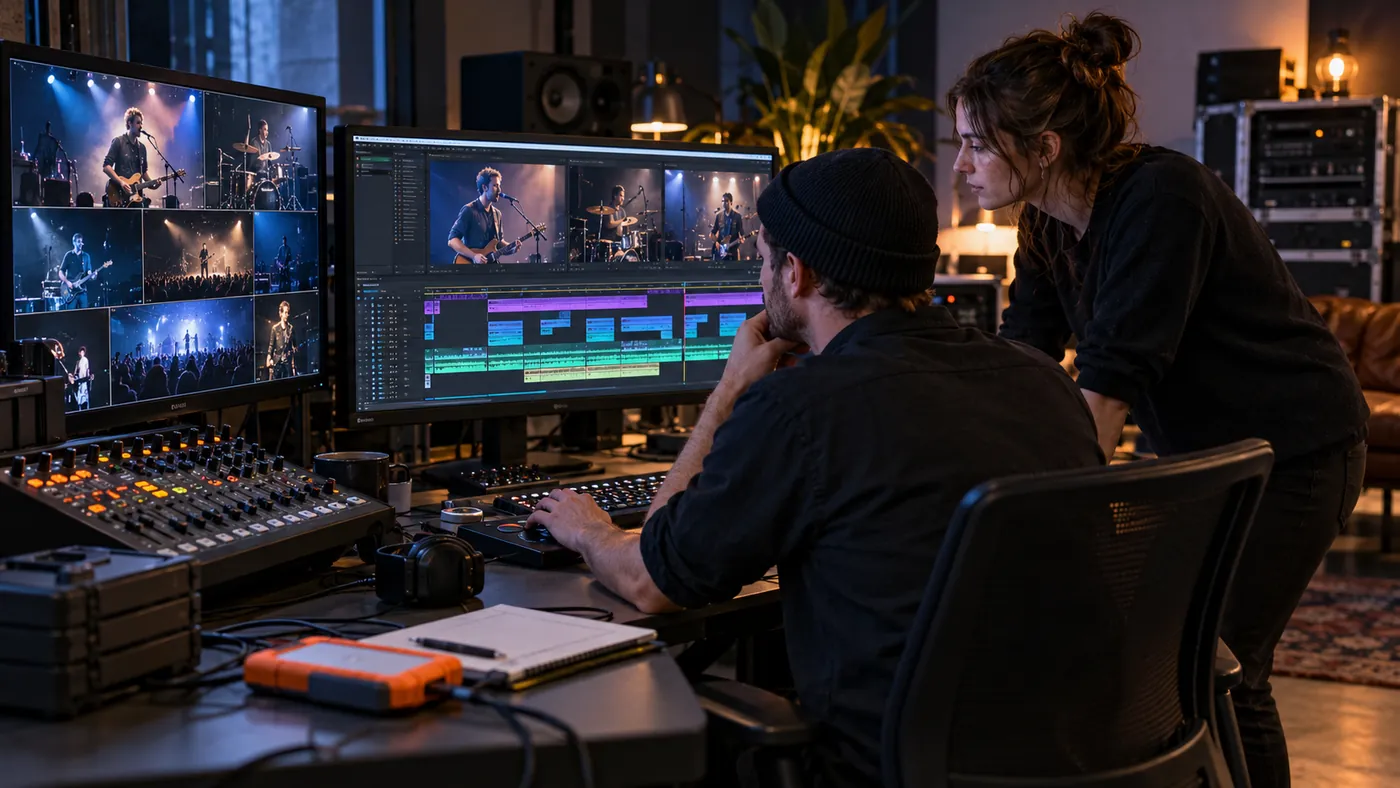
One of the most common mistakes planners make with a hybrid concert that includes online transmission is to assume that once the livestream is over, they can simply trim that recording and upload it to YouTube. The Korea Creative Content Agency’s 2025 concert ON THE K : B finished its live transmission on 7 February, but did not release a separate edited broadcast with additions such as viewer reactions until 20 February, 13 days later.
From an event planner’s practical perspective, that 13-day gap is not simply laziness or an upload delay. As the equipment and broadcast guidance in "Case Article Review" also explains, the live feed and the edited VOD broadcast are two independent deliverables with different audiences and formats. Treating them as a single task can exhaust the budget and leave only a dispute with the video team.
1. Decouple the two release dates: the end of the livestream is not production completion
Commissioning livestreaming and subsequent VOD production as a single undifferentiated video-production job can lead to serious problems on site.
- Calculate the post-production workload: A live-switched feed conveys the immediacy of the event, but can look rough when watched later as VOD. Producing a proper subsequent broadcast requires substantial post-production: returning to the original clean camera sources separately from the live feed, colour correcting them, adding captions and intercutting reaction shots. At the budgeting stage, planners should clearly separate the live-transmission fee from the VOD editing fee in the scope of work. This ensures that the video team’s assignment continues beyond the live event and that the agreed deliverable can be secured.
2. Prevent contamination of performance metrics
According to the Music Industry White Paper, the live transmission recorded approximately 38,000 views and the subsequent broadcast approximately 18,000.
- Avoid the illusion created by adding totals: When writing a results report, a planner may be tempted to state that the concert achieved a combined 56,000 views. However, a simple sum without removing overlap between fans who watched the livestream and then watched the edited broadcast is a vanity metric. Meaningful insight comes from analysing the live transmission’s concurrent-viewer retention and the VOD’s viewing duration separately, rather than focusing on the size of an overall number.
3. Manage audience expectations in advance
Immediately after a livestream ends, fans refresh the channel and ask when the replay will be available.
- Two-track messaging: As soon as the live transmission finishes, the planning team should issue clear cut-off information on the broadcast screen and official social channels. State the timeline explicitly: “The live video from today will not be rebroadcast. The official edited programme, with viewer reactions and behind-the-scenes material, will be released on 20 February.” A clear announcement allows fans to wait through the 13 days without frustration and generate a second wave of traffic.
4. A four-stage protocol for a live-and-VOD two-track programme
When planning a hybrid performance that provides both a livestream and a subsequent edited broadcast, the practical team should follow these four stages.
| Stage | Operating standard |
|---|---|
| Stage 1: Commission separate budgets and scopes of work | In the contract with the video producer, budget for live streaming and post-production as independent items, specifying the people, equipment and delivery deadlines for each. |
| Stage 2: Secure clean-feed archives | During rehearsal, check that isolated original recordings from every camera, or ISO feeds, and the original multitrack audio are being recorded simultaneously and safely to backup drives, in addition to the live-switched feed. |
| Stage 3: Agree the director’s-cut rules | Obtain advance sign-off on editing guidelines for the subsequent programme: how much raw material, such as mistakes or silent sections, will be removed, and how many minutes or what proportion will be devoted to viewer comments or interviews. |
| Stage 4: Measure performance indicators separately | Keep the live platform’s peak concurrent viewers and the VOD platform’s cumulative views and watch time in separate spreadsheet sheets, using them as evidence for the next event’s channel strategy. |
Planner’s memo: two releases are two launches
When the live cue has been given and the event ends safely, a planner understandably wants to put everything down with a sense of relief.
If a subsequent VOD release remains, however, packing up on site simply means starting work in a new editing room. The energy of the live event must be refined into a finished visual language and presented to the public once again two weeks later. Making the demanding work of these two tracks fit together precisely within an overall budget and schedule is what completes the operational planning needed to avoid disappointing tens of thousands of online viewers.
Conditions for applying this elsewhere
For concerts published as a live transmission and a later broadcast. Without separate evidence, overlapping viewers cannot be added as new reach.
Information not established
The white paper does not establish a detailed measurement date, unique or overlapping viewers, actual editing days, staffing, costs, detailed reaction segments or additional filming. The full original videos were not directly reviewed in playback.
Reference material
- Korea Creative Content Agency, <2025 Music Industry White Paper> · page 306, Table 4-1-7: actual ON THE K : B release dates, views and studio audience; published 11 December 2025
- Sports World · 5 February 2025 advance report on MRCH’s appearance: KOCCA Music Studio concert and original plans for the livestream and later broadcast
Have a correction or additional evidence? Request a correction