The key points first
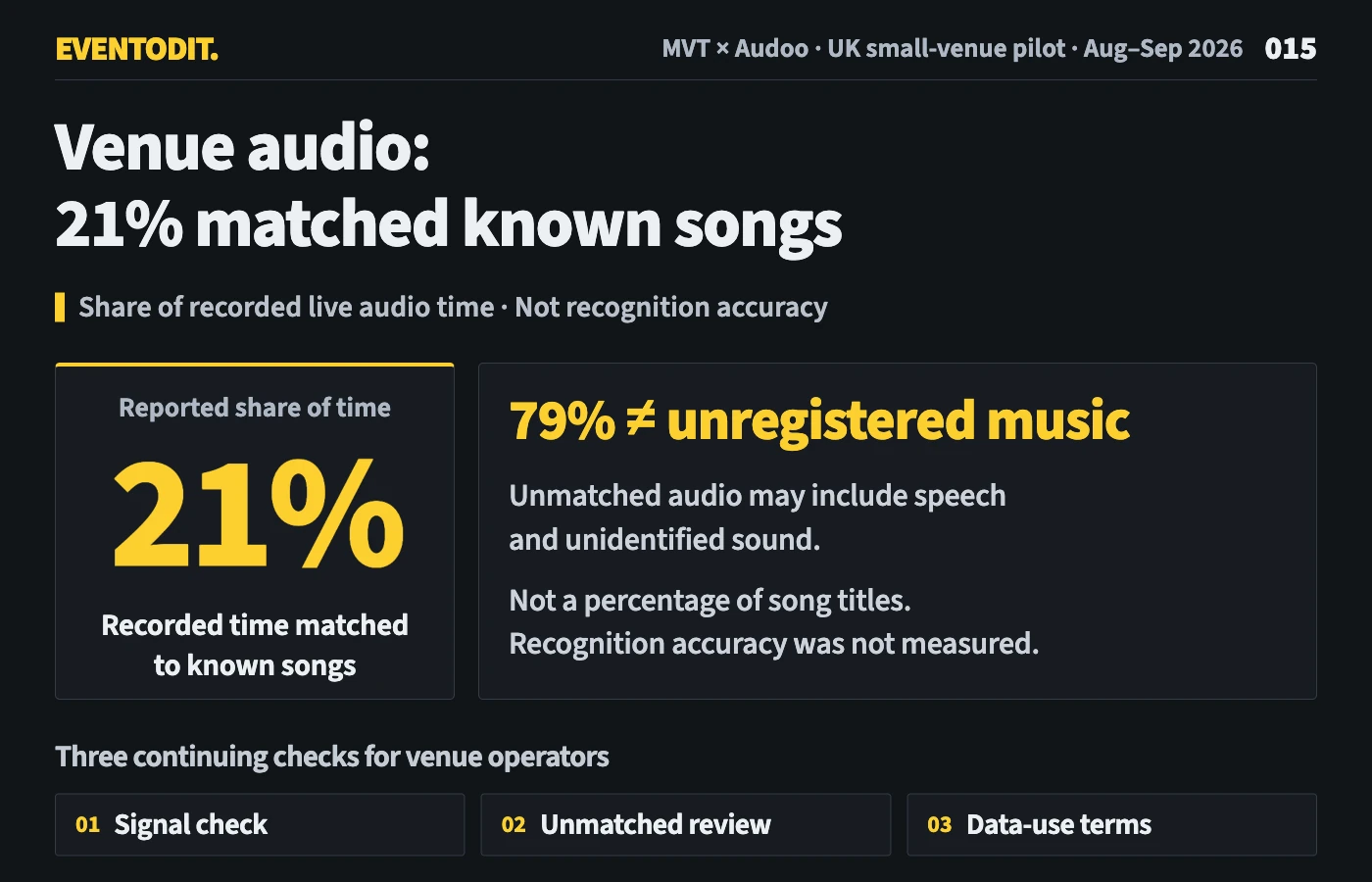
- In the pilot, 134 of 623 hours of performance audio matched known songs: about 21%.
- The remainder may include speech between songs and sounds the system could not recognise.
- It therefore cannot be concluded that 79% was unregistered music.
- The pilot is an attempt to assess more accurately how royalties for music played in venues—the usage payments received by composers—should be distributed.
Why was the pilot carried out?
At small music venues, it is difficult to record who created the music, which songs were played and how much they were performed. MVT says that PRS for Music’s approach to licensing UK grassroots venues assumes that all music performed is registered repertoire. MVT has long argued that this assumption may not reflect reality. The pilot is an attempt to test it against actual sound.
MVT had estimated that registered songs account for around 20–34% of music played in venues. The pilot’s 21% is broadly consistent with that estimate. It has not, however, established a precise proportion.
How does the system recognise songs?
Audoo’s equipment takes an audio signal from a venue’s mixing console and identifies songs. Performers do not have to submit a list saying which songs they played. The company describes this as a practical advantage.
Some sounds, however, cannot be recognised by the system. According to the announcement, unmatched audio may include speech between songs and other unidentified material. The announcement does not establish which arrangements or songs have lower recognition rates. Saying that only 21% was identified therefore does not mean that all the remainder was unregistered music.
What the pilot showed about music in venues
- The system recognised 2,238 live performances.
- These included 23 tribute-band performances featuring more than 380 songs.
- In September alone, 1,190 different songs were recognised, and 87% were identified only once.
- The music varied greatly from venue to venue. No single artist was heard in more than 16 of the 64 venues providing data in September.
This suggests that music in these venues does not revolve around a small number of popular songs in the same way as radio or large concerts. It has therefore prompted arguments that distributing royalties according to radio audience figures may not be appropriate.
Why does this matter?
Songs heard during performances need to be recorded accurately so that the songwriters behind them can receive fair usage payments. If records are incomplete, a great deal of music may be performed while payments go to only a few songs.
The pilot can therefore be seen as an attempt to measure venue music more accurately. It is relevant to venues, composers and the organisations that manage royalties.
What should live music teams prepare?
Automatic song recognition does not remove all the work required onsite.
- Teams need to check that the device is connected properly.
- They need to be able to ask the performing team about songs the system could not recognise.
- They need to decide who will receive performance data and in what form.
The same applies to those receiving the data. Receiving it does not mean they can sell or share it however they wish. Contracts and terms need to define how the data may be used.
What is still unknown
- It is not known whether the pilot results apply to all venues across the UK.
- The system’s song-recognition accuracy has not yet been independently verified.
- The cost of using the technology and the price of selling the data have not been confirmed.
- Whether the same approach would apply to venues in Korea requires separate consideration.
The takeaway
The system did not recognise all the music heard in the venues. Filling those gaps, and deciding who should be informed and under what terms, will be an important task for the live music business.
Reference material
Have a correction or additional evidence? Request a correction