Receiving an email does not mean the review has started
With this change, planners opening a proposal link in a Cvent email must first sign in to Cvent. Cvent shows the proposal only after checking access permissions following sign-in. According to the provider, the change is intended to prevent proposal information from being exposed through an email link alone while allowing authorised planners to continue their review.
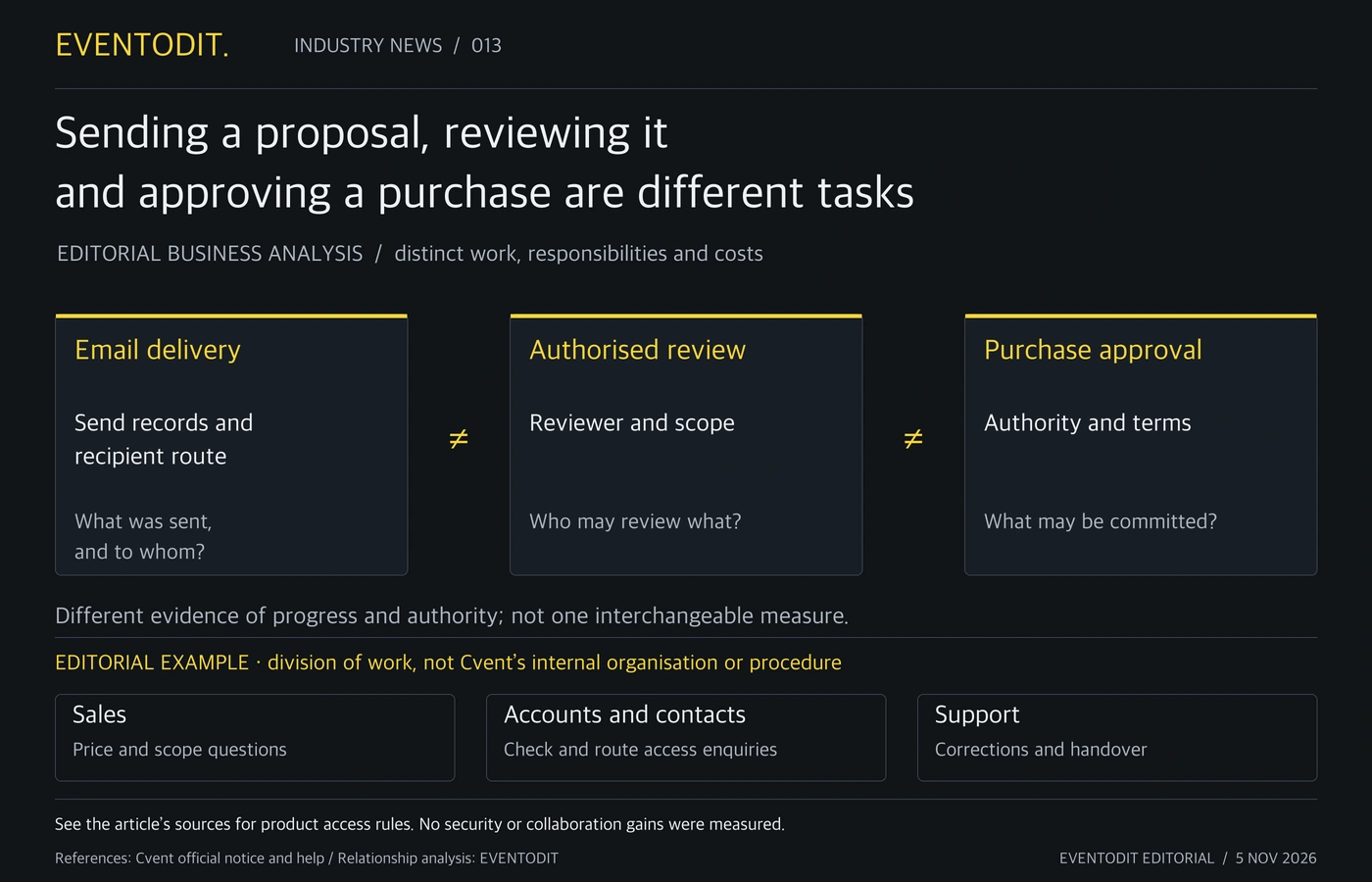
A record that a proposal was sent therefore does not mean the customer’s internal review has started. Whether the planner, budget manager and final purchaser can open the same material must be checked separately.
Planners and NSO contacts are verified differently
NSO stands for National Sales Office, a contact that receives requests for proposals on behalf of several venues. According to the notice, NSO links in emails received on or after 3 November 2026 lead to the NSO login page. A contact without a Cvent account can verify their identity using a one-time code sent to their email address. If they use a Cvent account, the email in their profile must match the address that received the link.
Access is limited to the NSO contacts selected when the proposal is submitted or updated. Contacts who were not selected, or who removed themselves using “Change the NSO”, cannot access the proposal. Opening a link sent to a different email address in the same browser requires signing in again with the address for that link.
Recipients therefore do not all open the material in the same way. Businesses need to distinguish who received it through which route and what permissions they have.
Authentication, viewing permission and purchasing authority are separate matters
Verifying someone’s identity and granting permission to open particular material are separate matters. The person who can read the material also cannot be assumed to be the person who approves the budget or signs the contract. This change checks who can access a proposal; it does not determine the customer’s purchasing authority.
For example, a planner collecting proposals from several venues to explain them to a client’s purchasing team needs material comparing prices and scope, but every internal contact may not need access to the originals. Deciding who reads the originals, who gathers comparative comments and who requests revisions makes the sharing scope and response responsibilities clearer.
Access support is a staffing cost after the proposal is sent
Suppliers need to distinguish revising proposal content from helping the customer start a review. Sales or operations staff should decide on price changes. Checking the receiving address or reviewer, by contrast, should be handled by those responsible for contact and account administration.
The following table is an editorial breakdown to help businesses distinguish work and costs. It is not Cvent’s official support procedure or pricing structure.
| Situation during a transaction | Work to distinguish | Clues for assessing staff time and costs |
|---|---|---|
| The customer changes the person reviewing the proposal | Check whether this is a price change or a change of reviewer and contact details | Who handles the verification request and by when the right person will be brought in |
| The purchaser and agency review together | Separate who receives the original material, comparative comments and revision requests | Time spent organising material and waiting for external replies |
| A contact reports being unable to open the material just before the deadline | Distinguish an access problem from disagreement over proposal terms | What to pass to technical support and what follow-up sales should continue |
More of this work does not necessarily mean a separate fee should be charged. Distinguishing support included in the basic service from recurring customer-specific coordination helps prevent costs from being overlooked.
Controlling links leaves downloaded material to manage
The access conditions for an email link and the permitted use of documents downloaded by the customer are separate matters. Comparison material downloaded by a reviewer, prices copied into an internal report and a subsequently revised quotation may contain information from different points in time. Customer support costs depend on who explains the latest terms and notifies people of corrections to earlier material.
The platform’s sign-in process cannot, by itself, replace document version management or checking the sharing scope agreed with the customer. The right approach depends on the customer contract and how the review actually works.
Three distinctions businesses can prepare
Businesses can use this change as an opportunity to divide proposal management into three parts.
First, distinguish contacts who can receive a proposal from people who can actually access it. The correct NSO contacts need to be selected when submitting or updating a proposal.
Second, record price questions, access enquiries and requests to correct material separately. Treating an access enquiry as customer indifference, or the number of proposals sent as the number actually reviewed, can distort sales judgment.
Third, decide who handles support after the proposal is sent. Set criteria so that sales, account administration and technical support do not keep passing the same enquiry between them.
The notice provides no evidence that this change improved proposal retrieval rates or contract conversion. Businesses need to assess actual effects through their own enquiry records and handling times.
Implications for Korean businesses
The material reviewed here is a supplier notice from Cvent Supplier Network. It does not mean that the same access rules have been introduced at every Korean quotation platform or venue. Nor can it be extended into a legal judgment about Korean businesses’ handling of personal information or contracts, or a security assessment.
Korean agencies and suppliers can still take one point from it: go beyond checking who received a proposal to identify who will actually compare it and participate in the decision, and whether that person can access the material. This distinction helps explain the scope of account administration and sales support clearly to customers.
Conditions for applying this to other events
This article is an analysis of business operations based on Cvent Supplier Network’s product notice dated 3 November 2026. It does not report tests of the notice’s access conditions using actual accounts or verification of security outcomes. It should not be treated as applying generally to other platforms or Korean transactions.
Unconfirmed information
The procedures for granting permissions to actual accounts, conditions by region and contract, fees, access logs and file recall features, customer support workload and effects on contract conversion were not verified.
Reference material
Have a correction or additional evidence? Request a correction