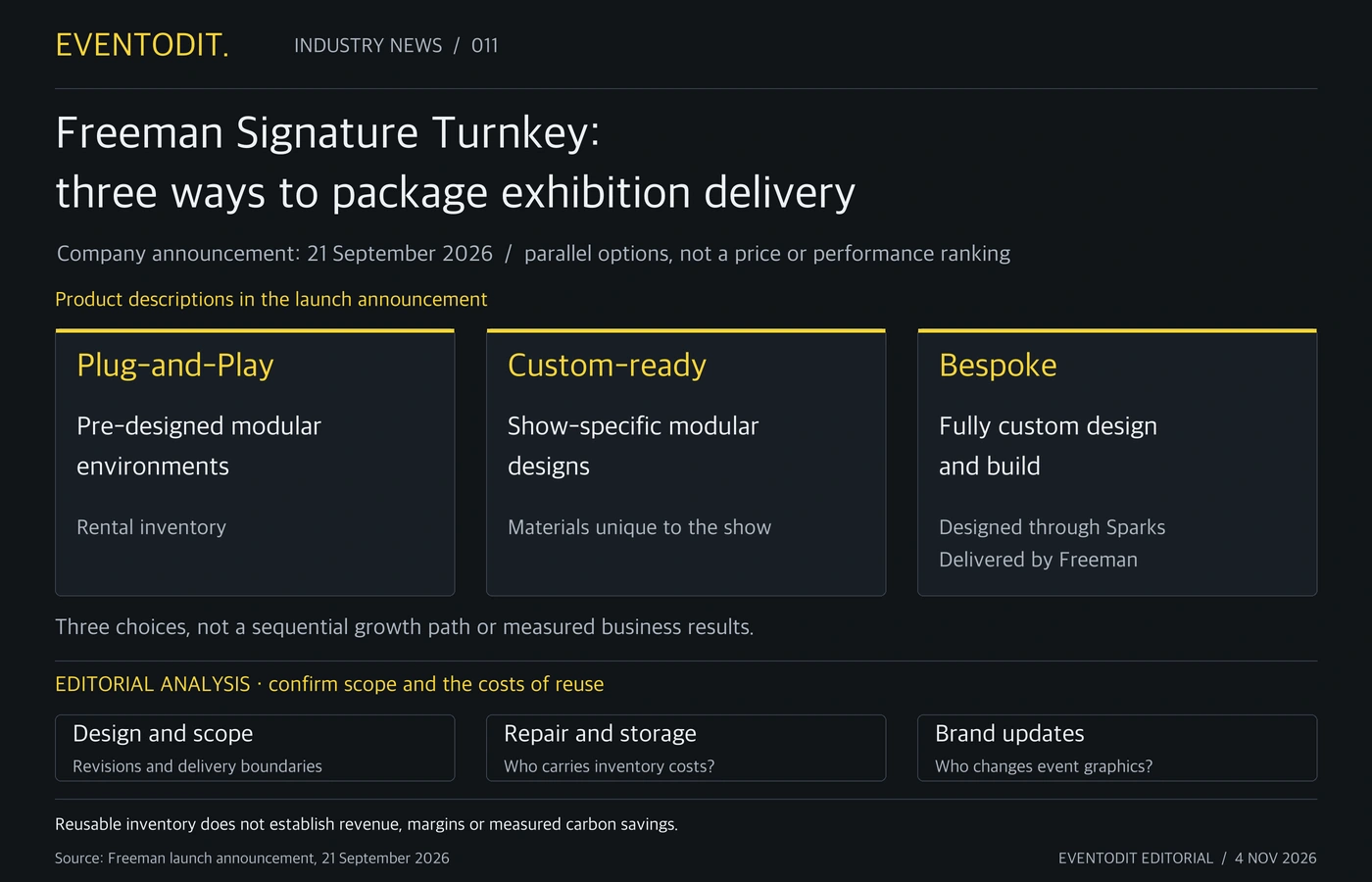
Turn a one-off booth build into a product family
Freeman introduced three ways for organisers and corporate event marketers to configure exhibition spaces for exhibitors and sponsors. The company says it manages planning, design, installation and dismantling, allowing organisers to offer completed environments without having to design them separately.
The editorial team sees a change in the unit being sold, rather than simply the shape of the booth. If organisers set an event’s overall design direction and prepare configurations that exhibitors and sponsors can choose from, suppliers maintain a product family instead of producing a new quotation for every drawing. Deciding what can repeat and where fresh design begins becomes part of the business.
This is an analysis of a launch announcement. Creating a product does not secure repeat orders, and using reusable materials does not automatically reduce costs.
The three options create different revision work
| Product | Announced design approach | Business conditions for suppliers to examine |
|---|---|---|
| Plug-and-Play | Predesigned modular environments and reusable rental inventory | Where should the boundary lie between a repeatable base configuration and requested changes? |
| Custom-ready | Modular designs and dedicated materials tailored to the event | Who pays for adapting a design created for one event to its next edition? |
| Bespoke | Fully custom design and fabrication, premium materials, sponsor strategies and special activities | How should the staffing and costs of new design and onsite changes be included in the quotation? |
These are choices for different purchasing objectives, brand expression and degrees of change. Customers do not have to move through them in sequence. Suppliers can also explain repeatable configurations separately from additional development, without treating every order as custom production.
Read package prices alongside their scope
Comparing prices by a fixed product name alone can miss important differences. Equal booth areas do not represent equal products when the inclusions for structures, graphics, electricity, transport and onsite labour differ. Treating every request beyond the standard configuration as a free service can separate the agreed price from the actual delivery work.
The base configuration, permitted revisions and items requiring separate orders therefore need to be presented consistently in sales explanations and quotations. Customers can then compare which product includes their requests, rather than simply choosing an inexpensive picture.
Repeat sales still carry costs between bookings
A supplier operating reusable inventory must cover storage, inspection, repairs and preparation for the next order as well as installation. Even the same structure needs further preparation if its graphics, brand colours or connecting parts change. Reusability alone cannot establish the profitability of repeated delivery; the frequency of actual bookings also matters.
Orders concentrated on the same dates cannot be served by rotating the same inventory. The time needed to transport items to another region and bring them back also reduces their available selling period. Suppliers need to distinguish stock in the warehouse from stock they can promise to customers.
The announcement does not disclose inventory ownership, storage and repair costs, or payback periods. Korean businesses considering similar products need to use their own booking, revision and repair records to judge the supply commitments they can handle.
A single sales channel still needs specific design and delivery responsibilities
Bespoke was introduced as designed by Sparks and delivered by Freeman. This structure sells design and execution through a single channel. Offering one customer-facing channel also requires the coordination needed to connect partners’ proposals with the work actually performed.
When organisers, designers and builders develop a product together, they need to decide who receives revision requests, which changes trigger additional design fees and what support will be provided onsite. Reusing a drawing and adapting it for a new sponsor’s brand are different tasks. Usage rights and revision fees must be explicit in the contract before income from repeat supply can be shared.
The announcement does not disclose the two companies’ internal allocation or contract-specific rights. It can therefore be viewed as an example of joint product development, without establishing a particular revenue split or transfer of design ownership.
Read environmental descriptions alongside the product scope
Freeman says it uses reusable inventory and environmentally friendly materials, and describes Plug-and-Play designs as Better Stands Silver certified. This is information supplied by the company; the certification was not independently checked for this article. It should not be extended to Custom-ready, Bespoke or the entire event.
Proposals using environmental descriptions need to make clear which products and elements they cover. Environmental performance information and the scope and costs of the product a customer buys require different supporting evidence.
Define what the business can repeatedly take responsibility for
This is a launch announcement from a US supplier. Availability in Korea, eligible exhibition venues, prices and contract conditions were not established.
Korean suppliers do not need to develop every product from scratch. They can start with configurations that receive repeat enquiries and distinguish changes customers can request from work requiring fresh design. Sales, design and production staff need to explain the same product consistently, and time must be available to manage inventory and revisions.
Freeman’s three options illustrate how standardisation and custom production can be sold together. Whether this can be sustained as a business depends on the prospect of the next order and the cost of maintaining staff, inventory and information until it arrives. Defining repeatable work and work requiring fresh payment in advance turns turnkey convenience into a commitment the supplier can handle.
Conditions for applying this to other events
This article analyses US supplier Freeman’s September 21, 2026 announcement launching Signature Turnkey Solutions. The certification and environmentally friendly materials mentioned in the announcement are treated as the company’s statements and do not automatically apply to other products or events.
Unconfirmed information
Prices, contract terms and sales for the three products, inventory ownership and operating costs, utilisation, payback periods and availability in Korea were not checked. Certificates, carbon-emission reductions and customer outcomes were not independently verified either.
Reference material
Have a correction or additional evidence? Request a correction