Three things to know first
First, these are 2025 records. They describe exhibitions that actually took place last year, rather than orders won in 2026 or a forecast for next year.
Second, they do not cover all of Europe. UFI estimates that the data cover around half of the European exhibition market. With the other half missing, a country or exhibition absent from the report must not be treated as having no demand.
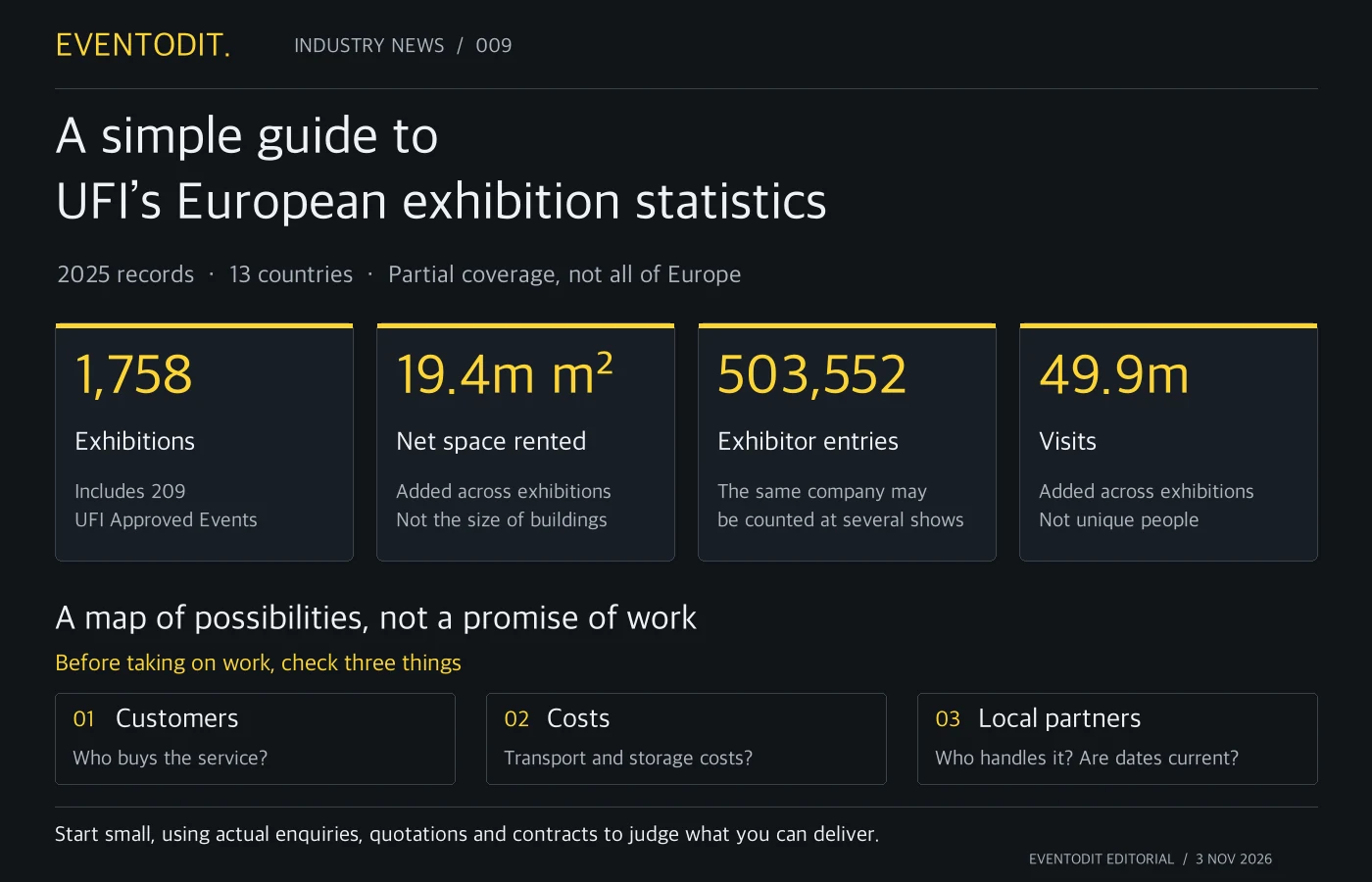
Third, each figure means something different. The main figures are:
- 1,758 exhibitions, including 209 UFI Approved Events
- 19.4 million m² of exhibition space rented in total
- 503,552 exhibiting companies in total
- 49.9 million visits in total
The figure of roughly 500,000 exhibiting companies does not mean 500,000 different companies worldwide. If the same company exhibited at several events, it is counted several times.
Rented space means the total area let across exhibitions
The 19.4 million m² figure adds up the space rented at each exhibition. It is not the size of the land or buildings owned by exhibition venues. If several events take place at the same venue, that space is counted several times.
This figure alone should therefore not lead to a decision to buy more storage space or equipment. A large total means there was substantial exhibition activity. It does not mean our company will win that much work.
What can the data be used for?
They can provide a useful starting point. For example, they can help frame questions such as:
- Which cities regularly host exhibitions in fields where our company has expertise?
- Who is the main audience at an exhibition? Does it attract trade buyers or the general public?
- Who pays for services at the exhibition: the organiser, an exhibitor or an agency?
At exhibitions focused on trade buyers, interpreting and support for business meetings are important. At events focused on the general public, information services and hands-on activities matter. Even within the European exhibition market, different events need different services.
What to check before taking on overseas work
Providing services at European exhibitions requires more preparation than it may first appear.
- Transport and storage costs: Sending equipment overseas and storing it locally costs money.
- Local partners: If work is shared with a local supplier, decide who receives client requests and who resolves problems onsite.
- Event dates and conditions: An event held in 2025 will not necessarily take place on the same dates or under the same conditions in 2027. Check the latest schedule directly.
How to start small
It is better to start with small questions than a broad goal such as entering Europe.
- Can we help with local installation at one exhibition attended by an existing client?
- Can we supply equipment and staff to recurring exhibitions in a particular city?
- Can we help Korean exhibitors organise their materials before an overseas exhibition?
Each option requires different people, time and costs. The better choice should be based on our company’s actual enquiries, quotations and contracts, rather than these statistics.
The takeaway
UFI’s data provide a map for exploring the European exhibition market. The map can point to promising places, but winning work there still requires separate checks on customers, costs and local partners.
Reference material
Have a correction or additional evidence? Request a correction