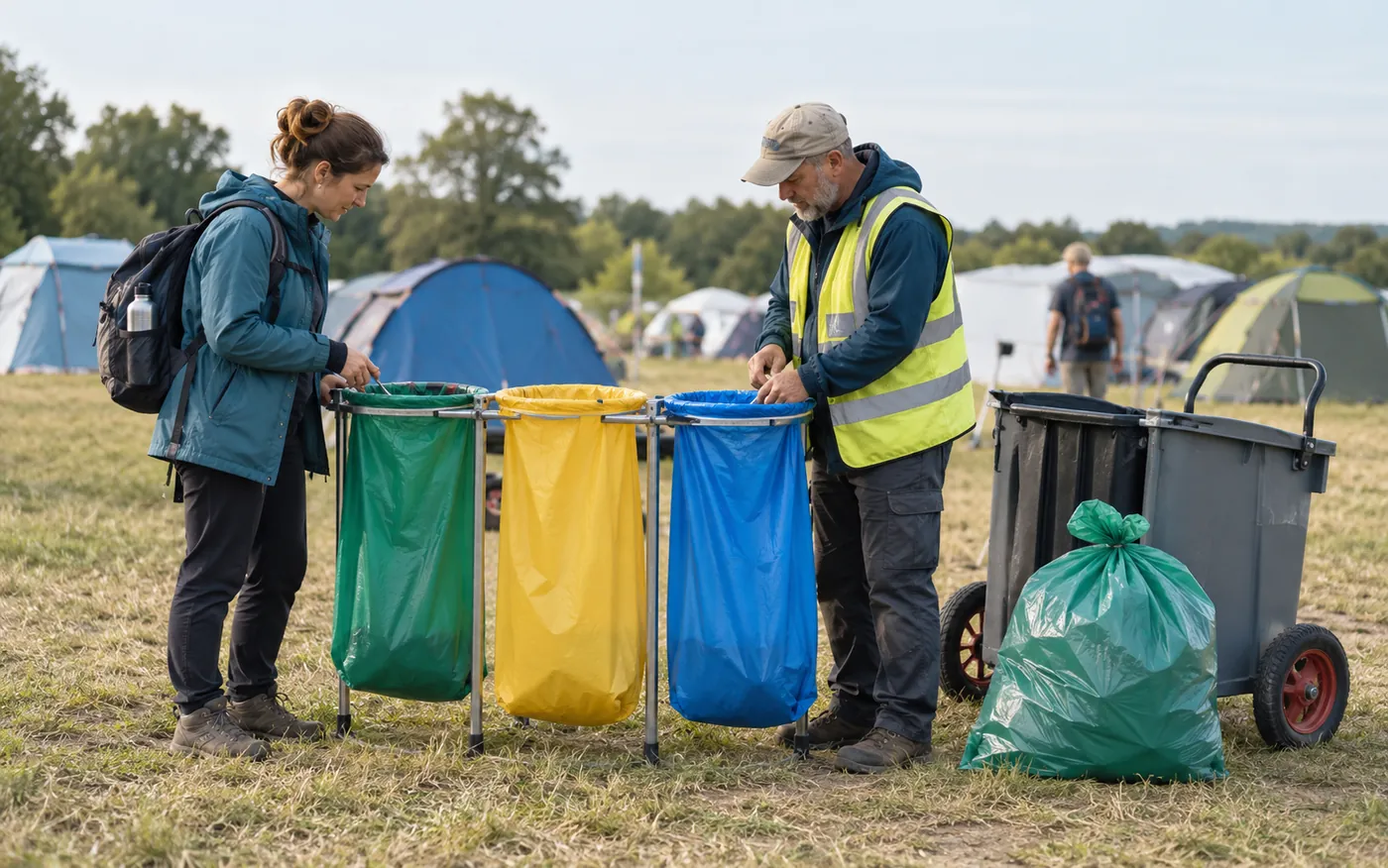
At a residential camping festival where tens of thousands eat, drink and camp, waste sorting is more than cleaning: it is core infrastructure directly connecting site safety and ESG performance. Roskilde Festival 2025 distributed four carefully designed types of sorting bags so visitors could separate metal, glass, plastic and other waste themselves. Yet field research found that this excellent design lost its function the moment a bag was tied to a tent pole.
For a professional event planner, the case reveals the fatal gap between a 2D design proof on a computer monitor and the 3D physical state in which visitors actually use it on site (UX). Giving Sign-off based only on the design proof in a procurement order is the worst desk-bound administration, ignoring visitors’ actual behaviour.
1. Physical Distortion on site: "Bags are tied and filled"
The bag proof approved by the planning team was designed to look best when spread completely flat. In the campsite, however, visitors did not put bags on the ground: they tied their tops to tent poles or nearby posts.
- The betrayal of the design proof: tying the bag’s opening rolled its most important upper text and sorting pictograms into folds, concealing them completely. Moreover, a label printed on only one side left nothing but a blank back visible when the bag turned in the wind.
- Validate use conditions in three dimensions: before delivery, planners must obtain a sample Mock-up and carry out a three-stage Stress Test: [hang it on the actual holder → fill it 100% with rubbish, such as bulky PET bottles → tie it to a pole]. Print area must be calculated not as a flat plane, but as the surface of a crumpled, swelling sphere.
2. The collision between audience Logistics and loading Capacity
A waste-sorting policy succeeds or fails on whether visitors can carry heavy bags themselves from their tents to the disposal point.
- The limits of weight and Portability: oversized bags are left unemptied for days, causing odours and pests. When full, they become so heavy that handles tear or visitors give up carrying them. This directly causes illegal dumping in the camping area. Planners must design the bag’s appropriate volume in litres and load-bearing capacity in relation to the maximum distance visitors can walk, normally within 100 m.
3. Prevent misreading the Metric: "The real reason behind 22% recycling"
The organiser announced that 22% of all waste was recycled, but field researchers Behave Green found qualitative data showing people could not sort waste because the instructions were not visible.
- Combine quantitative and qualitative data: the result of 22% recycling alone cannot reveal the problem’s cause. To establish whether it came from hundreds of cleaning staff working extra hard, or recyclable materials being stuffed into general bins because bag supplies ran out, supporting data must include on-site Walk-through records observing waste volumes and disposal behaviour camp by camp.
4. A four-stage procurement protocol for on-site UX supplies
When commissioning information materials or consumables that visitors use and handle themselves, the planning team must follow these four-stage criteria.
| Stage | Work criteria |
|---|---|
| [Stage 1: A 3D Mock-up rehearsal] | Prohibit approval of a 2D proof on screen. Make a sample in the actual delivery material and test visibility in conditions matching the site, including outdoors, wind and tying it to a pole. |
| [Stage 2: Apply Multi-angle Printing] | Require double-sided or repeated four-sided printing on Flexible materials that may blow or crumple, such as bags, banners and flags, so instructions remain visible from every angle. |
| [Stage 3: Map carrying and replacement Turnaround routes] | Mark on the route plan the walk carrying a full rubbish bag to the sorting point and the location of additional supply points for new bags, making them recognizable with pictograms. |
| [Stage 4: Pinpoint field monitoring] | During the event, staff must look beyond whether bins are full and identify specific bottleneck locations where visitors misread guidance and put in the wrong waste, recording data to improve next year’s production designs. |
A planner’s note: perfect design is proved in the mud on site
A design proof spread flat on an office desk under fluorescent lights is always perfect. Its true performance is tested only when it reaches visitors’ rough hands amid driving rain, wind and dust in the middle of a festival.
A planner’s gaze must not remain on the designer’s Illustrator screen. It takes persistence to imagine whether visitors approaching from a distance can read the lettering when the commissioned bag is tied to a pole and swollen tight with rubbish. Excellent UX that prevents on-site inconvenience begins with precisely that desperate imagination.
Conditions for applying this elsewhere
For reviewing supplies used by participants who sort and transport their own waste at residential festivals.
Information not established
The 20-camp qualitative study does not establish festival-wide problem rates or each improvement’s contribution to recycling.
Reference material
- Behave Green / Roskilde Festival · 2025 camp waste-bag evaluation: methods pp. 7–13, operational changes pp. 14–17, usability pp. 29–35 (2025.8)
- Roskilde Festival Gruppen · Post-event 2025 environmental results: 1,760 tonnes of waste, 22% recycling, and original evaluation link
- Roskilde Festival · Resource and waste operations and 2025 results
Next tasks and related resources
Checks of labels, carrying and additional supply under actual installation conditions.
Related practical guides
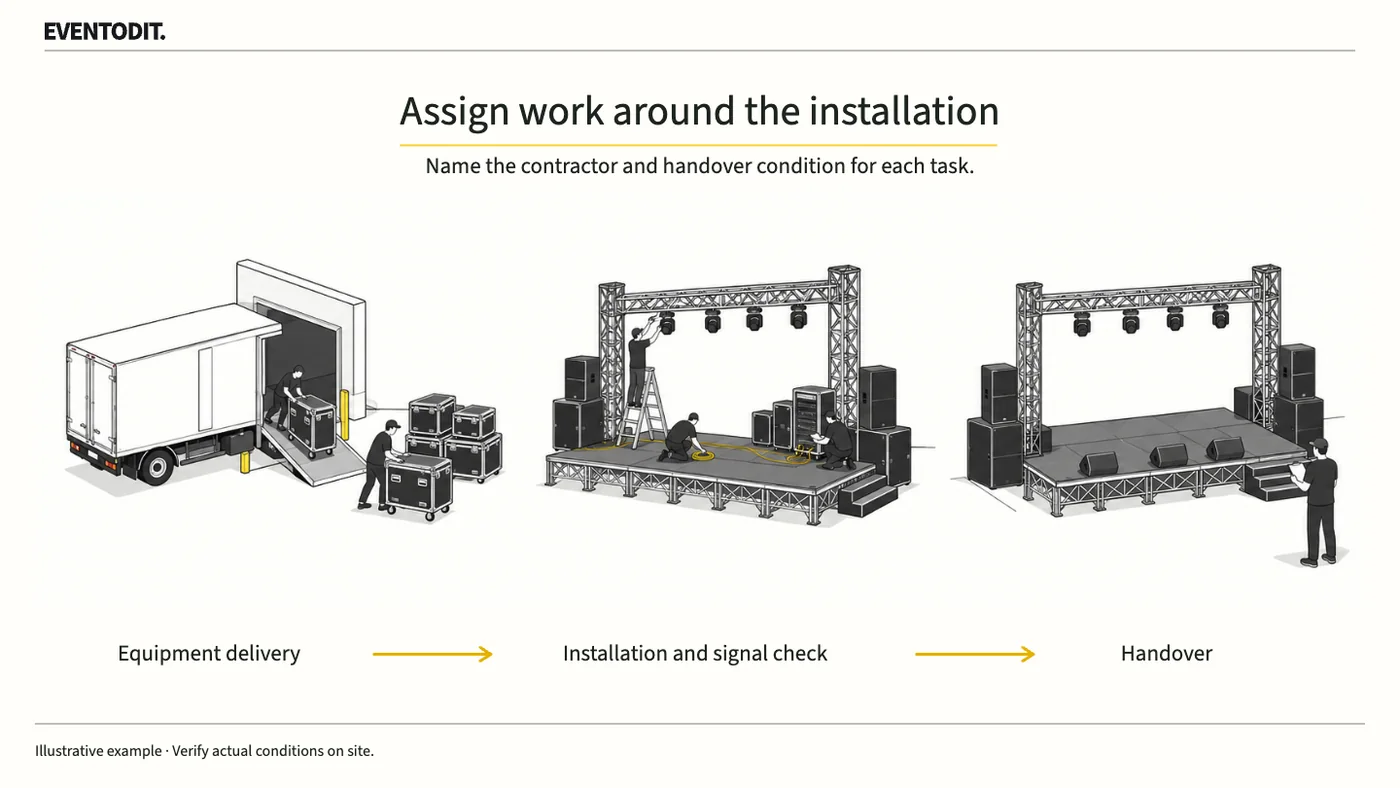
Event Equipment Procurement and Handover
“Equipment installation included” does not assign unloading, power connections, operation or removal. Name the contractor for each task and what they must hand to the next team to expose gaps and duplicate orders.
Read guideHave a correction or additional evidence? Request a correction