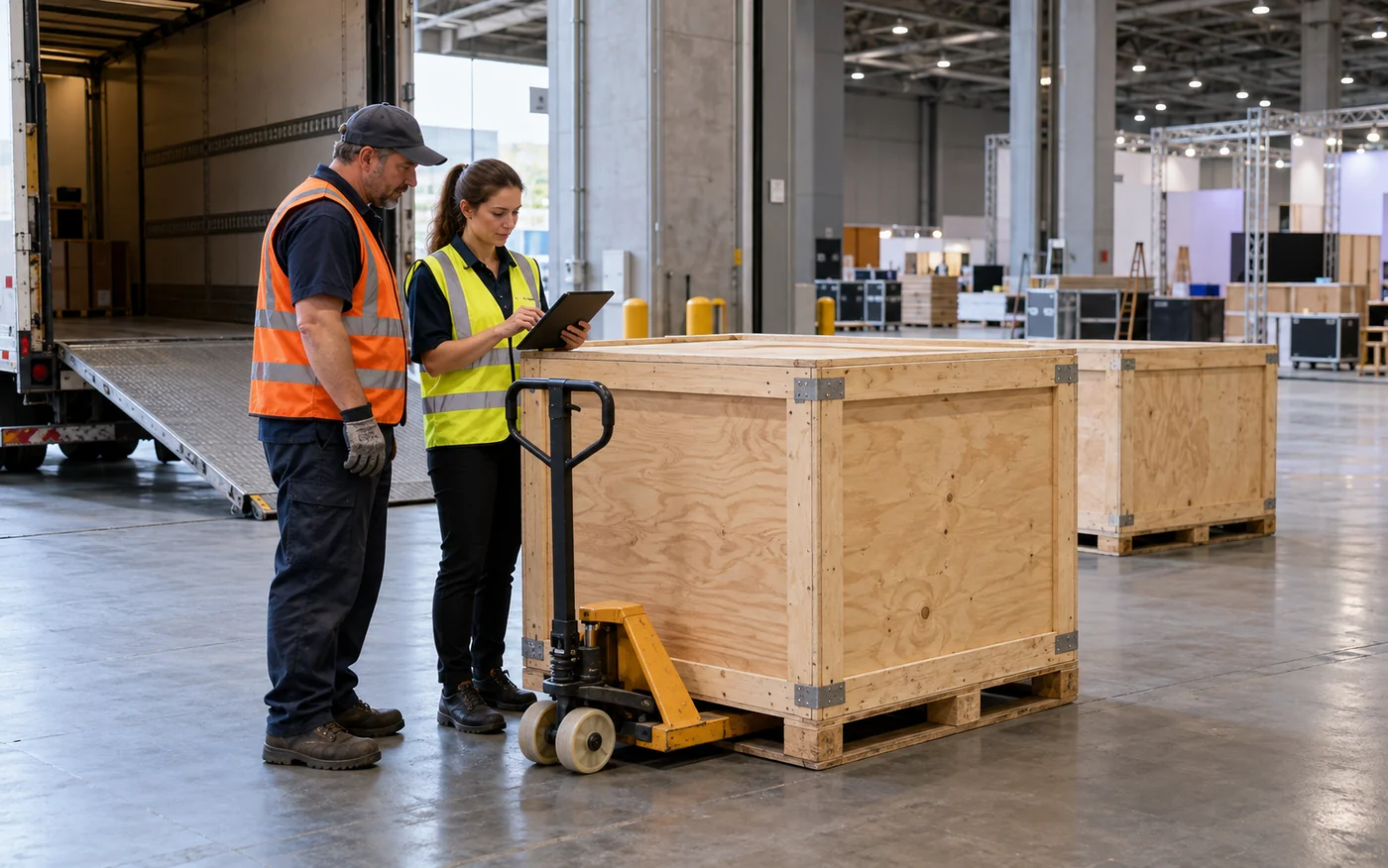
At a mega exhibition involving hundreds or thousands of companies, getting exhibitor freight into the venue through Inbound Logistics is close to warfare. RE+ 2026 in Anaheim, a major US energy exhibition, operated a manual separating two destinations for exhibition freight—Advance Warehouse intake and Direct to Show Site shipping—with strictly distinct deadlines and receiving conditions.
For the lead on-site planner, a Two-track logistics system splitting freight between two destinations is not simply an exhibitor convenience. It is sophisticated Back-end timeline design to disperse huge Bottlenecks at limited venue Loading Docks and control the extreme confusion of the first setup day.
1. The Advance Warehouse: a system that buys time with safety
Advance Warehouse shipping, sending freight ahead to a designated external logistics warehouse from a month before opening, is a core line of defence in exhibition logistics.
- The privilege of first-priority Move-in: when exhibitors deliver freight to the Advance Warehouse, the General Service Contractor stores it and places it at the booth first on the morning of the venue’s initial setup day. This gives the build team a powerful time advantage, allowing it to unpack equipment and start assembly as soon as it arrives.
- Respect Lead Times and deadlines: as in the RE+ case, Advance Warehouse intake reaches its Cut-off one to two weeks before the event begins. Planners must notify exhibitors in writing beforehand that missing this deadline can mean complete refusal of warehouse receipt or substantial Surcharges, preventing settlement disputes with the logistics contractor.
2. Direct-to-Site: avoid the hell of the Marshalling Yard
Heavy equipment or freight that missed Advance Warehouse intake must be shipped Direct-to-Site. The planner’s greatest concern here is the procession of trucks arriving without control.
- Target Move-in scheduling: letting freight trucks go straight to the venue address paralyses the loading dock within one hour. Good logistics planning distributes a target schedule dividing allowable arrival dates and times down to the minute according to booth size and position.
- Control the Marshalling Yard: large freight trucks cannot go directly to the dock. They must first register at a designated external Marshalling Yard and enter the dock only after a radio call. Planners must clearly hand exhibitors and drivers a Call-in Rule-set: direct shipments must pass through the Marshalling Yard, and trucks bypassing it for the dock will be turned away.
3. Hand-over responsibility: arrival and receipt are different words
A courier’s delivery-complete notification means nothing at an exhibition.
- Synchronize with the on-site build team: if Direct-to-Site freight reaches the loading dock while the booth’s construction contact or responsible manager is absent, the General Service Contractor will refuse to unload it or leave it stored with an additional charge. The planner must establish a disclaimer in the exhibitor manual: freight and build-team arrival times must be Synchronized, and the exhibitor is responsible for returned freight caused by an absent recipient.
4. A four-stage Move-in Logistics protocol for practitioners
To prevent logistics confusion across hundreds of booths, the organiser and General Service Contractor (GSC) must establish these four-stage criteria.
| Stage | Work criteria |
|---|---|
| [Stage 1: Distribute destination-specific Routing instructions] | Give exhibitors Shipping Label templates clearly separating the Advance Warehouse address, with intake closing one month beforehand, from the on-site loading-dock address open only during event setup. |
| [Stage 2: Confirm the Target Move-in plan] | Schedule truck entry from inner booths to outer booths and heavy freight to light freight, controlling Marshalling Yard access when the timetable is breached. |
| [Stage 3: Communicate Material Handling rules] | Make clear the Drayage fee system for forklift movement from dock to booth, and define small-freight limits for handcart use by weight in kilograms. |
| [Stage 4: Empty Container removal Rule-set] | Immediately activate storage labels for empty wooden crates and pallets after unpacking, preventing them being abandoned in corridors and securing construction Aisles. |
A planner’s note: the most perfect exhibition is decided at the unseen loading dock
Visitors see spectacular booths and neon signs. To create that spectacle, however, thousands of tonnes of freight, forklifts and tense workers play a giant game of Tetris at the loading docks behind the exhibition.
A planner’s passive assumption that people will bring the freight in somehow returns as a bill for overnight construction before opening and safety incidents. Control where, when and how freight enters by separating two destinations and establishing a precise timetable. An exhibition’s true spectacle is hidden not on stage, but in the meticulous Back-end work of coordinating logistics-truck dispatch intervals.
Conditions for applying this elsewhere
Apply where assigned move-in schedules and official handling scope can be verified.
Information not established
Exhibitor quantities, actual logistics costs, booth-specific target times and site delays were not verified.
Reference material
- RE+ · Exhibitor FAQ: advance warehouse, addresses, direct shipping, marshalling and material handling (checked 23 October 2026)
- RE+ · First Time Exhibitor Guide, file dated 8 September 2026, pp.4–6: late charges, carriers and move-out
- RE+ · Exhibit Rules & Regulations linked from official exhibitor page, pp.2–3: show dates and assigned move-in
Have a correction or additional evidence? Request a correction