
Donating furniture and fixtures to the local community after a major event has recently become an essential part of ESG planning. The Paris 2024 Olympics likewise launched a massive Reuse project after the Games, donating 54,000 items of furniture and 22,000 bedding items used in the athletes’ village to the anti-poverty organisation Emmaüs France.
From the lead on-site planner’s perspective, however, post-event donation is beautiful only in the plan. On site, it means a war of Reverse Logistics that is among the hardest things to control. The deadline for clearing the athletes’ village is immediately approaching, and if recipients’ warehouse Capacity cannot keep pace with tens of thousands of items, the organiser bears enormous penalties for delayed restoration of the site.
The Paris Olympic Village’s load-out deadline was just eight weeks. By contrast, recipient organisation BSE’s distribution of furniture to vulnerable people was designed to take two years.
- Secure Buffer warehouses as a necessity: when the event’s load-out speed does not match the recipient’s distribution rate, load-out trucks cannot leave the venue without an enormous intermediate store into which goods can temporarily be unloaded. The Paris Olympics logistics team’s separate operation of three shared regional logistics hubs was a survival strategy to bridge precisely this Time-gap.
- Assign responsibility for long-term storage costs: outside warehouse rent and management costs arising because a recipient cannot accept goods immediately are not solved by goodwill. When budgeting, the planner must consult recipients and explicitly confirm who pays to store surplus stock long term.
Mattresses and sofas just removed from an event are never ready for immediate reuse. They carry sweat and contaminants from countless people.
- Set up the Refurbish process: note that Ecomaison, leading the donation programme, separately provided steam cleaners and sorting workbenches. Donated goods must pass through a huge production process: [unloading → sorting by damage → cleaning and cover removal → repacking].
- Prevent the risk of Rejected receipt: indiscriminately pushing heavily contaminated or irreparably damaged goods onto recipients hits them with a cost bomb for industrial-waste disposal. Specialist Triage staff must remain at the load-out desk, filtering goods for on-site disposal from those to be sent to recipients.
The Paris Olympics donation logistics mix unlike data: 420 planned vehicles and 230 trailers actually deployed.
- Manage two separate data streams: do not count a donation as complete merely because a loaded truck has left the venue. Record the organiser’s on-site Dispatch quantities separately from the recipient warehouse’s finally inspected and accepted Sign-off quantities, allowing Loss and damage during transport to be traced.
When planning load-out that donates one-off fixtures or furniture to third parties, the working team must follow these four-stage criteria.
| Stage | Work criteria |
|---|---|
| [Stage 1: Verify receiving Capacity in advance] | Measure how many vehicles the recipient can unload daily and how many pallets it can store, and contract an intermediate Buffer warehouse for use when limits are exceeded. |
| [Stage 2: Agree R&R and cost responsibility] | Confirm in writing whether the organiser or donation recipient pays for transport, cleaning/refurbishment and final disposal of damaged goods. |
| [Stage 3: On-site Triage] | Station inspectors at the venue’s load-out gate and separate freight before loading into Grade A for immediate donation, Grade B for donation after repair and Grade C for immediate on-site disposal. |
| [Stage 4: Issue Double-checked receipt documents] | Cross-check the venue’s outbound Delivery Order against the recipient warehouse’s incoming Receipt, confirm there are no discrepancies and then close settlement. |
Sending usable fixtures to neighbours rather than a rubbish dump after an event is the most beautiful decision a planner can make. But to make that decision real, the planner must reach for a calculator before writing a moving press release.
Warehouse area, steam-cleaner power, the unloading speed of an 11-tonne truck and the price of waste-disposal stickers: only when these cold, dry logistics numbers are perfectly controlled can the planner’s goodwill finally reach its next destination bearing the label donation.
Conditions for applying this elsewhere
When donating purchased equipment or authorised items to third parties after an event.
Information not established
The published 420-vehicle plan and 230-vehicle result cover unmatched transport scopes, so no completion rate can be calculated. Korean cost, tax and legal conditions need separate checking.
Reference material
- Ecomaison · Post-event Paris 2024 reuse case: 8 weeks, 230 semi-trailers, 112 organisations, sorting/refurbishment support (updated 2026.2.4)
- Emmaüs Défi · 2024 Activity Report, pp. 5 and 10: approximately 400 tonnes and 2,500 pallets received from the village
- CMA CGM Foundation · Donation logistics plan: regional hubs, separate BSE allocation and phased supply matched to warehouse capacity
Next tasks and related resources
Item-level receiving conditions, storage responsibility and dispatch/receipt records.
Related practical guides
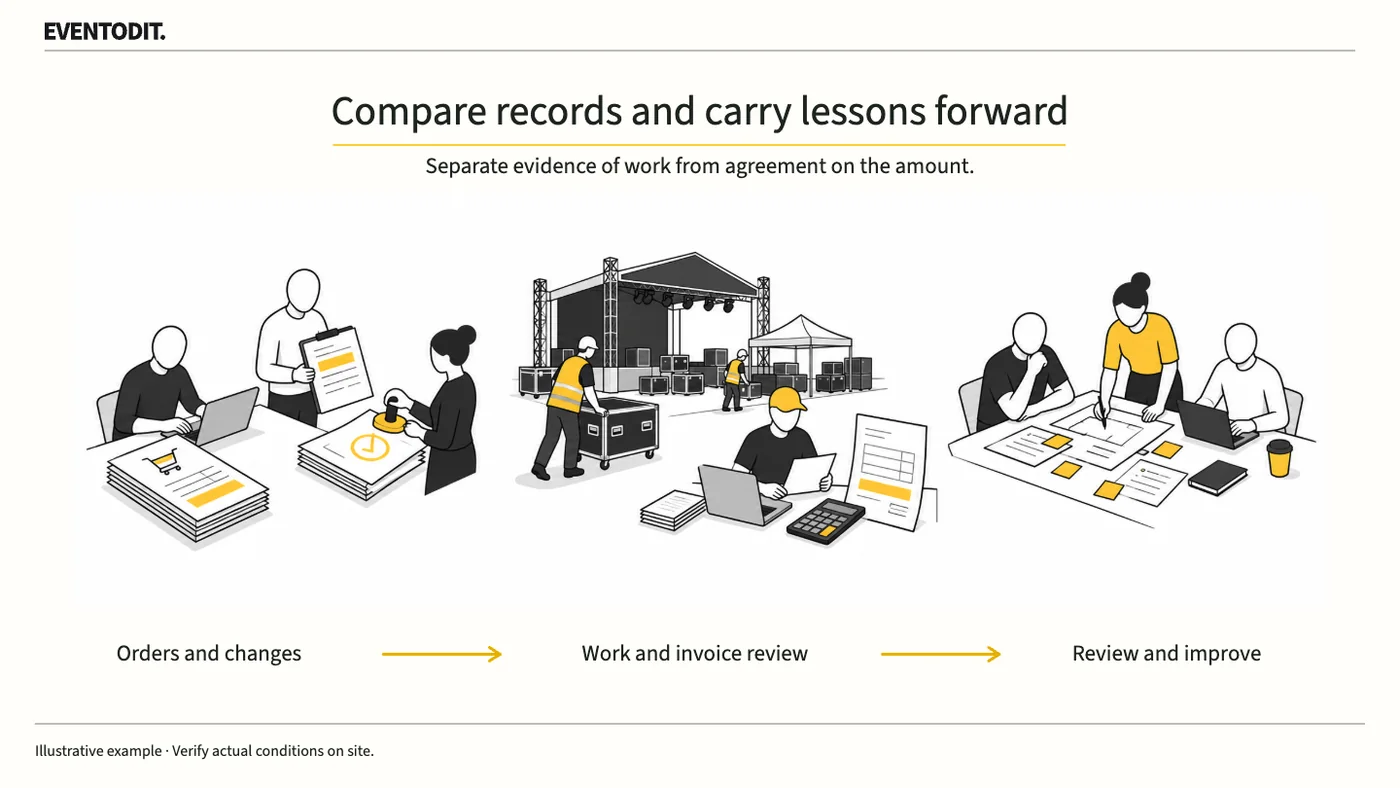
Event Settlement and Operational Debrief
If a supplier’s bill has increased, establish what changed and who approved it. Compare delivery records with the charge, then record changes needed in the next brief as separate debrief actions.
Read guide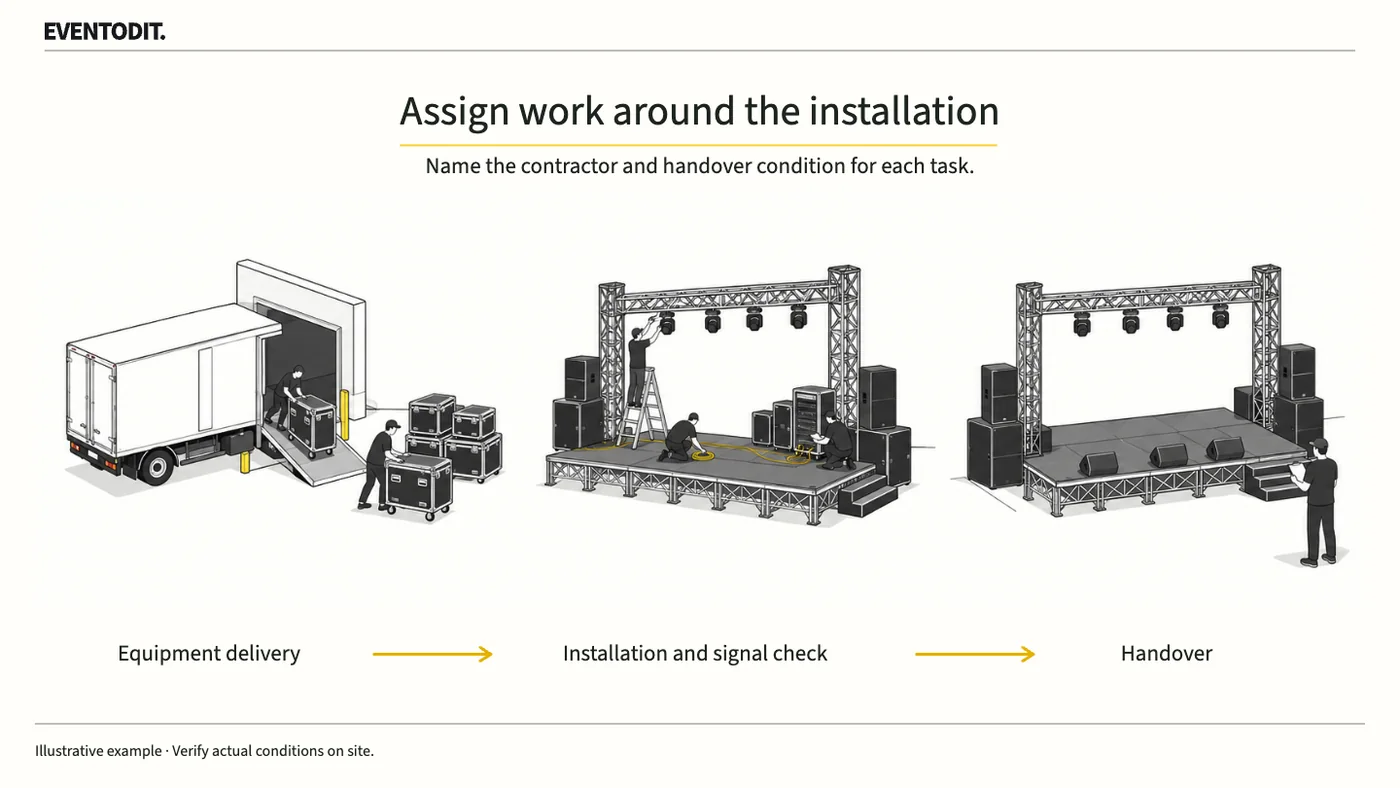
Event Equipment Procurement and Handover
“Equipment installation included” does not assign unloading, power connections, operation or removal. Name the contractor for each task and what they must hand to the next team to expose gaps and duplicate orders.
Read guideHave a correction or additional evidence? Request a correction