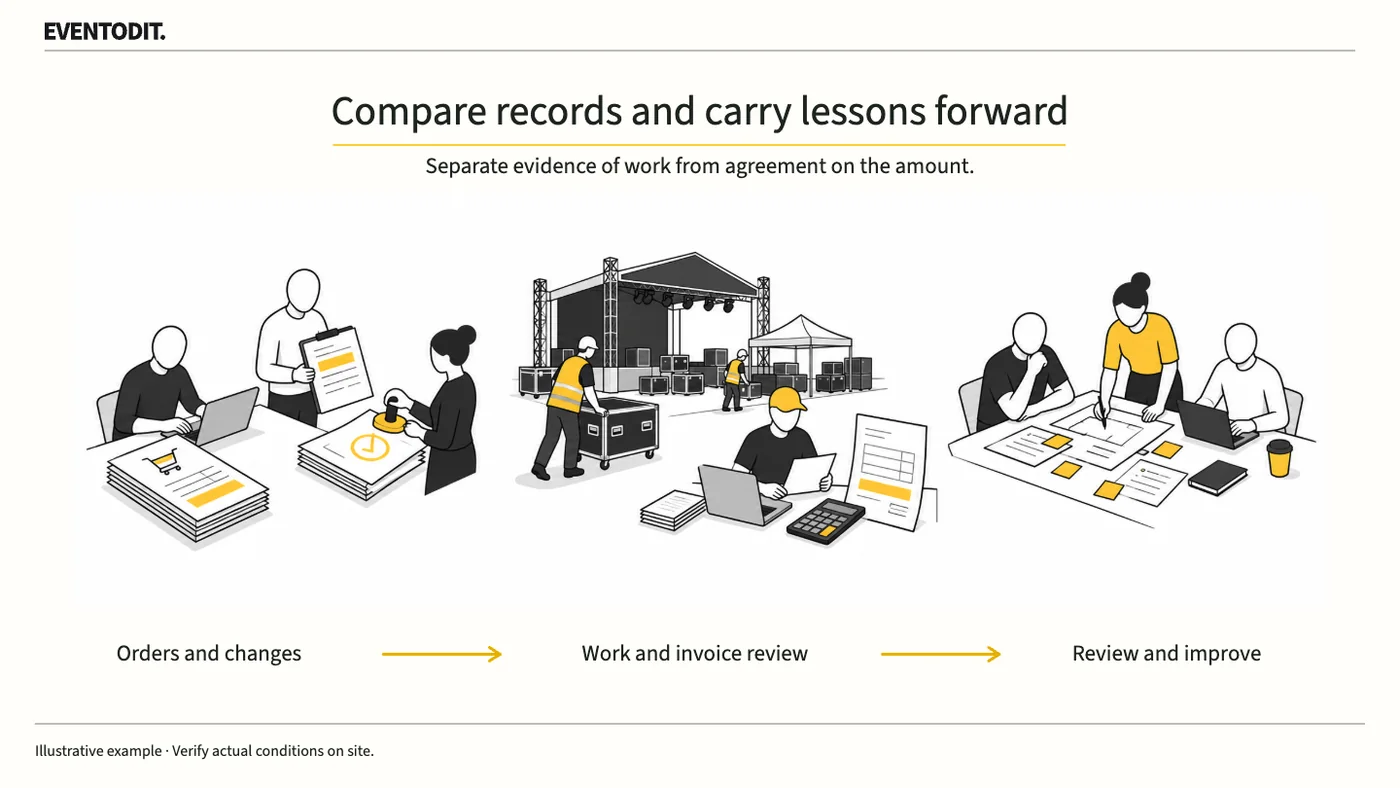
Part 1. Planning and Procurement Lead
"Do more than match the total: trace change approvals and the causes of additional costs."
- Compare work performed for each order item: Matching a supplier's invoice total to the budget does not reveal which specific work increased. Place the work originally ordered, changes approved along the way, and work actually performed on site alongside the invoice items and compare them.
- Identify the causes of additional costs: If additional costs arise, do not record only the fact that costs increased. Classify the causes, such as increased quantities, extended operating hours, specification changes, or omissions from the original scope, so the next request for quotation can avoid unfavourable conditions.
- Separate verification on site from agreement on the amount: A site representative confirming that a supplier actually performed the work is different from an authorised contract representative agreeing to pay the invoiced amount. Clearly distinguish the two responsibilities and procedures.
Part 2. Settlement and Finance
"Classify unsupported charges as unconfirmed; do not erase or overwrite them arbitrarily."
- Separate and hold unconfirmed costs: Do not arbitrarily erase a charge to zero or mix it with confirmed amounts when there is no prior approval record or the supplier and client dispute the scope performed. Clearly mark it as unconfirmed or under discussion, and assign a person and deadline for verification.
- Manage each status separately: Do not combine the stages of settlement. Record and manage invoice receipt, completed verification of performance and supporting evidence, and actual payment as distinct statuses in the settlement sheet.
- Share sensitive data according to authority: Settlement evidence may contain suppliers' sensitive unit prices or personal information. Do not distribute original records indiscriminately; restrict sharing to the authorised approvers who need them.
Part 3. Debrief and Operations Lead
"A debrief is not price bargaining. Specify exactly which documents must change for the next event."
- Separate accountability disputes from the operational debrief: Keep settlement discussions about reducing the amount or assigning blame separate from an after-action review (AAR) intended to improve the next execution. Turning the debrief into a negotiation makes it difficult to uncover real operational problems and improvements.
- Assign specific improvement actions: When a debrief identifies a problem, avoid vague promises such as improving communication. Specify who will change which field in which document and by when, so implementation can be checked.
- Track agreement and improvement completion separately: Reaching a payment agreement with a supplier does not automatically complete the purchasing-form improvements identified in the debrief. At the next event planning meeting, verify that the improvements agreed in the previous review have actually been applied to the documents.
- Compare orders and changesCheck original scope, approved changes and actual work
- Examine differences and causesCompare evidence and accounts; separate unknowns
- Choose improvement actionsAssign owner, deadline, document change and verification
- Verify next executionCheck application and results in the next quotation and order
Keep payment and contractual disputes separate from the debrief and follow authorised procedures.
Final check before use: After the event and before closing payment and settlement, check that comparisons between the order and actual invoices, as well as improvement actions for the next event, have all been recorded.
Conditions for applying this elsewhere
Confirm access to contracts, orders, change approvals, acceptance and invoices first. Follow organisational rules and applicable law for payment, tax and retention.
Information not established
Individual payment requirements, tax treatment and settlement amounts have not been verified. The debrief study's average effect cannot become an event cost-saving rate.
Reference material
- World Bank — Contract Management: General Principles (2017), printed page 17: comparing contracts, approved supporting evidence and actual delivery before payment. Not Korean tax or contract rules.
- Tannenbaum and Cerasoli (2013) — Do Team and Individual Debriefs Enhance Performance? A Meta-Analysis. Human Factors 55(1), 231–245; DOI 10.1177/0018720812448394. Public abstract and full text reviewed.
Have a correction or additional evidence? Request a correction