Part 1. Planning and Safety Lead
"Cumulative visits differ from current occupancy and cannot serve as a safety indicator."
- Define what each count measures: Clearly specify whether gate figures represent the total number of visits over the event, unique people with duplicates removed, or a count that includes staff and performers.
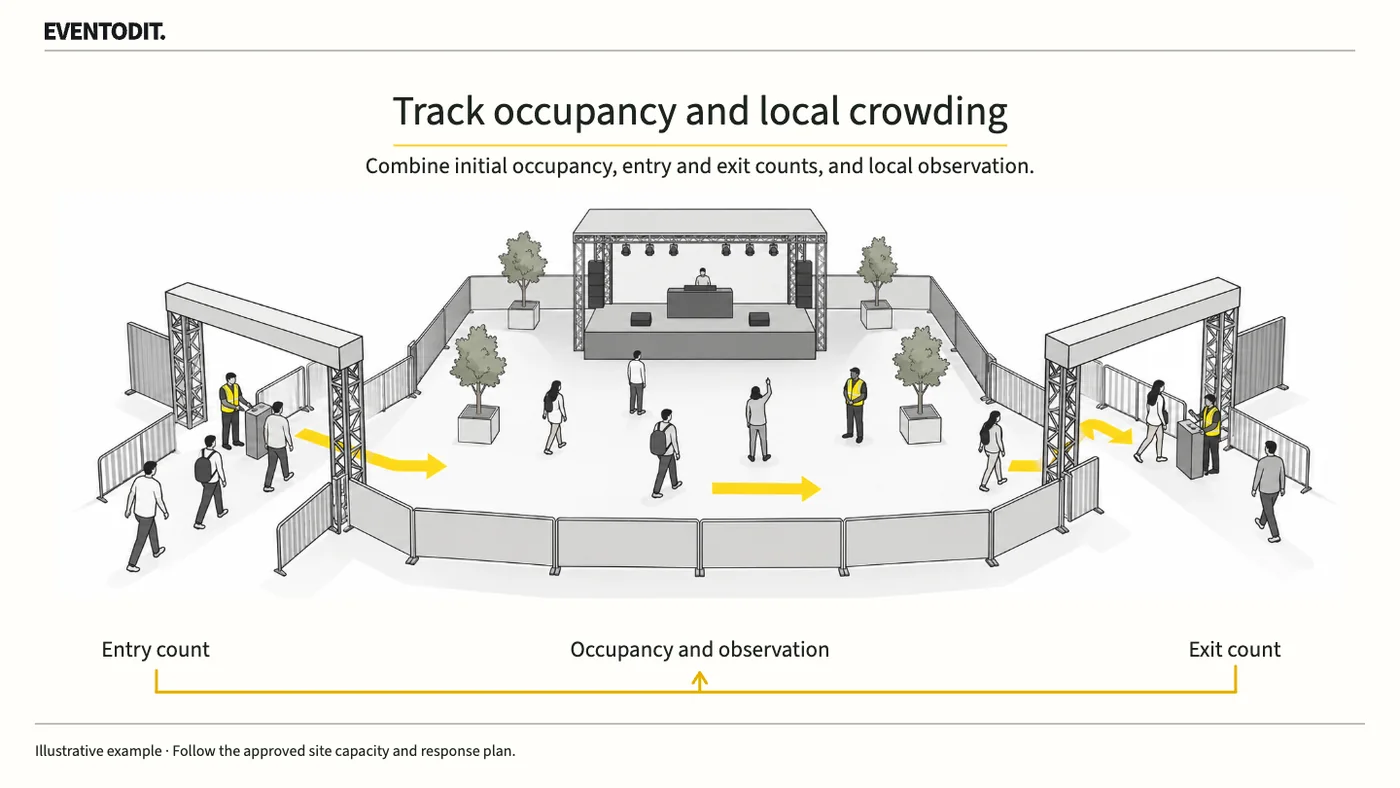
- Establish a method for estimating current occupancy: Count entries and exits at every access point concurrently and on the same basis to estimate how many people remain inside the venue.
- Do not invent estimates for gaps in counting: If exits at a gate are missed or a bypass opens and creates an error, do not report an old figure as current or enter zero for an uncounted area. Do not add uncertain figures together to create false precision.
Part 2. Control Room and Integrated Monitoring
"Bring gate counts and observations from inside the venue together on one monitor."
- Cross-check entry and exit counts against zone observations: Even when overall attendance appears to leave capacity, people may concentrate in a popular area and create local overcrowding. Cross-check numerical data with patrol reports to identify blind spots.
- Recheck conditions after action: If you take action such as slowing admission to reduce density in an area, do not stop at issuing the instruction. Record when and where it was applied and obtain a further on-site report on whether congestion has actually eased.
- Intervene immediately when communications or observation fail: If a zone falls outside CCTV coverage or a patrol officer's radio communication fails, dispatch staff as a priority to close the observation gap. Do not assume what is happening outside the camera view.
Scroll sideways if needed to compare the branches.
- Entry and exit countsScope, time, starting number, entries, exits and omissions
- Zone observationsDrawing ID, blockages, movement direction and help requests
- Venue and operating statusPassage, entrance and programme changes
- Control-room comparisonCheck timing differences, reporting gaps and local congestion
- Authorised response decisionApply site reporting, admission adjustment and support procedures
- Recheck after actionReport owner, action time and changed site conditions
Set reporting intervals and response criteria in the site safety plan. This diagram does not specify capacity or density limits.
Part 3. Zone and Patrol Staff
"Rather than reporting vaguely that it is crowded, identify where and which movement is blocked."
- Report the precise location of a bottleneck: Mark on the plan exactly where local overcrowding is occurring, such as in front of a stage, at the entrance to a popular activity booth, on stairs or in a narrow passage. Instead of simply reporting congestion, specify the direction and cause, for example that movement toward an exit in a particular passage is blocked.
- Report obstructions to movement immediately: Immediately inform the control room and request authority to intervene if stored items obstruct audience routes or if overcrowding leaves an attendee in urgent need of help.
- Record areas of recurring congestion: After the event, mark on the plan where counts were interrupted or congestion recurred. This record provides important evidence for improving staffing and routes at the next event.
Final check before use: Before the event begins, cross-check the safety reporting system and confirm that on-site staff understand the approved capacity and density response plan.
Conditions for applying this elsewhere
Competent personnel judge against approved capacity, passages and response plans. First establish whether all movements can be counted in open zones.
Information not established
Site capacity, boundaries and counting errors have not been verified. This is not a congestion-prediction or automatic safety-assessment tool.
Reference material
- UK HSE — Monitor the crowd: total attendance and local distribution, combining entry and exit counts with observation. Not Korean capacity criteria.
- Helbing, Johansson and Al-Abideen (2007) — The Dynamics of Crowd Disasters: An Empirical Study. Open arXiv manuscript; DOI 10.1103/PhysRevE.75.046109. Analysis of 2006 Mina pilgrimage crowd video.
Have a correction or additional evidence? Request a correction