
The opening week of a major international film festival such as Busan International Film Festival (BIFF) runs on an extreme schedule, with up to five films shown in one auditorium each day without pause. To screen five 120-minute films and hold audience Q&A sessions (GV) as well, the time available between screenings is only around 20–30 minutes.
From a professional event planner’s perspective, five daily relay screenings succeed or fail not through the quality of the image on screen, but through control of the golden Turnaround window: moving 300 viewers out immediately after a screening and bringing the next 300 in. The planning team’s cue sheet must work backwards with the start of House Clearing as priority zero, rather than the film’s start time.
1. Control the lobby Bottleneck: prevent Cross Traffic tangling 600 people
An auditorium lobby is not designed to hold the previous screening’s departing audience and the next screening’s waiting audience simultaneously.
- Establish a One-way route: if the exit gate for 300 people pouring out overlaps with the entry gate where 300 are waiting, the lobby is paralysed in an instant. During the site survey, planners must open all auditorium emergency exits and rear passages to create a completely One-way system: entrants through the front main gate, departing visitors through the rear emergency gate.
- Physically isolate the ticketing Queue Line: strictly Zone waiting blocks with Tensa barriers or guide barriers so the next audience’s queue does not block lobby toilets or entrances to other auditoriums.
2. The Hard Stop rule: "Even a moving Q&A must stop for the timetable"
At a film festival, the biggest trigger for a collapsing timetable is a GV audience Q&A with directors and actors.
- The snowball of cumulative Delay: if the first screening’s Q&A runs 10 minutes late, carried away by the atmosphere, it causes the catastrophe of a fifth late-night screening delayed by 50 minutes or more. The on-site house manager (PM) must agree a written Hard Stop rule with the moderator on stage in advance.
- Hand over end Cut-off authority: provide visual cues through a prompter or timer at five minutes and one minute before the scheduled end, and explicitly authorize the on-site manager to force the session to finish by raising house lights or lowering microphone volume when time is exceeded.
3. Clearing and technical Reset: the invisible 15-minute battle
Immediately after the audience leaves, the auditorium becomes a Back-end worksite where rubbish collection and technical checks for the next screening happen simultaneously.
- Deploy Sweepers with divided duties: clearing a 300-seat auditorium within 15 minutes is impossible with a vague plan that ushers will clean when they have spare time. Assign separate Sweeper staff by zone, such as rows A–C and D–F, to collect rubbish and check lost property, resetting the seating mechanically.
- Check projection and subtitle Sync: while Clearing is under way, the projection booth must complete a Pre-run checking that the next screening’s DCP encryption key (KDM) is unlocked and live Subtitling is synchronized.
4. A four-stage Relay Screening operating protocol for practitioners
A planning team preparing repeated relay sessions must follow this four-stage on-site protocol.
| Stage | Actions |
|---|---|
| [Stage 1: Calculate the timeline backwards] | Subtract audience admission (15 minutes) + House Clearing (10 minutes) + spare Buffer (5 minutes) from the next screening’s start, and fix that time as the previous session’s absolute Hard Stop. |
| [Stage 2: Build routes that prevent Cross Traffic] | Physically separate entry and exit gates, and define a separate control line around the waiting audience’s dwell area in the lobby. |
| [Stage 3: Delegate on-site presenter authority (Sign-off)] | Delegate Cut-off authority to the house manager to end a session immediately if a GV or other accompanying programme runs late. |
| [Stage 4: Clearance and technical readiness signals] | Order the main gate opened only immediately after seating-cleaning completion and projection/sound/subtitle-system standby signals have been collected together on the radio channel. |
A planner’s note: a film festival’s real running time begins after the screen goes dark
The audience watches a 120-minute film in a darkened auditorium, but the practical planner’s clock runs most intensely from the moment the film ends and the screen goes dark.
What completes a five-screening daily programme is not a great film line-up, but a mechanical Turnaround system that seats the next audience without a single tangle amid the departing crowd. Leave the emotion to the screen. Planners must hold a radio and stopwatch and rigorously control lobby traffic.
Conditions for applying this elsewhere
For repeated use of the same auditorium where on-time starts and audience changeovers must be managed together.
Information not established
Occupancy, delays and next-entry times for added sessions, and their contribution to attendance growth, were not disclosed.
Reference material
Next tasks and related resources
Session screening, changeover and entry schedule with results.
Related practical guides
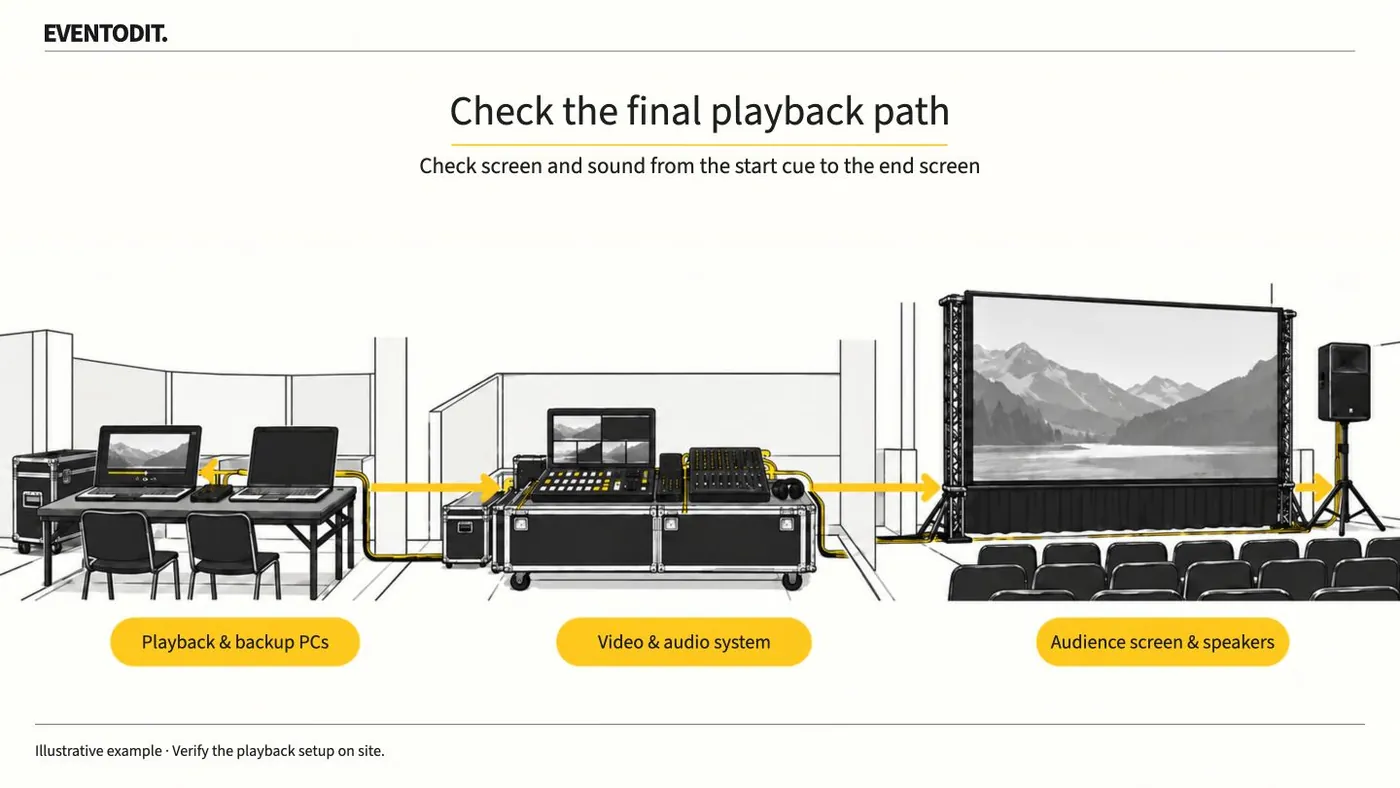
Event Video Acceptance and Playback
Play delivered video on the event PC and check the audience screens and speakers. Test from the start cue through the final screen change, then identify the file approved for playback.
Read guideHave a correction or additional evidence? Request a correction