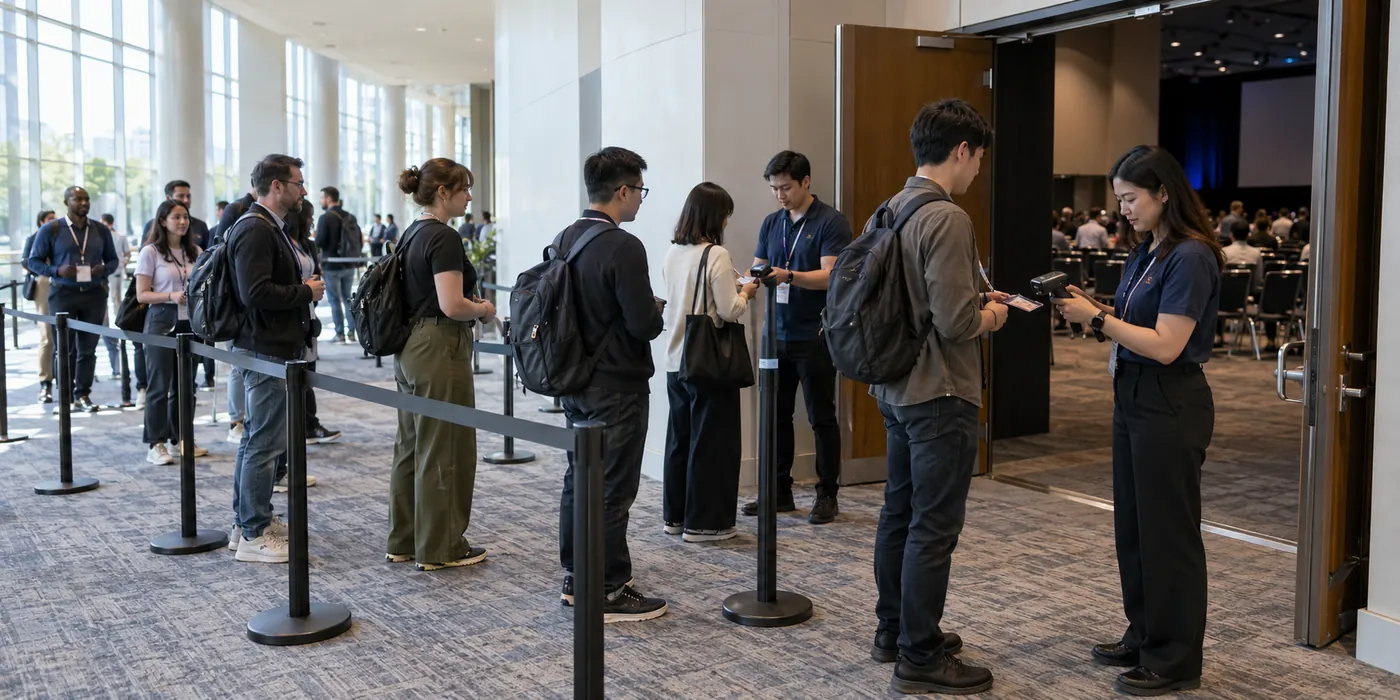
At large conventions and global conferences drawing tens of thousands, Session reservation systems are essential tools for reducing on-site congestion. New York Comic Con (NYCC) 2026 at New York’s Javits Center required Main Stage reservation holders to assemble 35 minutes before a panel began, and blocked consecutive bookings at system level when assembling was physically impossible, even if the sessions’ viewing times did not overlap.
For a professional planner directing the site, those 35 minutes are not simply waiting instructions. They are the result of meticulous system design working backwards from the golden Turnaround window needed to clear thousands of previous visitors from the hall, reset stage hardware and seat thousands of next-session visitors without delay.
1. Transit Time: code walking time into the reservation system
A visitor finishing a session on the first floor in Hall 1C must pass through escalator bottlenecks and security screening to attend the next session on the fifth-floor Empire Stage.
- Logic to prevent schedule Conflicts: Session A ending at 14:00 and Session B starting at 14:15 do not overlap on the timetable. But applying Session B’s assembly requirement of 35 minutes before the start means the visitor must reach the fifth floor by 13:40, making the two schedules physically incompatible. Before opening the Front-end reservation website, the planning team must code minimum travel Buffer rules into the back end so visitors cannot make multiple bookings for these impossible combinations.
- Measure Ground-truth: this Buffer cannot be measured using Google Maps Street View. During an on-site Dry-run, the planning team must walk from stage to stage and set assembly times from measured data including vertical travel, lift waits and bottlenecks.
2. Simultaneous stage and audience Turnaround: the risks of house clearing
House operations that Clear-out 100% of the audience after every session, as at the Main Stage, require tremendous on-site control.
- Control the intersection of audience exits and equipment load-in: while thousands of the previous panel’s audience pour out through the exits, microphone checks and presentation changes for the next speakers must happen backstage simultaneously. If visitor exit routes overlap with the technical crew’s working routes by even 1 m, a fatal safety incident or session delay occurs.
- Apply a Hard Stop when delayed: the previous session starting 10 minutes late does not mean it can finish 10 minutes late. To protect the Turnaround, the stage director must agree a written Hard Stop Rule-set beforehand that forcibly cuts the microphone at the scheduled time even for a speaker who started late.
3. Rule sets for No-shows and Stand-by seats
If reservation holders do not arrive 35 minutes early, when and how their empty places are released to Stand-by visitors is the most important rule for preventing a riot at the gate.
- A single Cut-off time: arbitrary judgements such as letting people into empty seats when it looks appropriate cause intense friction between house ushers and visitors. A clear Cut-off must be announced: at 10 minutes before the session starts, absent reservation holders are automatically cancelled as No-shows; after that, waiting visitors enter in groups of 10, only up to the counted number of remaining seats.
- Delegate on-site authority: a temporary part-time gate worker cannot decide to release remaining seats. Explicit final Sign-off authority must be given to the dedicated house manager (PM) for that gate, who can assess completed stage setup alongside reservation-holder counts.
4. A four-stage Turnaround & Queue protocol for practitioners
When operating sessions involving a large-scale hall Clear-out, follow this four-stage process.
| Stage | Actions |
|---|---|
| [Stage 1: Measure physical Transit Time] | Measure actual travel time between halls, including escalator waits, and apply it to reservation-system blocking logic that prevents incompatible bookings. |
| [Stage 2: House Clearance and technical checks] | Approve opening the main gate only after confirming 100% of the previous audience has left and the next speakers’ microphone/presentation stage setup is fully complete. |
| [Stage 3: Reservation-holder assembly and Cut-off] | Direct reservation holders to assemble 35 minutes early, and apply a clear Cut-off 10–15 minutes before the session begins to treat absentees as No-shows. |
| [Stage 4: Admit Stand-by visitors to remaining seats] | After the gate manager finally confirms the number of surplus seats created by No-shows, admit the on-site waiting queue safely inside the control line. |
A planner’s note: waiting time is breathing room in the plan, not waiting
The 35 minutes NYCC required of visitors are not the result of incompetent operations. They are a safety Buffer won by the organiser to present the next show as perfectly as possible.
Between the numbers 14:00 and 14:30 in the reservation system lie thousands of footsteps, backstage sweat and the intense work of untangling microphone cables.
An outstanding planner does not look at blank boxes in the system scheduler. They draw into the plans how slowly people really walk and catch their breath within those boxes. Only that measured breathing room—Transit Time—guarantees a delay-free timeline for a large festival.
Conditions for applying this elsewhere
Where large-stage seating clears between sessions, test actual horizontal/vertical movement to define reservation conflicts.
Information not established
35 minutes is not average waiting time; actual waits, turnover duration, no-shows and standby admissions were not published.
Reference material
- NYCC official reservations · 2026 scope, 35-minute assembly and standby conditions (checked 19 October)
- NYCC official FAQ · 8–11 October 2026 and room-specific audience turnover (checked 19 October)
- NYCC panellist manual · Changeovers, technical checks and finish times (checked 19 October)
- COMICON · 2026 panel reservation launch report (10 September)
Next tasks and related resources
Session assembly, seating-turnover and spare-seat release criteria
Related practical guides
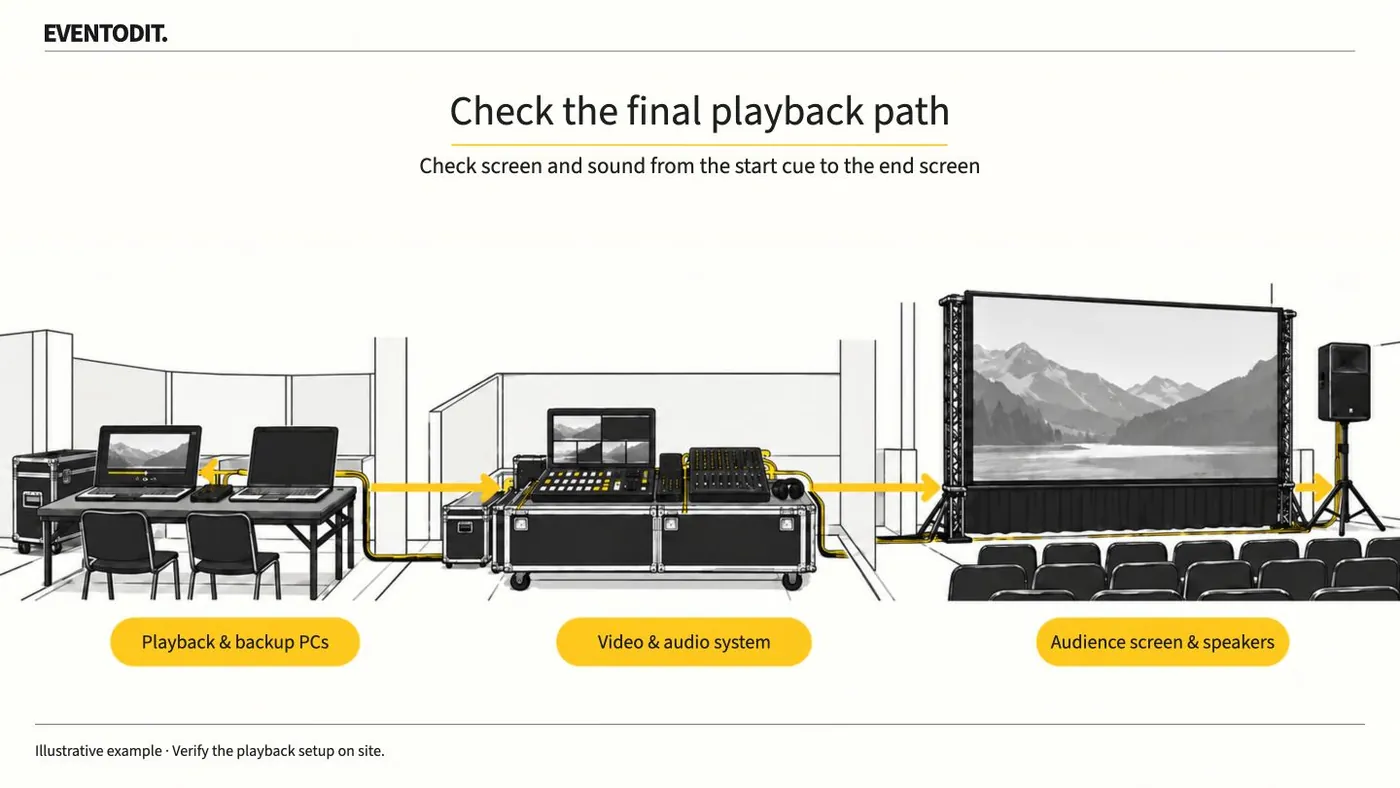
Event Video Acceptance and Playback
Play delivered video on the event PC and check the audience screens and speakers. Test from the start cue through the final screen change, then identify the file approved for playback.
Read guideHave a correction or additional evidence? Request a correction