
Seoul Fashion Week 2027 S/S, held in September 2026, used two enormous Hubs: DDP and the area around Lotte World Tower in Jamsil. It clearly separated their purposes, with fashion shows and buyer order consultations at DDP, and public runways, K-culture pop-ups and flea markets in Jamsil.
From a professional event planner’s perspective, the most fatal trap in a Multi-hub plan operating two physically distant places simultaneously is naively assuming that every visitor will travel back and forth to enjoy the festival. Two spaces must mean two Audiences, and routes and performance measurement must likewise be managed as two rigorously separate events.
1. Functionally isolate spaces according to the Target Audience
DDP and Jamsil were not simply an expansion of space. They served the completely different purposes of B2B, business-to-business trade, and B2C, business-to-consumer trade.
- A complete B2B experience at DDP: the 98 buyers from 20 countries visiting DDP needed quiet, efficient business routes rather than festival excitement. Concentrated infrastructure leading directly from runway presentations to individual showrooms and consultation tables was essential.
- A complete B2C experience in Jamsil: for general visitors to Jamsil World Park, by contrast, the core was brand experience and immediate purchase conversion—See Now, Buy Now. QR route guidance leading straight from the show to purchases at Lotte Department Store’s online shop became the Jamsil hub’s foremost operating objective. Each space must provide a complete experience in its own location.
2. Do not engineer forced Crossover between hubs
A frequent mistake in Multi-hub event planning is trying to inflate overall event traffic by dragging the audience from Hub A to Hub B on shuttle buses.
- The limits of designing transfer routes: someone who has finished buyer consultations at DDP will not go out of their way to take the subway or wait for a shuttle to see the flea market in Jamsil. Conversely, a member of the public who has seen the NCT costume exhibition in Jamsil has no reason to move to DDP’s trade show.
- The case for separate operations: rather than wasting the budget on excessive inter-hub shuttle services or two-way stamp trails, the practical approach is to concentrate budgets and guidance so each audience can maximize satisfaction at the one hub it visits.
3. The blind spot in performance reports: separate Vanity Metrics from genuine data
When reporting to municipalities or sponsors after the event, combining results from two different hubs into one blunt number breaks the compass for planning the next season.
- Separate traffic counts: approximately 176,000 people entering through Jamsil World Park’s gates constitute an inclusive visitor count containing passing footfall around Lotte World Mall. This figure must not be mixed with DDP’s registered fashion-show audience and packaged as attracting a total of 180,000 fashion-show spectators.
- Break down revenue measures: the announced order-consultation amount of US$7.57 million at DDP is merely an initial amount in which buyers expressed interest, not the final actual Contract Value. The consultation amount, the amount ultimately contracted and actual B2C online-shop sales generated in Jamsil must be clearly distinguished in Logging to establish a basis for allocating the following year’s budget.
4. A four-stage protocol for Two-track, multi-hub events
When planning multiple venues with different purposes, the working team must establish these four-stage criteria.
| Stage | Actions |
|---|---|
| [Stage 1: Separate each hub’s audience and Scope of Work (SOW)] | Commission completely separate agency scopes: protocol, interpreting and consultation staff at the B2B hub; safety control and sales, including F&B and pop-ups, at the B2C hub. |
| [Stage 2: Check the completeness of each visitor route] | Rehearse independently at each hub to confirm that viewing → rest → achieving the objective through consultation/purchase → exit is fulfilled 100% within that one location. |
| [Stage 3: Apply two traffic Measurement standards] | Use different calculation methods: 100% genuine buyer data from Badge barcode scans, and estimated general-public data from People Counting at specified gates. |
| [Stage 4: Prepare independent Post-mortem reports] | After the event, prepare physically separate B2B order-results and B2C audience-success reports, and evaluate independently whether to retain or discontinue each programme. |
A planner’s note: dispersal is not expansion, but choice and concentration
Splitting an event across several venues is not simply a way to make the festival’s Scale appear larger. True Multi-hub planning is a sophisticated strategy for separating audiences that should not mix, increasing the intensity of their experiences.
If the spaces have been separated so buyers’ negotiation tables do not become tangled with the public’s flea market, the planner’s timetable and performance indicators must likewise be coldly divided in two. Every contrived attempt to bind the two hubs into one merely increases fatigue on site.
Conditions for applying this elsewhere
When two venues serve different audiences and purposes, do not assume every visitor makes a return trip between them.
Information not established
Reported order consultation value is not contracted value; World Park gate traffic is not fashion-show attendance or customer count.
Reference material
Next tasks and related resources
Hub-by-hub audience, programme, movement and measurement definitions.
Related practical guides
Venue Relocation
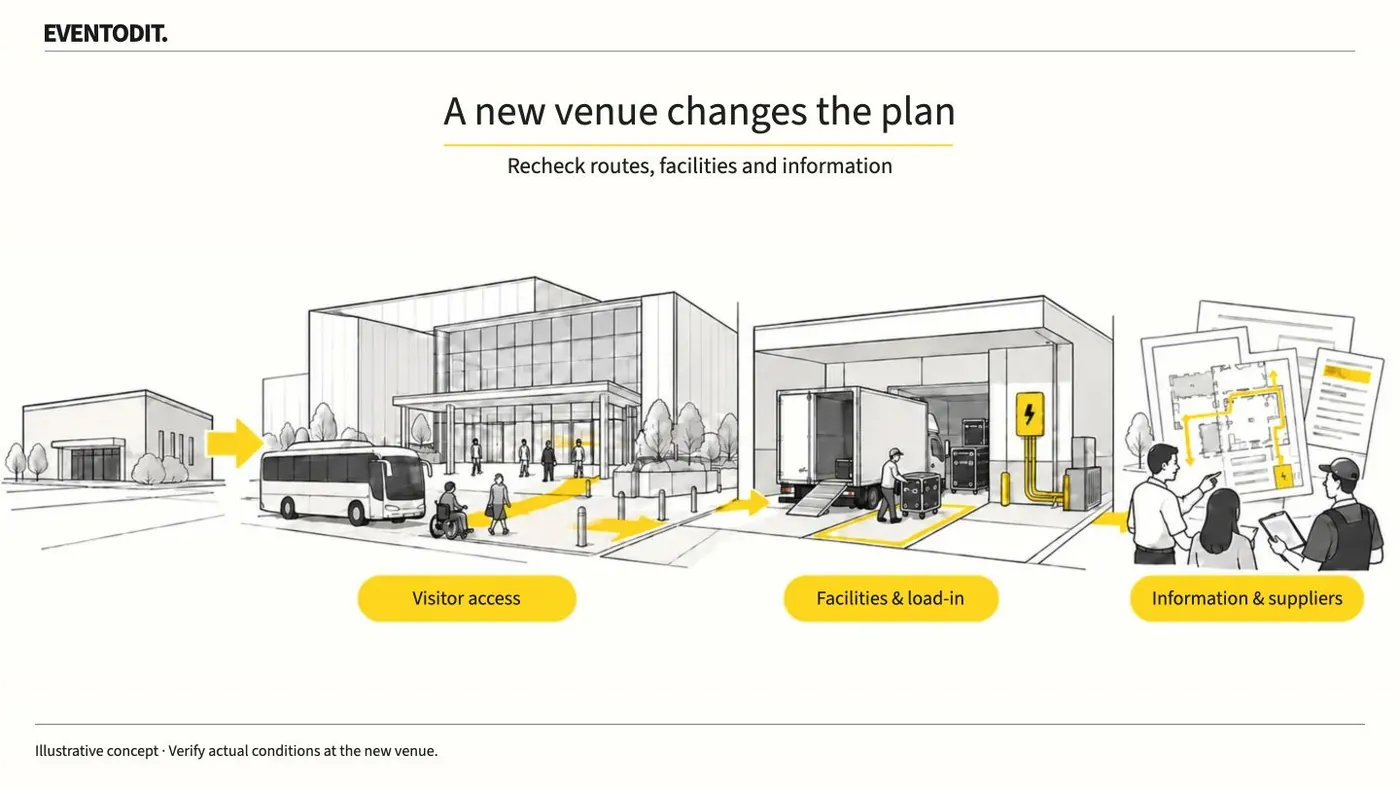
A venue move changes how visitors arrive, queue and travel between programmes. Check those conditions at the new site and update the plan, running order, visitor information and supplier orders together.
Read guideHave a correction or additional evidence? Request a correction