Part 1. Planning and Procurement Lead
"When the venue changes, reset the reference point for the schedule and every document."
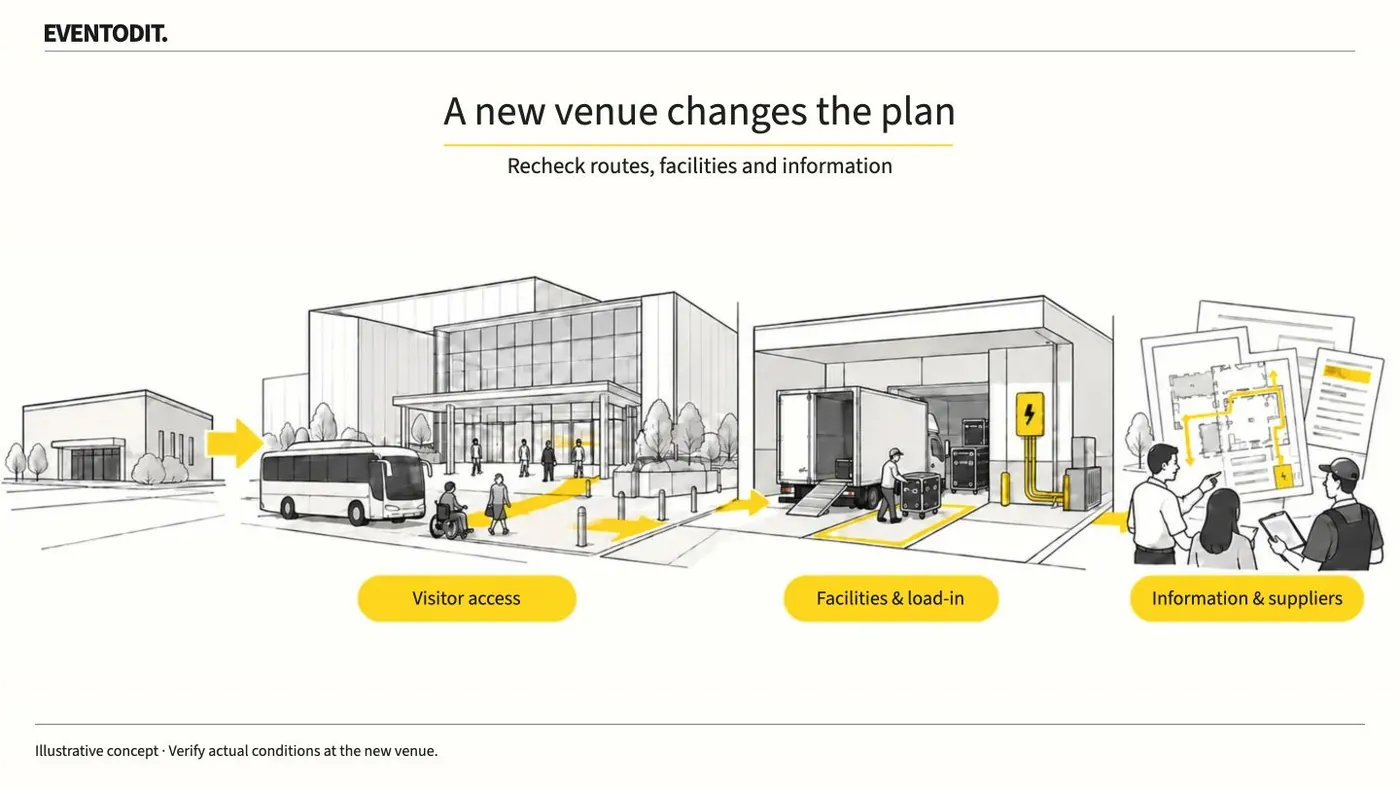
- Review documents and visitor information throughout: Ensure map search listings, invitations, booking messages and parking instructions all point to the new venue's arrival locations, so visitors who remember the previous venue are not confused.
- Reset travel time between programmes: When distances on the plan increase, the time needed for visitors to exit, walk, check in again and take their seats changes entirely. Do not reuse the old running order unchanged; revise the cue sheet to match movement at the new venue.
- End of previous sessionPrevious programme finishesConfirm when visitors leave
- TravelMove between areasTest the route for the actual audience
- Next session entryRegister and take seatsCheck waiting and repeat check-in time
- Programme revisionAdjust the scheduleDecide start time, intake point and route
Carry the adjustments into the show cue sheet and staffing plan.
- Share one change register with all suppliers: Prepare a comparison of the old and new conditions side by side. Do not guess unconfirmed conditions; set clear reply deadlines and distribute the same register to all suppliers and visitor-information staff.
Scroll sideways if needed to follow each role.
- Planning lead: Prepare the change recordRecord old and new conditions, unresolved owners and deadlines
- Suppliers: Check supplier impactsUse the same record for price, schedule and scope responses
- Planning lead: Update documents togetherCompare layout, operations, cues, notices and orders
- Operations / visitor information: Notify earlier recipientsSend the version, confirmation date and changes
- Planning leadPrepare the change recordRecord old and new conditions, unresolved owners and deadlines
- SuppliersCheck supplier impactsUse the same record for price, schedule and scope responses
- Planning leadUpdate documents togetherCompare layout, operations, cues, notices and orders
- Operations / visitor informationNotify earlier recipientsSend the version, confirmation date and changes
Columns identify roles. Read steps from top to bottom; arrows show the handover direction.
Part 2. Facilities and Technical Director
"More floor area does not automatically mean greater capacity or better installation conditions."
- Reinspect changed infrastructure and load-in conditions: With the new facilities team, check how the unloading location, permitted access times, available power, structural fixing methods and other physical conditions affecting system installation have changed, and obtain formal approval.
- Recalculate usable capacity with structural obstructions included: Use the actual available area after the stage and system structures are installed, rather than the area shown on the bare drawing, to secure visitor circulation routes and emergency exits again.
- Redesign evacuation and safety routes: Confirm the safety standards applicable to the new venue and rearrange equipment and circulation to prevent bottlenecks and accidents.
Part 3. Floor Operations and Visitor Information Lead
"A site survey should begin where visitors get off, not at the front gate."
- Check approach routes from public transport and parking: Walk every crossing, level change and ramp from public-transport stops, parking areas and taxi drop-off and pick-up points to registration, checking access for wheelchair and pushchair users.
- Blind-test the clarity of signs: Ask staff unfamiliar with the venue and uninvolved in planning to follow the actual route. Identify places where they get lost or ask questions, and focus signs and staff at those points.
- Anticipate and control the queue tail: Predict whether the last person in a long registration queue would block another programme's route or a passageway. Give on-site staff authority in advance to stop the queue and guide visitors to disperse.
Final check before use: Cross-check the changes and handover history, ensuring the revised operating conditions and supplier-specific orders have been communicated without omissions after the venue change.
Conditions for applying this elsewhere
When relocating, reassess visitor and equipment routes and Korean site approvals rather than reusing the old schedule or address.
Information not established
The studies do not guarantee a causal relocation effect. Actual capacity and passage conditions require applicable Korean site standards and approvals.
Reference material
- Park Jong-chan and Shin Hye-sook (2024) — Effects of changes in a local festival's servicescape on visitor satisfaction and behavioural intention: Gwangju Kimchi Festival. Journal of Hospitality and Tourism Studies 26(2), 81–95. Public KCI abstract reviewed.
- Kim Jong-soon, Yeon Bun-hong and Kim Hye-sun (2025) — Importance–satisfaction analysis of a local cultural festival's servicescape. Journal of Korean Association of Physical Education and Sport for Girls and Women 39(4), 145–157. Public full text reviewed.
- UK HSE — Venue and site design: venue suitability, audience movement, infrastructure and layout review. An overseas operating reference, not Korean statutory criteria.
Have a correction or additional evidence? Request a correction