Part 1. Planning and Procurement Lead
"Combine fragmented manuals and document the decision-maker and timeline."
- Do not misinterpret weather warnings: The absence of a Korea Meteorological Administration strong-wind advisory does not mean an event can safely continue. The wind limits for truss, LED supports, outdoor tents and other structures at the venue may be much lower.
- Prepare a combined response plan for each structure: Gather the safety criteria held by suppliers for stages, speaker towers, tents and other systems into one integrated weather response and evacuation checklist.
- Establish the decision-making chain: To prevent confusion, specify who monitors conditions, who receives the report, and the designated decision-maker who ultimately declares a show stop when a specified weather condition is reached.
Scroll sideways if needed to follow each role.
- Weather monitoring / reporting: Monitor and measureUse approved criteria, locations and responsibilities
- Weather monitoring / reporting: Report findingsCompare forecasts and readings with installation limits
- Stop decision-maker: Decide the stopThe preassigned decision-maker issues the instruction
- Stage / visitor information: Act on siteStop performance or admission and inform visitors
- Weather monitoring / reportingMonitor and measureUse approved criteria, locations and responsibilities
- Weather monitoring / reportingReport findingsCompare forecasts and readings with installation limits
- Stop decision-makerDecide the stopThe preassigned decision-maker issues the instruction
- Stage / visitor informationAct on siteStop performance or admission and inform visitors
Columns identify roles. Read steps from top to bottom; arrows show the handover direction.
Confirm actual actions and thresholds with competent personnel who reviewed the installation.
Part 2. Facilities and Technical Director
"Do not guess at the design limits of structures. Check the qualified contractor's calculations."
- Set operating limits for each structure: Stage safety depends not only on the frame but also on ground conditions, ballast and the area exposed to wind; conditions can change in real time. Set precise wind limits that reflect each structure's characteristics.
- Measure and report weather in real time: Do not rely solely on a forecast app. Install wind meters at major structures within the venue, monitor changing readings in real time, and report immediately to the control room when readings approach the established limits.
- Inspect infrastructure before reopening: Do not restart merely because the weather has improved. After strong wind or heavy rain, the technical team must first inspect for structural deformation, displaced anchoring pins, flooded electrical cables and other electric shock hazards, and determine whether it is safe to resume.
Part 3. Floor Operations and Stage Manager
"A rain tent is not a shelter. Secure a safe refuge and evacuation routes."
- Simulate evacuation for lightning and sudden weather: Small outdoor rain tents are not safe shelters during lightning. Mark evacuation routes on the venue plan that can guide visitors and staff to a preassigned refuge in a substantial indoor building or large structure.
- Rehearse a shutdown: During cue-sheet rehearsals, simulate an event stop caused by worsening weather and practice the announcements, performer evacuation, audience control and staff radio reporting as they would occur on site.
- Control staff return and event restart: When the weather improves, prevent visitors from entering the stage and staff from returning early until safety checks are complete. Once the operations lead gives final approval to restart, confirm that all staff are back in position before beginning visitor announcements.
Scroll sideways if needed to compare the branches.
- Inspect systems and routesRelevant owners check structures, electrics and passages
- Confirm staffing and return readinessCheck staffing, radio and operational readiness for return after approval
Improved weather alone does not authorise restart. Size alone does not make a lightning shelter safe. US NWS guidance recommends a substantial building with electrical wiring and plumbing; open rain shelters are not safe. Confirm designated refuges against local requirements with qualified personnel.
Operational workflow
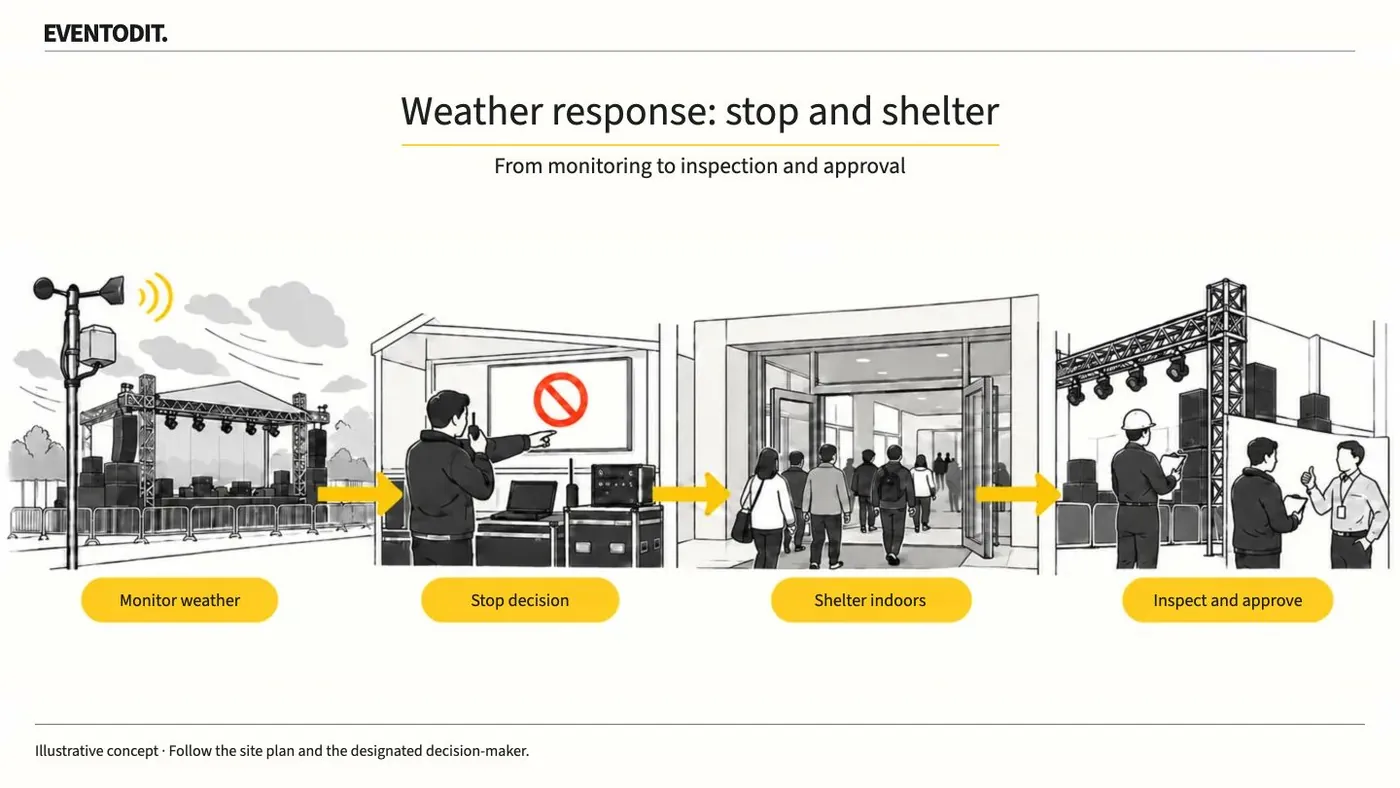
- Agree structure-specific limits and contacts in advanceQualified personnel define operating limits, measurements, observers, reporters and stop authority; rehearse the response.
- Monitor conditions and report risksThe observer compares readings, including average and gust wind speeds, with the agreed site-specific criteria and reports to the event lead.
- Authorized lead orders the stopApply the consolidated response table and communicate the show stop to every team by radio and emergency announcement.
- Direct evacuation and control accessGuide performers and spectators to a sturdy indoor shelter assessed in advance. Do not use tents as shelters.
- Technical team reinspects after weather improvesCheck structural deformation, detached fixings and water ingress into electrical equipment; report the safety inspection results to the event lead.
Incomplete or unapproved
Check and approval confirmed
- Confirm all staff back in positionOnly after approval, field operations confirms each team's return, radio response and readiness to direct people.
- Guide spectators back and resume operationsBegin spectator return guidance and restart the event only after confirming that all responsible staff are in position.
Do not use weather-warning thresholds as structural operating limits. This diagram provides neither numerical limits nor a safety assessment. Improving weather alone does not authorize restart.
Final check before use: Small variables at outdoor events can lead to major accidents. Before the venue opens, check that all operations staff have completed a severe-weather simulation exercise.
Conditions for applying this elsewhere
Agree thresholds and actions with competent contractors or specialists familiar with design, ground, anchoring, ballast and exposed area, plus venue and local requirements. Size alone does not make a lightning shelter safe. US NWS guidance recommends a substantial building with electrical wiring and plumbing; open rain shelters and small outdoor buildings are not safe. Confirm designated refuges against local requirements with qualified personnel.
Information not established
Overseas HSE and NWS references do not replace Korean statutory standards. Installation safety and site operating limits need separate confirmation.
Reference material
- Korea Meteorological Administration — Strong-wind safety actions and warning thresholds. Checked 2026.10.11.
- Korea Meteorological Administration — Lightning safety actions. Checked 2026.10.11.
- UK HSE — Safety of outdoor loudspeaker and lighting supports. Checked 2026.10.11.
- UK HSE — Event emergency plans and show-stop procedures. Checked 2026.10.11.
- US National Weather Service — Lightning safety plans for outdoor activities. Checked 2026.10.11.
- US National Weather Service — Lightning safety indoors and safe shelters. Checked 2026.10.27.
Have a correction or additional evidence? Request a correction