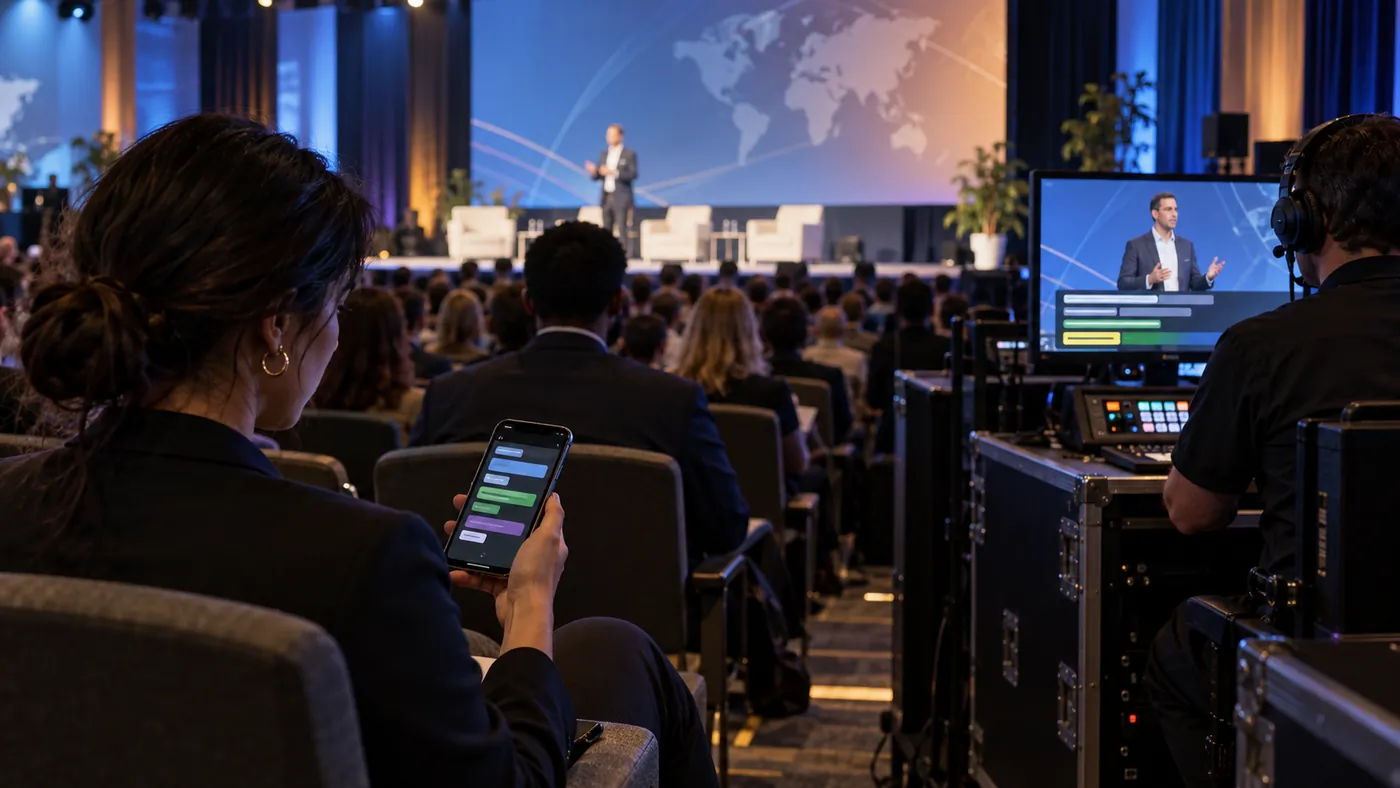
At an international conference, on-site attendees and online viewers may use language services on different screens. In its post-event account of COMEUP 2025, held at COEX in Seoul in December 2025, interpretation provider EventCAT said it supplied QR-accessible AI interpretation and captions across five stages, and live captions for the main-stage YouTube broadcast.
Access on a visitor’s phone and captions on a broadcast are separate outputs to check. Following the reference standard "Case Article Review", this column distinguishes the scope described by the supplier from testing suggestions for other events.
1. Separate output paths: check on-site access and broadcast captions independently
On-site attendees can use a QR code or URL to select a language on their own device. Online viewers need captions on the broadcast screen or a separate access route. Seeing a translation on a phone does not by itself establish that captions are working for online viewers too.
- Assign checks separately: At another event, the interpretation lead can check QR access and stage and language selection from an attendee’s seat, while the video lead checks caption display, placement and delay on the actual broadcast. The team can compare both results to identify the affected path if a problem occurs.
- Distinguish the case from a technical configuration: EventCAT’s current support documentation describes a way to composite a caption layer into a broadcast. Neither that document nor the supplier’s retrospective establishes the exact compositing method or wiring used at COMEUP 2025. The five-stage on-site service and the main-stage broadcast should also be described separately.
Scroll sideways if needed to compare the branches.
- Personal audience deviceOpen the stage’s QR or URL and check the chosen language
- Online broadcastInspect the final feed with captions composited by video staff
Editorial application concept, not a reconstruction of COMEUP 2025’s wiring, equipment or staffing.
2. Recheck inputs and screens during session changes
When several stages run at once or speakers follow one another, teams need to check which speech appears on which screen. In a transition rehearsal for another event, stage staff can provide the interpretation lead with the next session’s language and speaker name, while the sound and video teams check that the inputs and outputs match the intended stage.
- Check previous displays and transition procedures: Look for a sentence left from the previous session or audio arriving from another stage, then clear a display or change an input when needed under the procedure agreed with the provider. Resetting the mixer or deleting the caption cache after every session is not a universal rule. Agreeing responsibilities and recovery methods in advance helps the team respond calmly to transition errors.
3. Hand over the speech and Q&A audio used for captions
For an interpretation service to process a presentation, speech from the correct stage must reach its input. EventCAT’s current on-site setup guidance describes receiving a clean signal from the sound mixer and checking its level. This is a configuration to consider for another event, not a record of the actual COMEUP wiring.
- Confirm the input scope with the sound team: The planner can arrange for the sound director and provider to review microphone types, available outputs, levels and network conditions together. If an audience question is not picked up by a microphone, the chair can repeat it into a microphone and the team can test that the repeated speech also reaches the interpretation input.
- Agree incident-response roles: Decide in advance who among the interpretation lead, video director and site lead checks and communicates a translation error or interruption. A fault may affect only one output, so record on-site and online status separately.
4. A four-stage protocol for multilingual delivery across media
The following suggestions are for events providing language services on personal devices in the venue and through an online broadcast. They are not a reconstruction of COMEUP 2025’s internal wiring or actual incident response.
| Stage | Operating standard |
|---|---|
| Stage 1: Confirm audio inputs and handover | The sound director and interpretation provider agree the presentation and question microphones for each stage, available mixer outputs, input levels and connection method. |
| Stage 2: Check the broadcast layout | The video lead confirms how captions will be delivered and, during rehearsal, checks their position against slides, speaker names and on-screen information. |
| Stage 3: Run both paths in rehearsal | Send the same speech through the service. An on-site lead checks QR access and language display on an actual attendee device; the video lead checks the content and delay on the final online screen. |
| Stage 4: Agree error notices and recovery roles | Assign responsibility for diagnosis, caption display adjustments, recovery and audience communication. When needed, broadcast an agreed alternative notice and separately communicate any on-site access issue. |
Planner’s memo: check the same presentation again on each audience’s screen
When one presentation reaches both on-site and online audiences, their screens and language-selection options may differ. Planners should schedule time for the provider and video and sound teams to check their respective inputs and outputs.
Testing the same short passage on an actual attendee device and on the broadcast screen, and deciding who communicates what if an error occurs, helps teams run multilingual services more reliably.
Conditions for applying this elsewhere
For events combining personal-device interpretation and online streaming. Confirm equipment and contract conditions and agree caption placement and recovery responsibilities for the specific setup.
Information not established
The full YouTube caption output was not independently replayed beyond the supplier account. Historical compositing, wiring, session languages, accuracy, latency, incidents, recovery procedures and satisfaction were not verified.
Reference material
- EventCAT · COMEUP 2025 post-event case (22 December 2025; supplier account)
- Ministry of SMEs and Startups · COMEUP 2025 event record (12 December 2025)
- Korea Policy Briefing · Post-event COMEUP 2025 report (22 December 2025)
- XL8 official support · Ways to display captions at in-person events
- EventCAT official support · Audio connections and caption outputs
Have a correction or additional evidence? Request a correction