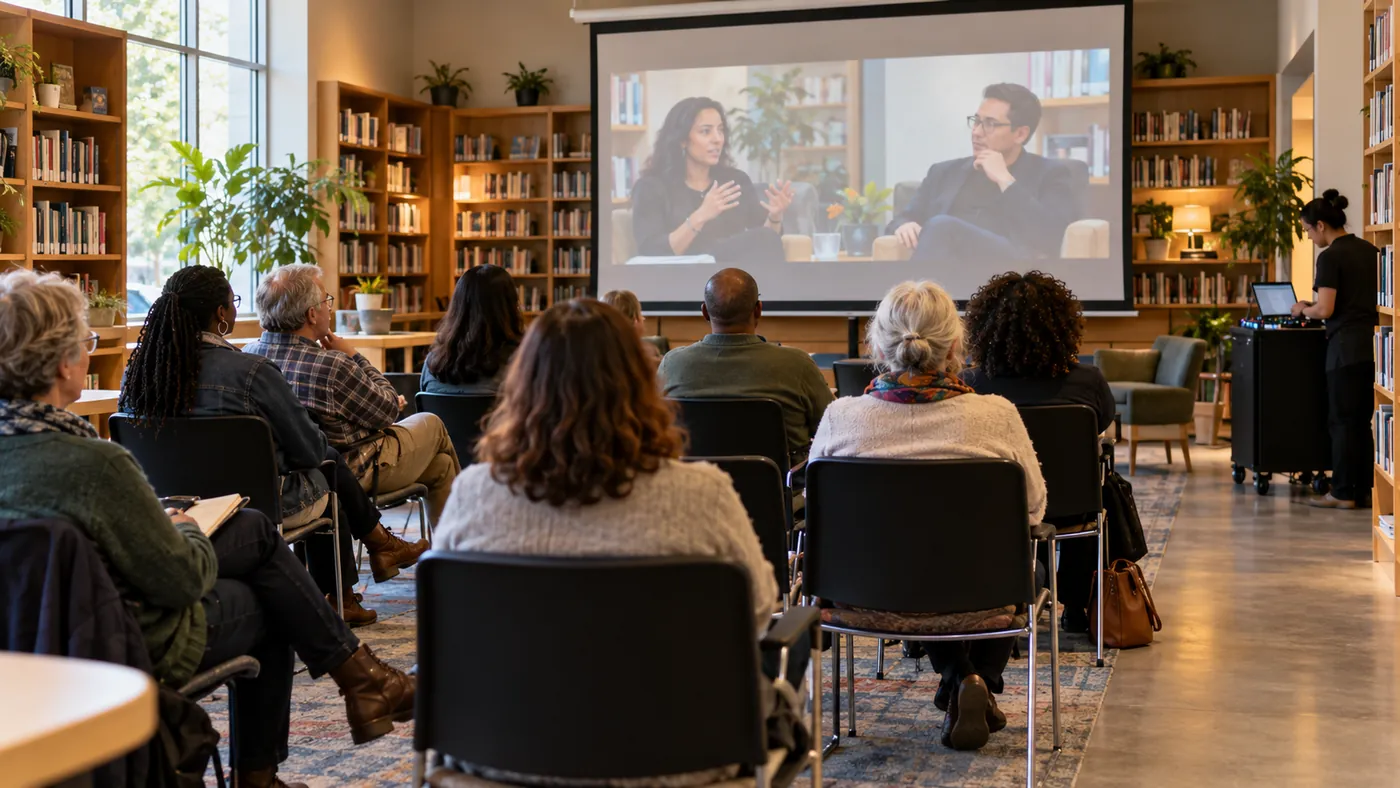
A shared screening of a festival conversation at a local library or cultural centre can offer another way to participate for audiences who cannot easily travel. The 2025 Edinburgh International Book Festival annual report and the city council’s report recorded 91 watch parties in Scottish libraries. The organiser said more than 700 people attended library watch parties across 12 local authority areas.
Even when video is supplied centrally, welcoming audiences and checking the screening environment remain local responsibilities. Following the reference standard "Case Article Review", this column distinguishes the published results from operating suggestions for other events.
1. Distinguish individual viewing from group-screening conditions
Receiving a link for online viewing does not by itself establish the conditions for showing that video to a group in a library. The rights and permitted uses that need checking may vary with the content, contract and jurisdiction.
- Confirm which content may be screened and when: For another event, the central programme lead can check with relevant rights holders, including speakers and producers, whether group screening is permitted, at which locations, by livestream or on demand, and for what period. The approved session list and conditions can then be passed to local hosts in writing.
- Connect the conditions to local schedules: Check that the livestream start fits the library’s opening and closing times. For on-demand viewing, confirm that preparation and screening can be completed within the availability window. The individual contract terms and rights-checking process used in Edinburgh were not established from the published materials.
2. Count watch parties, attendance and online views separately
The organiser’s 2025 annual report recorded 91 library watch parties and more than 700 attendees across 12 local authority areas. It separately reported almost 20,000 online event views across the festival’s livestreamed and on-demand programme. Those online views were not confined to the library watch parties.
| Published figure | What it counts | What it cannot establish on its own |
|---|---|---|
| 91 watch parties | Screening sessions held in libraries | The number of distinct libraries or capacity per session |
| More than 700 attendees | Library attendance reported by the organiser | Unique people after removing repeat attendance |
| Almost 20,000 online views | Views of the festival’s online programme | The number of people watching together on one screen |
Scroll sideways to read every column.
Several people can watch one library screen, and one person can attend multiple gatherings. Central platform views and local attendance should not simply be added and reported as a unique audience.
3. Check sound and picture at the receiving venue
Even if the central broadcast looks and sounds correct, teams should separately check what local audiences can see and hear from their seats. Libraries differ in room size, sound equipment and screen position.
- A local tech run: At another event, the library host can check speech intelligibility and the visibility of the picture and any captions from actual audience positions, especially the back of the room, then report the result to the central team. Caption availability alone does not establish that all required accessibility support is in place; check the audience and venue needs for that session.
- Agree contacts and alternatives for interruptions: The central team can take responsibility for content availability and technical enquiries, while the local host handles audience information and the room. Agree what to say and what alternatives are available if the connection drops or the screening is delayed.
4. A four-stage protocol for local watch parties
These suggestions are for teams preparing shared screenings with local venues. They do not reconstruct the Edinburgh book festival’s individual contracts or local equipment operations.
| Stage | Operating standard |
|---|---|
| Stage 1: Confirm screening rights and availability | The central team checks each item’s group-screening permission, eligible locations, availability window and playback method, then shares the conditions with local hosts. |
| Stage 2: Coordinate local schedules and preparation | Match the livestream time or on-demand window to library opening hours, and allow time for setup, connection and playback checks. |
| Stage 3: Run a test from audience seats | The local host checks the picture, sound and any captions from the seating area, including the back, and reports problems to the central contact. |
| Stage 4: Record session status and attendance | The local host records whether the screening took place, attendance and any interruption or connection problem. The central team records platform views and content availability separately. |
Planner’s memo: prepare the experience of watching together locally
Library watch parties can connect festival content with audiences in different places. Preparing that experience takes coordination between central content delivery and local space, staff and visitor information.
Checking screening conditions, testing picture and sound from audience seats, and recording the sessions actually held and their attendance can help establish a basis for future partnerships.
Conditions for applying this elsewhere
Check the rights applicable to the content and location before reviewing local hours, audience-position sound and picture, and access support. Individual viewing access does not by itself establish group-screening permission.
Information not established
The number of distinct libraries was not confirmed because public sources describe it differently. Venue-specific capacity, staffing, costs, equipment, contracts and satisfaction, and deduplicated audiences were not verified. Rights and local checks are editorial proposals.
Reference material
- Edinburgh International Book Festival · Annual Impact Report 2025, printed pages 3, 4 and 8: library watch parties, attendance and online views
- City of Edinburgh Council · Summer Festivals Scorecard 2025, 11 February 2026, Appendix 2: festival dates and 91 library watch parties; retrospective information supplied by the festivals
- Edinburgh International Book Festival · Festival 2025 In numbers: library attendance across 12 local authority areas and separate online programme figures
- Edinburgh International Book Festival · Post-event announcement on 2025 watch parties
Have a correction or additional evidence? Request a correction