
For a Cosplayer, damage to a costume means an end to festival participation. San Diego Comic-Con, held in Málaga, Spain, in early October, officially marked and operated a Cospital, combining Cosplay and Hospital, on its map to provide emergency costume and prop repairs for these participants.
Running a repair station with sewing machines and glue guns can look like simple customer service (CS). Yet from the lead on-site planner’s perspective, a space handling visitors’ direct complaints and damaged belongings becomes a huge bottleneck and a seed of disputes unless clear Limits on what will be repaired and physical Logistics for moving large props have been meticulously designed in advance.
1. The physical Pathway: "Can a visitor with wings get through this corridor?"
One of the most frequent mistakes is casually putting an ancillary facility such as a repair station in a spare corner.
- Measure routes for non-standard visitor dimensions: cosplay costumes and props far exceed the shoulder width of an ordinary pedestrian, approximately 60 cm. If someone carrying a 2 m prop staff or wearing huge wings must pass through a cramped corridor to reach the repair station, further damage can occur on the way, or other visitors’ movement can be brought to a complete standstill.
- Place it beside the back-of-house area: the Cospital must be separate from general visitors’ main route, in a location with a dedicated passage as generously wide as a wheelchair ramp, usually beside changing rooms or the Backyard.
2. The SOW Boundary: put criteria for refusing repairs in writing
An employee sitting at a repair desk cannot fix everything. Participant requests range from stitching torn fabric to broken 3D-printed props and LED electronic circuits with severed wiring.
- Control R&R, roles and responsibilities: the organiser’s FAQ limited support to stitching loose sections, securing accessories and minor damage, providing an excellent line of defence against risk. Intake staff must know the worker’s technical limits and the criteria for immediate repair Rejection from a manual, so they do not accept complex electrical devices or structurally collapsed props beyond their capability.
- Encourage participant Self-help: advance advice to bring a personal emergency repair kit is also essential communication for defending against complaints when the organiser’s facility reaches its Capacity.
3. Break down procurement items: the trap in ordering one repair-station package
If an agency or supplier receives a lump-sum order for one repair-station booth, nine times out of ten the site will present a desk with nothing but a needle and thread.
- Modularize quotation items: when commissioning a repair station, obtain separate line items for more than hardware—operating hours, dedicated staff’s sewing proficiency, the consumables list including glue guns, tweezers and fabric, separate power distribution and breaker capacity for high-power equipment such as sewing machines and irons, and even waste-disposal bags. This lets the team control in advance what may run short during operations.
4. A four-stage operating protocol for participant Support Desks
When setting up a support desk for damage and unexpected incidents, the planning team must follow this four-stage protocol.
| Stage | Actions |
|---|---|
| [Stage 1: Secure physical Access] | Mark Zones on the plan for large-prop access routes, wheelchair accessibility and separation from the main visitor route. |
| [Stage 2: Set support limits (Triage)] | Hand intake staff the manual of repairable/non-repairable criteria and give them Triage authority to Reject impossible cases immediately on arrival. |
| [Stage 3: Control waiting and Dwell] | If the wait exceeds 15 minutes, issue numbered tickets so participants can visit other event zones instead of remaining tied to the queue. |
| [Stage 4: Record outcomes (Logging)] | Record cases received by time slot, resolution rates and reasons repairs were refused, such as electronic-device failure, to inform increases or decreases in particular consumables or technical staffing at the next event. |
A planner’s note: support facilities exist to send visitors back out quickly
The success measure for an emergency support centre such as a Cospital is not how many people it kept there for a long time. It is the reverse: how quickly it returned a broken visitor to the heart of the event.
The repair station’s chairs do not need to be comfortable. What matters is the intake employee’s quick judgement and the number of glue guns with ample power. If visitors stand in front of the repair station for 30 minutes or more waiting for a needle and thread, it is as though the festival’s clock has stopped at that desk.
Conditions for applying this elsewhere
For visitors carrying large costumes/props, verify access and order skilled staff and operating hours separately.
Information not established
Repair count, resolution rate, wait time, actual staffing and budget were not published.
Reference material
Next tasks and related resources
Repair scope, staffing, consumables, waiting and resolution register
Related practical guides
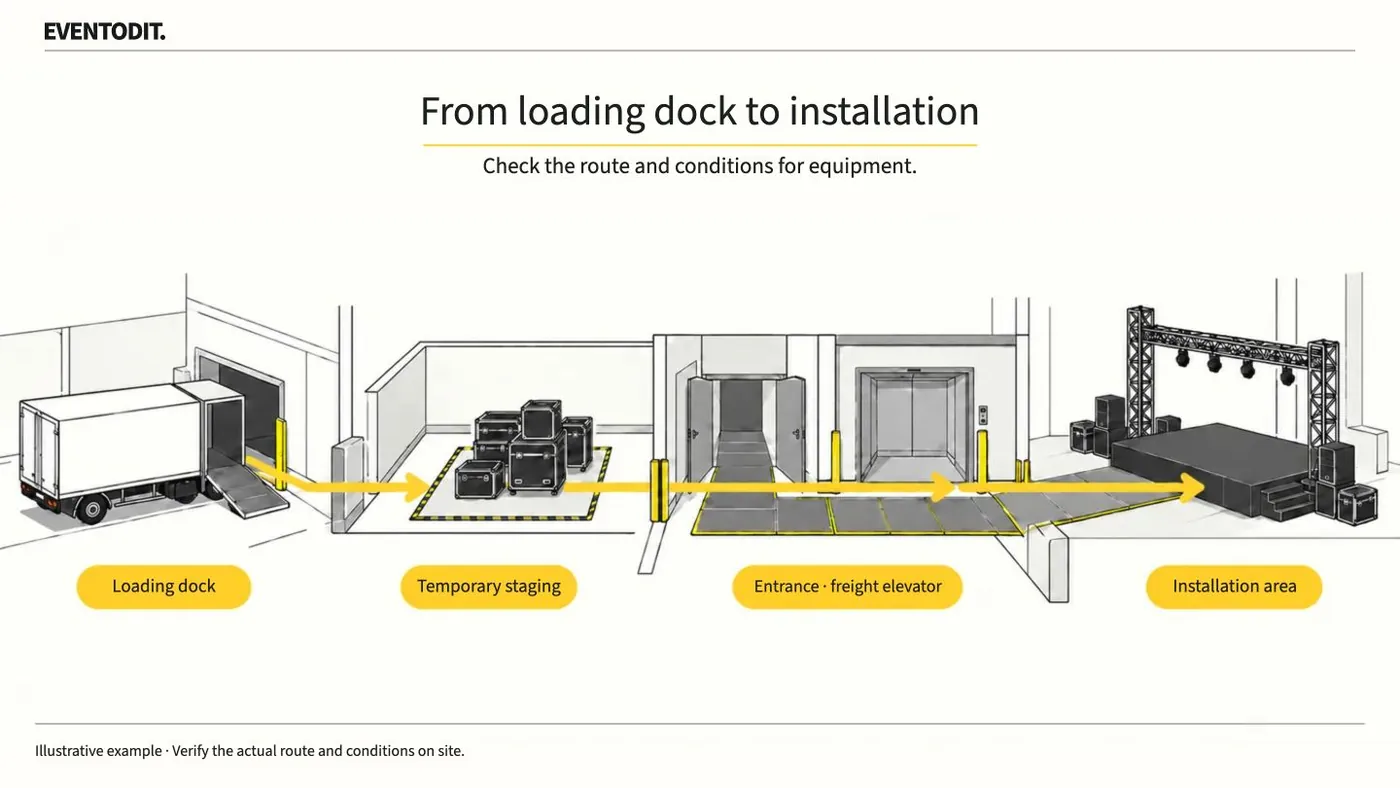
Venue Survey and Load-in
Check the route equipment will actually travel and the routes visitors will use. Mark questions for the facilities and technical teams on the plan and assign a person and deadline to resolve each one.
Read guideHave a correction or additional evidence? Request a correction