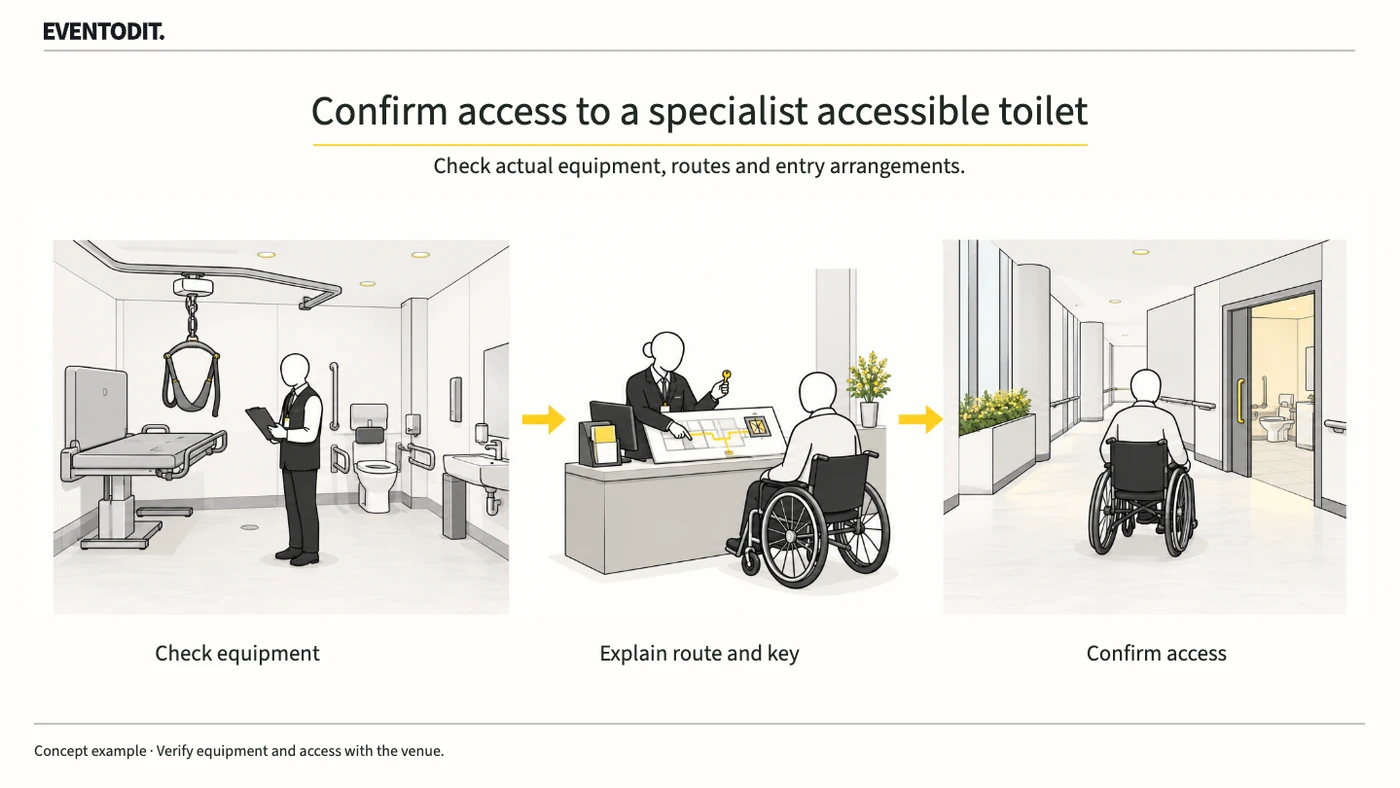
Part 1. Planning and accessibility lead
“Do not rely on a facility name. Confirm the actual equipment, entry and support available on the event day.”
- Distinguish standard accessible toilets from additional facilities: The UK Changing Places example describes a height-adjustable adult changing bench, hoist and space for a user and up to two assistants. Such a facility supplements rather than replaces standard accessible toilets. Do not infer that the equipment exists from an accessibility symbol, or treat the UK name or standard as a Korean legal installation requirement.
- Check access against the event schedule: Give the facilities team the date and audience arrival and departure times. Separately confirm when the toilet, accessible route, lift, key collection point and staff-call service are actually available; do not simply copy normal building hours.
- Separate entry assistance from personal care: Opening a door or providing a key does not establish that hoist operation, physical transfer assistance or personal care will be provided. Explain the support that the organiser has actually confirmed and distinguish unavailable or unconfirmed support.
- Hold unverified information and recheck before the event: Do not present unanswered equipment or access conditions as confirmed. Ask the facilities team to reconfirm any changes shortly before the event, even if they were checked before contracting.
Part 2. Venue and facilities management
“Check equipment limits, sling compatibility and the actual route as well as the equipment list.”
- Compare equipment and location on site: Obtain the actual equipment list, floor and location from the facilities team. Verify the bench, basin, hoist, toilet and shower against the plan and the room; do not assume an unlisted item or operating condition.
- Check load limits and conditions: The safe working limits of the hoist and bench belong to the specific equipment and facility. Do not transfer another venue’s number or determine suitability from body weight alone. Verify the manufacturer’s specifications and facility conditions.
- Confirm sling requirements and compatibility: State whether the facility provides a sling and what visitors must bring. Southbank Centre’s Royal Festival Hall is one venue that specifies a compatible personal loop sling. Connect the visitor and any accompanying care provider with a qualified facilities representative to check compatibility and assistance arrangements in advance.
- Verify the route and fault response: Inspect the path from the audience area, thresholds, doors and lift availability. Arrange a facilities contact and confirmed alternative guidance for locked doors or hoist and lift faults.
| Check | Confirm with facilities | Tell visitors |
|---|---|---|
| Equipment | Actual bench and hoist, load limits and restrictions | Available equipment and personal items required |
| Entry | Key location, unlocking and staff-call method | Where, whom and how to ask on arrival |
| Time and route | Event-day hours, thresholds and lift | Usable hours, location and accessible route |
| Faults and questions | Event-day owner and response | Confirmed contact and alternative guidance |
Scroll sideways if needed to read every column.
Part 3. On-site operations and visitor information
“Do more than label a map. Explain how to enter and whom to contact on arrival.”
- Give a specific key and call procedure: State the key collection desk and its hours, or the location of the phone or intercom for calling staff, alongside the toilet location. Do not transfer Southbank Centre’s venue-specific access procedure to another place.
- Review the information needed to plan a visit: Make the actual equipment, floor and route, access and request method, required personal items and event-day contact easy to find. Mark unanswered conditions as unconfirmed.
- Explain support respectfully: Staff should distinguish confirmed entry assistance from separate personal care and explain the scope respectfully. Connect the visitor, any accompanying care provider and a qualified facilities representative to confirm sling compatibility and transfer arrangements according to the visitor’s needs and actual support available. Do not promise unconfirmed assistance or decide on the visitor’s behalf. Do not judge need by appearance or ask visitors why they need the facility.
- Hand over between shifts: Pass on the key location and access, working status of the phone or intercom, facilities contacts and unresolved issues to incoming staff.
Use the form for the next handover
Use the [Care-toilet access and equipment checks](/en/templates/care-toilet-access-check.html) for the records described here. The XLSX contains Blank, Example and Instructions sheets. Write your event in Blank; the fictional example is a guide to what to enter.
Confirm equipment, entry, hours and routes separately with facilities. Publish only verified conditions and distinguish personal preparation requirements.
The access lead sends facility evidence and the final notice to the desk. The next shift checks and receives keys, call procedures and direct contacts.
Final check before use: Before opening the event, cross-check the specialist accessible toilet’s actual equipment, hours and route, entry method, personal items and on-site contact.
Conditions for applying this elsewhere
Uses UK Changing Places guidance and London’s Royal Festival Hall as examples, not Korean statutory standards or personal transfer instructions.
Information not established
Suitability of a sling or assistance method for an individual and event-day equipment condition have not been confirmed.
Reference material
Have a correction or additional evidence? Request a correction