Do not combine several decisions in one sentence
"Approval to proceed with the event" actually bundles several decisions together. Increasing the budget, changing load-in times and announcing the programme publicly each involve different authority. Write down each decision separately, then verify who can make it and on what basis. Keep the supporting document and its effective dates, whether it is a contract, delegation schedule or meeting resolution. If there is no evidence, or the authority has expired, ask the organisation’s responsible lead to clarify rather than listing that person as the decision-maker.
Having a contact or coordinator title does not confer authority to change venue access hours. Authority is established through documents, not job titles.
Separate review from decision
One person may hold several roles, but review and decision must remain separate in the record. The editorial team proposes four distinctions. Consultation and review provide information and opinions. Decision means permitting, refusing or holding a matter within the person’s authority. Execution means working within the permitted scope. Notification and receipt mean receiving the changed conditions and checking that they have been reflected in the recipient’s work.
Each role also needs a different record. Review records the subject, evidence and outstanding conditions; decision records the scope, conditions and time. Execution records the revision used and the deadline, while notification records the material received and the time of receipt.
Check the scope and conditions of each reply
Do not start work simply because a reply has arrived. Check whether the sender has authority, whether the subject and version match the request, whether the dates and areas are correct, what scope is permitted and whether conditions apply. If "Confirmed" could mean either receipt or permission, ask for clarification.
Attach the amount and scope to budget approval, and the dates and load-in conditions to venue permission. For a conditional reply, establish who will verify the condition, what evidence they will use and whether a separate final permission reply is required.
Silence is not approval
Do not convert an unanswered request into approval when its deadline passes. Bring together the unresolved matter and its effects, the replies already received and the decision still needed, then escalate through the agreed route. Hold the change in the meantime. Keeping the original plan or using an alternative also requires checking whether it is feasible under the current conditions. Treating an alternative as settled merely because nobody has replied makes the decision record diverge from the actual decision.
When replies conflict, first check whether they address the same revision. Cost approval and a refusal of venue permission are judgments under different authority, so they cannot be settled by a vote. Show the conflicting conditions together to the relevant authorised decision-makers and obtain a revised proposal. Do not select the reply from the person with the most senior title and delete the rest.
Follow a fictional case from hold to handover
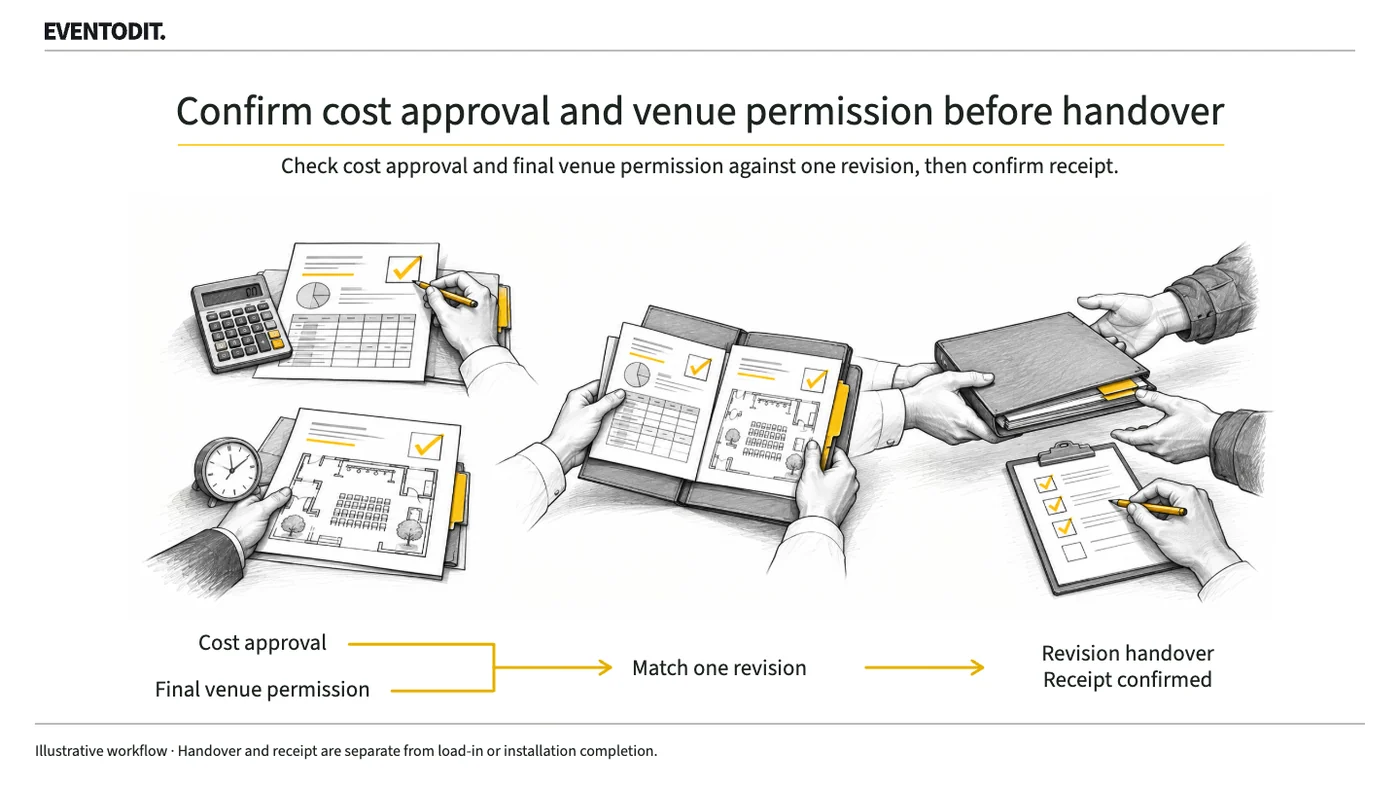
The following corporate-seminar case is fictional and provided for explanation. It is neither an actual record nor a market rate. The event is on 10 December, and the team wants to move load-in from 17:00 to 16:00. The additional cost is KRW 300,000, excluding VAT.
| Decision or task | Reply received and its scope | From hold to resolution | Result recorded |
|---|---|---|---|
| Additional cost | 12/08: the budget lead approves the cost of this change only | Cost approved; venue permission pending | Attach the cost approval record to the change proposal |
| Earlier venue load-in | 12/08: conditional reply, subject to confirmation that the previous event has cleared out | 12/10: the onsite operations contact confirms clearance; the venue contact gives final permission for 16:00 load-in | Preserve both the conditional reply and the final permission reply |
| Handover of the revision | Check the valid cost and venue replies against each other | 15:50: send revision v2 and the permission replies to the installation supplier and organiser; confirm receipt by both | The 16:00 load-in change is ready for execution |
Scroll sideways if needed to read every column.
If the supplier had been told "16:00 load-in confirmed" when cost approval arrived on 8 December, the venue condition would have been missing. In this case, handover took place after final venue permission. Completion here means handing over a change that is ready to execute; it does not mean that a vehicle has arrived or installation has finished.
Complete handover through delivery, receipt and comparison
Give the delivery team the change, its effective time, the material version to use, the decision replies and outstanding conditions, and the contact for problems. Confirm receipt and the recipient’s understanding of the permitted scope, then compare the schedule, work instructions and information materials to ensure they reflect the same change. Mark any recipient who has not received it as not yet notified, rather than complete.
Do not continue using an earlier reply unchanged when the decision-maker changes or a delegation expires. The same applies when the requested scope, amount, time, venue conditions or reference material changes. Preserve the original decision alongside the changes and seek fresh confirmation from the affected authorised decision-makers.
Completing a document handover does not complete onsite safety or technical checks. UK HSE event guidance also describes sharing information and checking work onsite through preparation, load-in, operation and load-out. Pass subsequent checks to the person responsible for that work so they can continue the record.
Practitioner checklist
- Does each decision record the authority evidence and the date it was checked?
- Are reviewers and decision-makers distinguished in the record?
- Have the reply’s subject, version, dates, scope and conditions been compared with the actual request?
- Are overdue matters held and escalated through the agreed route?
- Is there a receipt record showing that the delivery team received the same revision and conditions?
- Have earlier replies been rechecked when an authorised decision-maker or the change proposal changed?
Conclusion
Changes should proceed on the basis of which authority permitted what. If the cost has been approved but venue permission has not been granted, the change is not yet ready for execution. Finding the authority evidence, comparing the scope of replies and holding unresolved conditions helps reduce incidents in practice.
*Reference: This column adapts the structure and procedure of the editorial team’s original text, drawing on decision-making and change-control principles in UK GovS 002, HSE guidance on event roles and information sharing, and the Korea Tourism Organization’s 2022 ESG operations guide. The roles and procedure adapted for event work are editorial proposals. The seminar dates, amount and replies are fictional illustrations.*
Conditions for applying this elsewhere
Use where the organising organisation, funder, venue and suppliers decide different matters. Verify authority through actual delegations, contracts and institutional or venue processes; internal approval does not replace external or statutory and specialist checks.
Information not established
No specific organisation’s actual authority, contract effect, safety suitability or onsite result was verified. The roles and procedure are editorial proposals. The corporate-seminar dates, amount, replies and handover are fictional illustrations, not actual approvals or completed onsite work.
Reference material
- UK Government Project Delivery · GovS 002 v2.1 · decisions, roles, escalation and change control, issued 1 September 2025 / HTML updated 29 March 2026
- UK HSE · Are you a…? · organiser, venue and contractor roles, updated 16 March 2023
- UK HSE · Managing an event · phased work coordination, information and monitoring, updated 12 October 2024
- Korea Tourism Organization · 2022 ESG operations guide for sustainable MICE industry development · published June 2022, printed page65/PDF page61 on stakeholder input
After reading, complete the next task
Decision-level authority evidence, consultation/decision/execution/notification roles, reply scope, prerequisites, hold and handover records, with actual supporting material
This article’s template
Event decision authority, valid replies and handover register
Change handover linking decision-makers, valid replies, prerequisites and acknowledgment
Instructions, examples & downloadsRelated practical guides
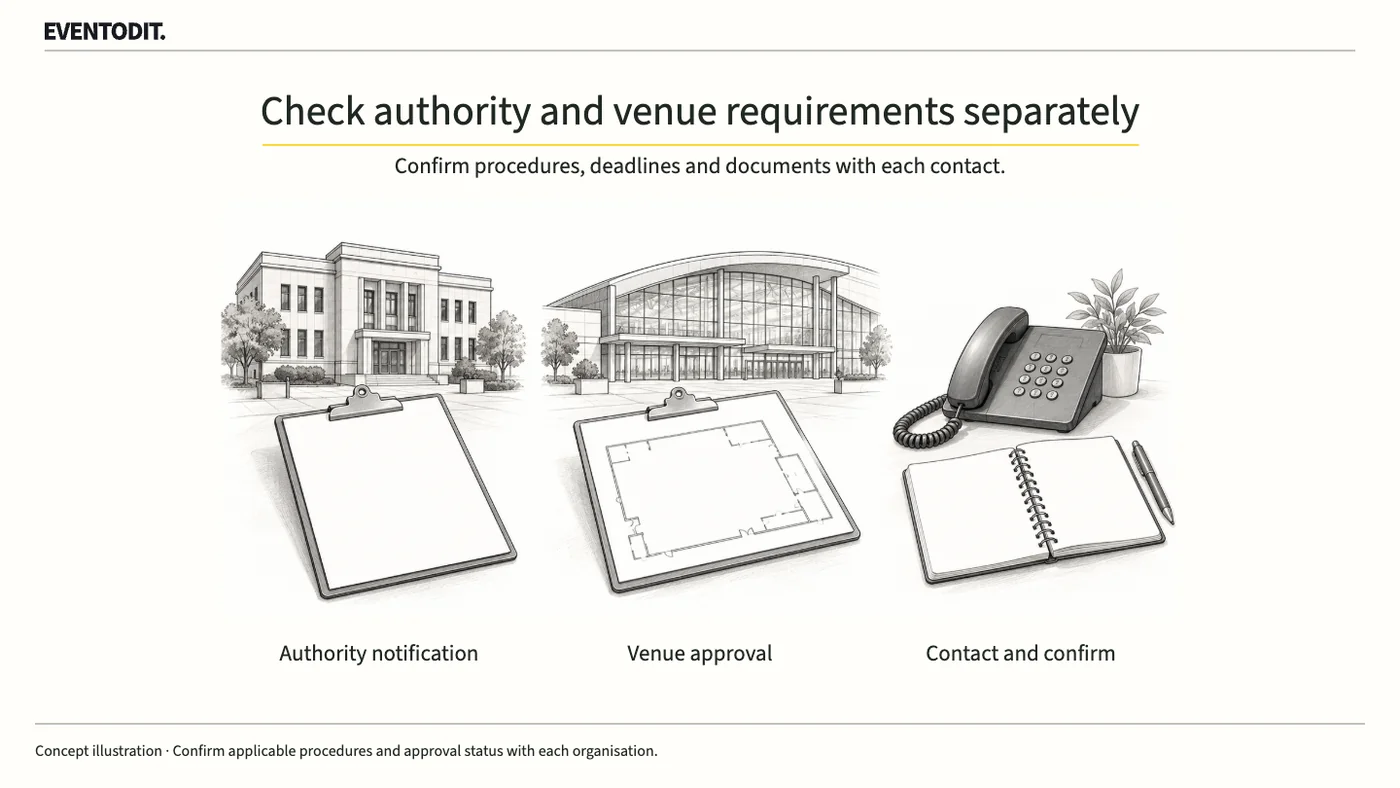
Check event permits and venue approvals separately
Describe the event and location, then check authority notifications or permits and the venue operator’s work approvals separately. Record receipt, approval and conditions to recheck after changes.
Read guide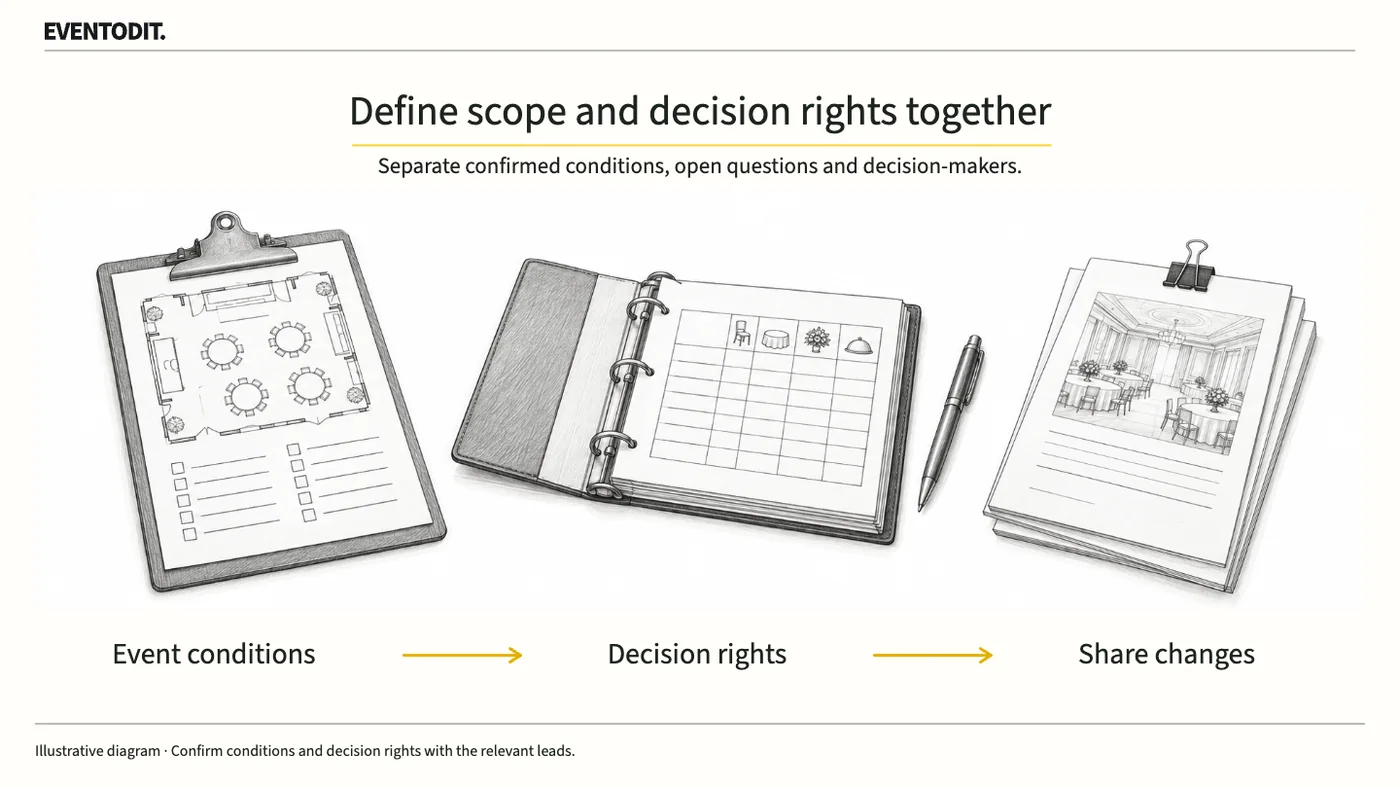
Define the event scope and decision-makers before procurement
Separate confirmed conditions from assumptions and agree who decides each event change.
Read guideHave a correction or additional evidence? Request a correction