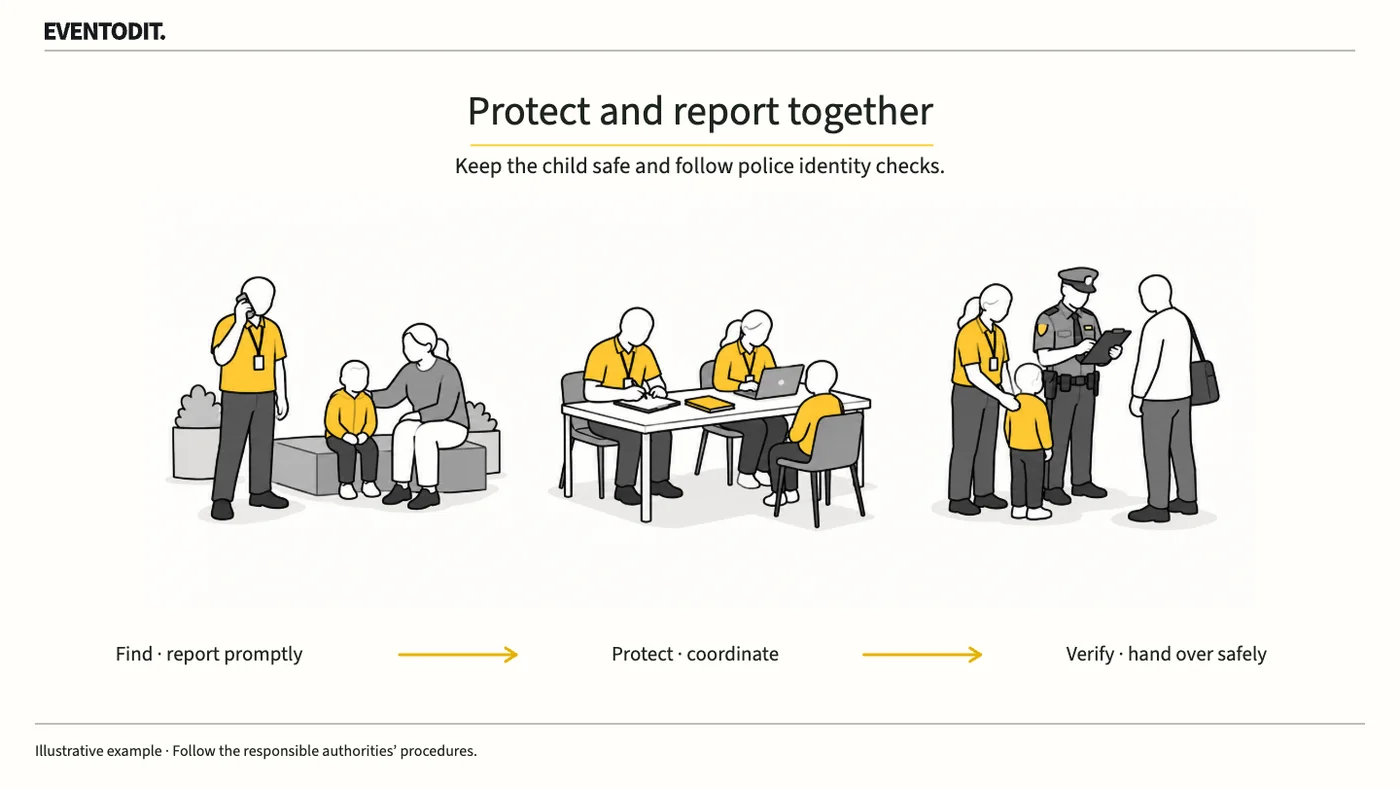
Part 1. Site and Safety Lead
"Do not delay reporting for an internal search. Use agreed procedures to prevent gaps in care."
- Follow police guidance and establish prompt reporting: Do not postpone a police report until the festival's internal search is complete or because a separate welfare point exists. Seek immediate action from the local police when danger is detected and activate the previously agreed interagency contact system.
- Agree public announcements and confidentiality in advance: Never display a child's name, photograph, contact details or precise care location on public screens or in a broad group chat. Public announcements should give only a general instruction to contact the designated information point. Share details needed for matching only with designated staff and police.
- Rehearse cross-reporting to prevent intake gaps: Before the festival opens, rehearse a situation in which the staff member who finds the child and the guardian report at different entrances. Use fictional identifiers and roles instead of actual child information to identify breaks in communication and handover.
The City of Boroondara's Australian event guidance advises against broadcasting a child's name and calls for confidential records. At Korean events, prioritise wording and contact arrangements agreed with police; do not treat an overseas document's waiting time as permission to delay reporting in Korea.
Pintea et al.'s 2025 study reports a quality-improvement case at one US children's hospital. The team mapped departmental roles and processes, then revised its reunification plan using a 16-person tabletop exercise and a later full-scale exercise. This does not justify transferring hospital target times or activation thresholds to festivals. Use exercises to identify communication, movement and handover gaps, and check event procedures against agreements with local police and the site safety lead.
Part 2. Control Room and Intake
"Reconcile reports from different points promptly and strictly control exposure of personal information."
- Link reports using identifying case details: To match the discovery report and a guardian's separate report at an information point, maintain a single restricted record linking the case number, report time, zone and person currently caring for the child.
- Restrict information sharing and record its handling: Share only the minimum child information needed for on-site matching with designated verification staff and the local police. Record who received the information and when; do not collect unnecessary personal information simply because an operational form provides a field.
- Communicate closure and confirm the search is stood down: As soon as the child has been handed over to the guardian or transferred to police or another relevant agency, notify search staff in every zone and the announcement team that the incident has ended, and confirm that each zone received the message.
Scroll sideways if needed to compare the branches.
- Child-discovery reportDiscovering staff: provide safe care, report to police and contact control
- Guardian reportInformation staff: log separately and pass to control
- Reconcile the caseControl room: link time, zone and care owner in a restricted record
- Designated staff and police checksApply the agreed procedure; follow police action if verification is insufficient
- Hand over and send closureRecord reunification or agency handover time and acknowledgment that searches and notices ended
Internal matching or searching must not delay police reports. Do not publish personal information or precise care locations.
Part 3. On-site Care and Handover
"Do not infer identity from the child's reaction alone. Follow the verification process and police directions."
- Care near the discovery location and never send the child alone: Reassure and safely care for the child immediately. Never send the child home or to a welfare point unaccompanied. If safety requires moving the child, promptly report the handover and route to event control so there is no gap in care.
- Follow guardian verification and police handover procedures: Do not hand a child over merely because an adult claims to be the guardian or the child reacts warmly. If verification is insufficient or accounts conflict, staff must not make an arbitrary identification; promptly follow local police verification and action procedures.
- Keep care staff present and complete the responsibility record: Follow the agreed shift-handover rules so a care worker remains with the child at a welfare or information point. On reunification or agency handover, record the recipient, handover time and acknowledgments of closure in the lost-child intake, care and handover responsibility sheet.
The Korean National Police Agency's Safety Dream guidance advises reporting first to its 182 missing-person service, reassuring and protecting the child at the discovery location, and not sending the child home alone. In an emergency, call 112 immediately. Record the recipient and time of any agency handover. If finder contact information is needed, as the police guidance describes, provide it through the designated agency's process.
| State | Decision or action | Record to retain |
|---|---|---|
| Child found | Safe care, police report and control-room intake in parallel | Case number, zone, owner and time |
| Claimed guardian reports | Refer to the pre-agreed verification lead | Checker, result and linked case |
| Insufficient verification or safety concern | Follow police verification and action | Request and agency handover time |
| Reunification or agency handover | Send closure to relevant staff | Recipient, time and acknowledgment of closure |
Scroll sideways if needed to read every column.
Final check before use: Before staff are deployed at the festival, check that everyone understands the lost-child intake and guardian-handover procedures and the system for coordinating with police.
Conditions for applying this elsewhere
For checking handovers and contacts in a response plan agreed with local police and the site safety lead. Follow the relevant agency's procedures for care, identity verification and personal information.
Information not established
No universal guardian-verification method or reporting waiting period is specified. Internal criteria from overseas event guidance or hospital research are not Korean obligations.
Reference material
- Korean National Police Agency Safety Dream — What to do when finding a lost child: reporting, care at the discovery location and agency handover. Checked 2026.10.23.
- Korean National Police Agency — reporting a found missing child to 112 or 182. Checked 2026.10.28.
- City of Boroondara — Lost persons: limits on broadcasting children's names, staff preparation and confidential records. Australian event guidance, checked 2026.10.23.
- Pintea et al. (2025), Reframing Disaster Planning With Quality Improvement Methodology — Open full text reviewed for single-hospital methods, exercises and limitations. DOI 10.1017/dmp.2025.52.
- Human Resources Development Service of Korea PDMS — Competency-unit list for a 2026 convention-planning course covering budgets, suppliers, risk, sponsorship, follow-up and promotion. A particular course plan, not a universal certification textbook.
After reading, complete the next task
Lost-child intake, care and handover responsibility sheet
This article’s template
Lost-child care and handover log
A restricted record of the current safeguarding person, handover result and people notified of closure.
Instructions, examples & downloadsRelated practical guides
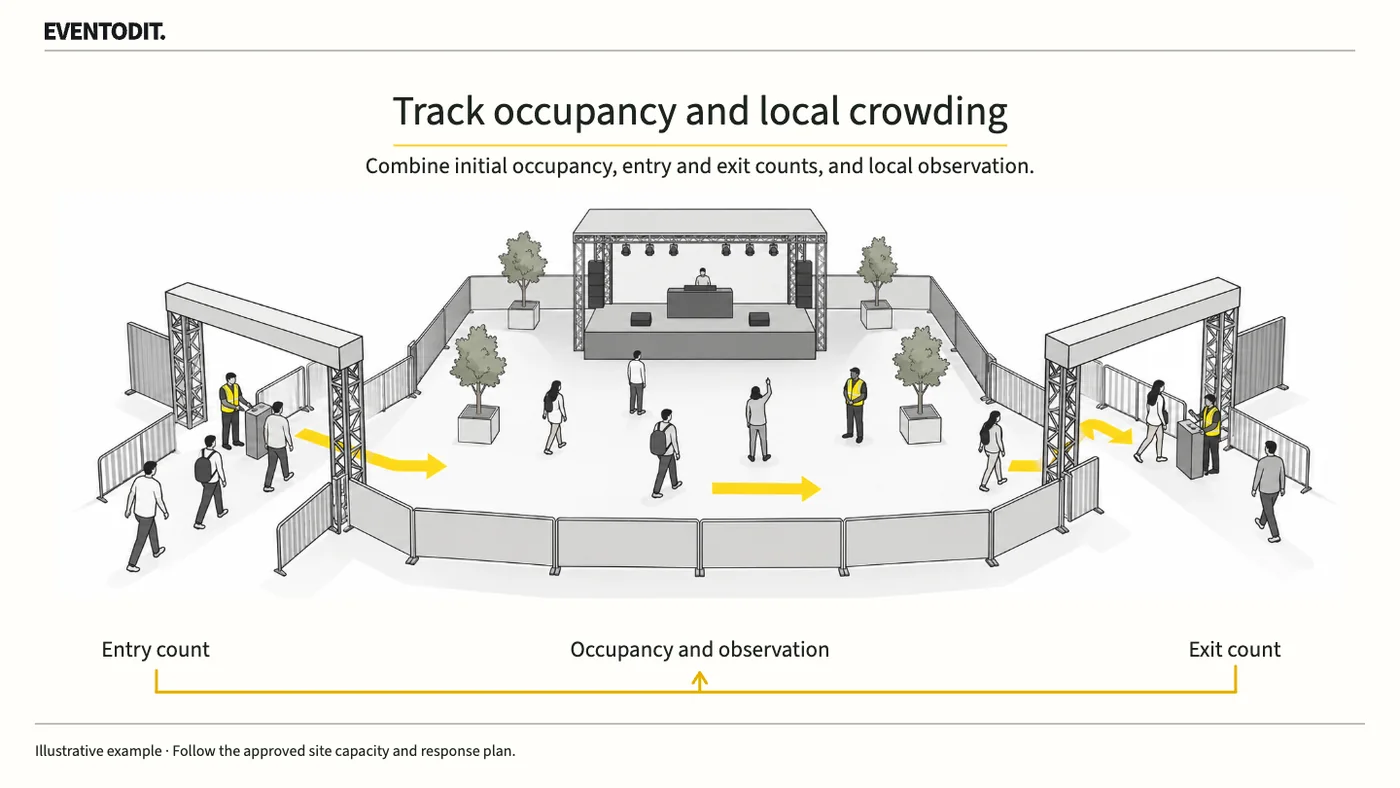
Event Occupancy and Crowd Density Management
The day’s entry total cannot show which area is crowded now. Event control should compare entry and exit counts with observations from the same period and identify any gaps in the count.
Read guideHave a correction or additional evidence? Request a correction