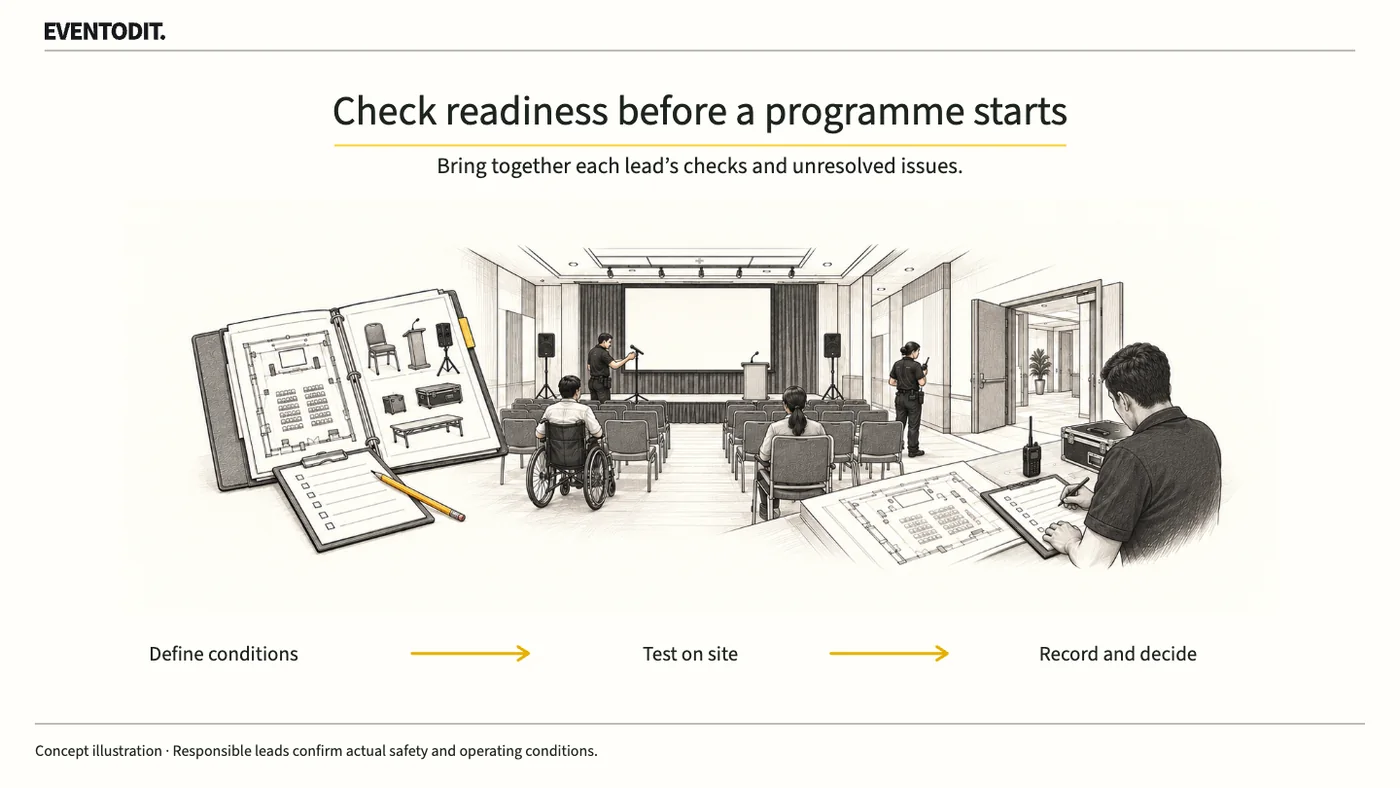
Set start conditions for each programme
Opening the venue and starting an individual programme are separate decisions. A lecture, activity, performance or consultation needs different people and materials. Record the start and finish, location, capacity and owner for each programme, together with prerequisites such as resetting the room, a speaker arriving and materials being handed over.
Ask the venue whether setup, rehearsal and dismantling are included in the booking, and compare the contracted hours with the work actually required.
Assign the owners and start decision-maker in advance
Operations confirms contact details and reporting routes for the programme lead, speakers or performers, technical and participant-support leads and venue manager. Agree who covers each role when the assigned person cannot be reached.
Name in the event plan the person authorised to decide whether each programme starts or is held. Operations sends that person the owners’ checks and outstanding issues. Record the decision-maker, decision time and reasons.
A completed technical test does not approve venue safety or participant support. Electrical, structural, fire and other specialist decisions follow the qualified lead, venue and relevant authority procedures.
Test the conditions participants will actually use
The technical lead tests the final presentation file and playback equipment, microphones, screens, video and sound in the intended sequence. For remote participation, separately check access, presentation permissions, audio delivery and what on-site and online participants see. Record file receipt separately from successful playback.
The programme lead checks room layout, entry and exit, session-change time, materials and consumables. An activity may need equipment handover and use instructions checked; a lecture may require separate confirmation that the speaker and presentation are ready.
Check access support and emergency readiness together
The participant-support lead checks promised or needed support with the relevant owners under the conditions participants will actually use. Select the checks relevant to the event.
- Captions or sign-language interpretation promised for the event are visible to participants and the necessary audio connection works.
- Wheelchair routes and seating are available and signposted.
- Required assistive listening equipment and alternative text or audio descriptions for visual material are ready.
If support is unavailable or fails, tell operations and discuss accurate communication and feasible alternatives with affected participants. Do not mark unconfirmed support ready.
The safety lead checks emergency plans, entry and evacuation routes, communications and necessary staff with venue management and the relevant specialists. UK HSE guidance covers route management and emergency preparedness; it is not a Korean legal standard. Follow the applicable venue and local procedures.
Keep unresolved issues separate from the start decision
Each lead reports the item, check time, result and unresolved reason to operations. Hold the programme if a mandatory check is missing or a safety or essential access-support issue remains. Assign an action owner, deadline and recheck time during the hold.
Operations gathers results and reports them to the previously designated decision-maker, who makes the final start or hold decision based on the relevant leads’ confirmations. Record the decision time, reasons and remaining actions. Check proposed changes or alternatives against the event plan and information given to participants. Mandatory legal and safety conditions must not be omitted at discretion.
If immediate danger arises, prioritise participant protection under the established emergency procedure and contact outside responders as necessary. In Korea, 119 may be appropriate depending on the situation; elsewhere follow the local emergency contact system.
Fictional example: checking captions before a lecture
This fictional example illustrates a workflow; it is not evidence of a real event or approval.
Forty minutes before a lecture, participant-support staff find that promised captions are not visible on the participant screen. Operations holds the start and records the missing captions, unknown cause, technical action owner and a recheck 20 minutes before the start. Technical and captioning staff check the display connection.
After a fix, participant-support staff recheck captions on the participant-facing screen and report the result. Operations confirms the remaining conditions with the speaker, venue and access-support leads and reports to the designated decision-maker, who records the decision and reasons. If unresolved, discuss alternatives with affected participants and communicate accurately; keep the programme on hold if an essential condition is unmet.
Example timeline before the start
These times are fictional examples. Adjust them to the programme’s risks and preparation needs, allowing time for action, rechecking and a decision.
| Timing | Check | Owner |
|---|---|---|
| Week before | Programme start conditions, venue hours and decision-maker | Operations lead |
| Day before | Technical test, access support and emergency contacts | Technical, participant-support and safety leads |
| 2 hours before | Speaker arrival, material handover and room layout | Programme lead |
| 40 minutes before | Collect reports and list unresolved issues | All leads and operations |
| 20 minutes before | Recheck unresolved issues and record start or hold | Decision-maker |
Scroll sideways if needed to read every column.
Check record template
Record each check for each programme. The designated decision-maker makes the decision; separately record its time and reasons. The result can be recorded as pass or fail, and the decision as start or hold.
| Programme | Item checked | Check time | Result | Unresolved reason | Action owner | Recheck time | Decision |
|---|---|---|---|---|---|---|---|
Scroll sideways if needed to read every column.
| Decision-maker | Decision time | Reasons | Follow-up |
|---|---|---|---|
Scroll sideways if needed to read every column.
Hand changes and unresolved items to the next session
If conditions change during a programme, the responsible owner immediately tells operations the impact and action needed. Hand the next team the updated layout, technical setup, access-support status and unresolved issues, and confirm that changed information reaches participants. Even in the same venue, sessions may need different people, materials or support.
Final check before use: Before starting, compare prerequisites and owners’ reports, action and recheck times for unresolved issues, and the designated decision-maker’s start or hold decision and reasons.
Scope
This is EVENTODIT’s practical proposal informed by UK HSE and VisitEngland safety and accessibility guidance. The timeline and record table are editorial examples. Do not apply one venue’s or country’s conditions unchanged elsewhere; follow the approved site plan, applicable requirements and confirmation by qualified leads.
Specific venue conditions, decision authority, safety compliance and actual outcomes have not been established.
Use the form for the next handover
Use the [Programme start conditions, checks and decision log](/en/templates/programme-start-readiness.html) for the records described here. The XLSX contains Blank, Example and Instructions sheets. Write your event in Blank; the fictional example is a guide to what to enter.
Create a row for each programme check with its owner and backup contact. Record actual findings and evidence and distinguish a repair report from a recheck.
Operations sends evidence and the start decision to show, venue, technical and audience-support leads. Hand changed conditions and open support/actions to the next session.
Conditions for applying this elsewhere
Verify the event, venue and local requirements with the people responsible; overseas guidance is not Korean law.
Information not established
Specific site conditions, authorities and actual event outcomes have not been verified.
Reference material
Have a correction or additional evidence? Request a correction