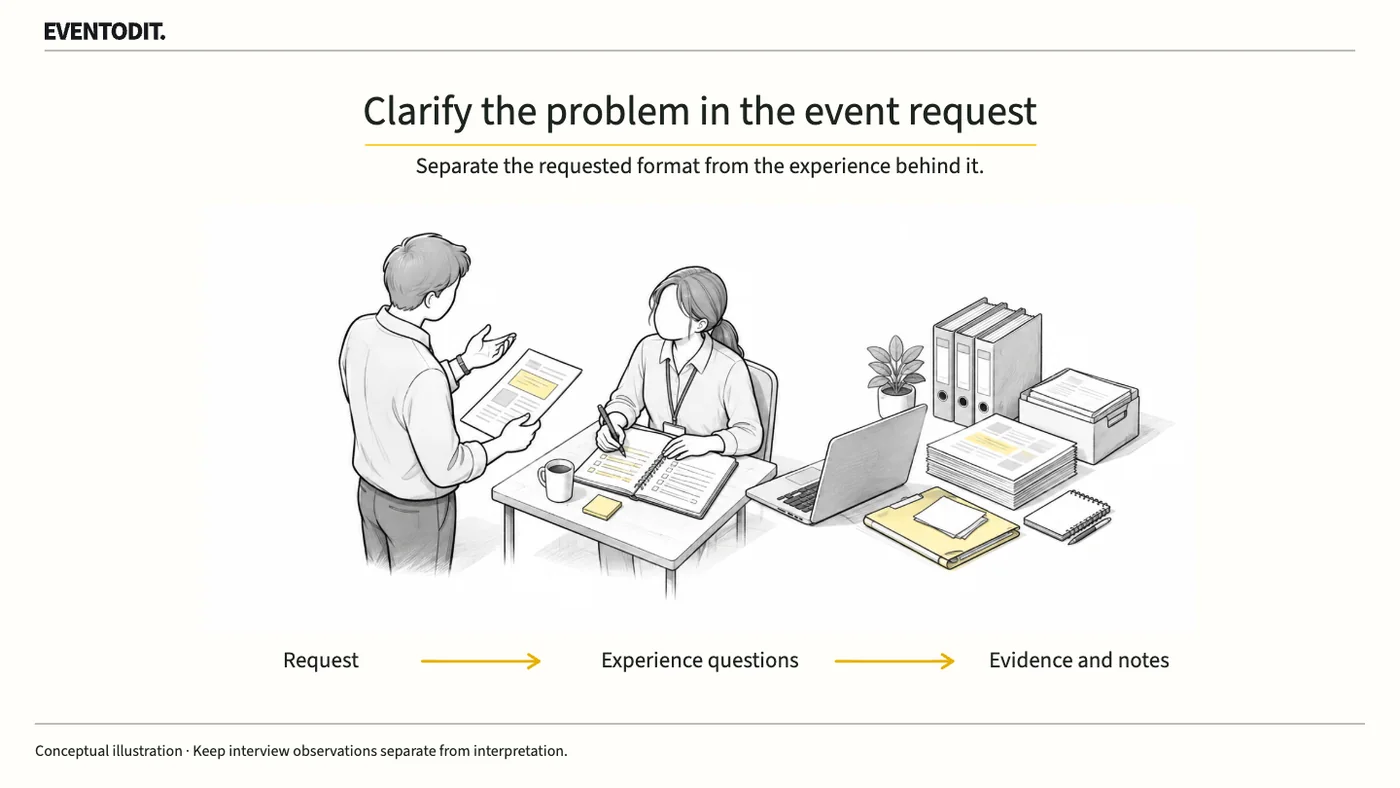
Check the background against records first
Before the interview, gather the request email, evaluations of previous events, relevant enquiry records and the guidance currently available. Record the date and scope of each source, because they may have been produced at different times and cover different people. Filling gaps with assumed causes can turn an interview from fact-finding into persuasion.
Ask the requesting department about the background and expectations, and ask the people doing the work where the process breaks down. If the issue concerns participants, plan to hear from participants themselves. Do not establish the needs of the entire audience from the requesting department’s account alone.
Begin with a recent experience rather than an event format
Asking “What kind of event would you like?” tends to produce an event name. Instead, ask “Could you describe a recent situation when this problem occurred?” to learn the date, place, people involved and task underway. Then ask, in sequence, where they got stuck, how they responded, what the impact was and whether there are records to check. Ask about event ideas last.
Ask about observable actions behind evaluative labels
Do not simply record an answer such as “Participation is low.” Ask what participation means and what behaviour the person observed directly. The next evidence to check differs completely depending on whether people did not register, registered but did not attend, or attended without talking to others.
Record a statement such as “A large event would help” as a hypothesis about a solution. Ask what experience led to that view and what actions the person expects an event to enable. Take care not to put the answer into the question.
Separate the record into four categories
The note-taker records what was said, evidence checked, the planning team’s interpretation and proposed solutions separately. Mark words that cannot be recalled accurately as a summary rather than a quotation. After the interview, the interviewer and note-taker compare the record together and correct omissions and interpretations.
The following is a fictional record, unrelated to any actual organisation.
| Item | Fictional example |
|---|---|
| Request | A request to hold a discussion meeting for new suppliers |
| Account heard | The requester says they have heard that new suppliers find it difficult to locate a contact point for enquiries |
| Evidence checked | Only the requester’s account has been obtained. Supplier accounts and enquiry records remain unchecked |
| Provisional interpretation | Some new suppliers may be unable to find a contact point. The extent and recurrence are unconfirmed |
| Next check | Keep the meeting as one of several options. The requesting department will provide enquiry categories and current guidance by the agreed deadline; the planner will check supplier experiences |
Scroll sideways if needed to read every column.
Compare people’s experiences with the evidence
One person’s experience can indicate that a problem may exist; it does not establish its prevalence or the views of everyone. If internal and participant accounts differ, retain both, record the difference and decide what further evidence is needed. When examining enquiry records, check whether the time periods and classification rules are comparable.
Check the summary before closing
Before finishing the interview, the interviewer summarises in their own words who was trying to do what, in which situation, and where they got stuck, and reads it back. Agreement with the summary does not mean the cause or solution has been verified. Retain points of disagreement. Attach the evidence needed, an owner and a deadline to each unconfirmed item.
Practitioner checklist
- Does the record describe a recent experience and blocked action rather than only the requested event format?
- Are direct experience, second-hand accounts, checked records and the planning team’s interpretation distinguished?
- Have evaluative labels been clarified as observable actions?
- Are the requested event and its expected effects recorded separately?
- Does every unconfirmed item have an owner and a deadline?
Use the form for the next handover
Use the [Event-request interview, evidence and unknowns log](/en/templates/request-interview-evidence.html) for the records described here. The XLSX contains Blank, Example and Instructions sheets. Write your event in Blank; the fictional example is a guide to what to enter.
Record the recent task and where it became blocked before considering event ideas. Distinguish direct accounts, hearsay, quotations and summaries and link evidence actually checked.
The interviewer sends the summary, evidence and assumptions to the problem-definition owner. The options reviewer treats the requested event as one possible response and follows up missing evidence.
Conclusion
The interview output is not approval to hold an event. It is a description of the problem, with evidence and outstanding questions. The event can be chosen at the next stage, after comparison with other responses. Before designing an event as soon as a request arrives, first check whether the problem can be explained.
*Reference: Adapted for event intake from user-research guidance in the GOV.UK Service Manual and the in-depth interview section of the Korea Institute of Design Promotion’s Citizen Design Group manual. The example is fictional and is not an actual research finding.*
Conditions for applying this elsewhere
Use when an event format is requested before the underlying problem is clear, or internal and participant accounts differ. One person's experience does not establish prevalence.
Information not established
This editorial procedure applies UK public-service research and the Korean citizen-design manual to event requests. No original fieldwork or verified event outcomes are claimed; worked examples are fictional. Agreement with a summary does not validate a cause, solution or event approval.
Reference material
- GOV.UK Service Manual · Using in-depth interviews: neutral questions, experience, follow-up and consent
- GOV.UK Service Manual · Learning about users and their needs: real users, evidence and problems
- GOV.UK Service Manual · Analyse a research session: observations, interpretations and actions
- Korea Institute of Design Promotion · 2018 Citizen Design Group manual · in-depth interviews, pp. 56–57
After reading, complete the next task
An evidence-linked problem brief with direct and second-hand accounts, provisional interpretations, proposed solutions and follow-up checks.
This article’s template
Event-request interview, evidence and unknowns log
An interview record distinguishing the requested event format from the problem, evidence and assumptions
Instructions, examples & downloadsRelated practical guides
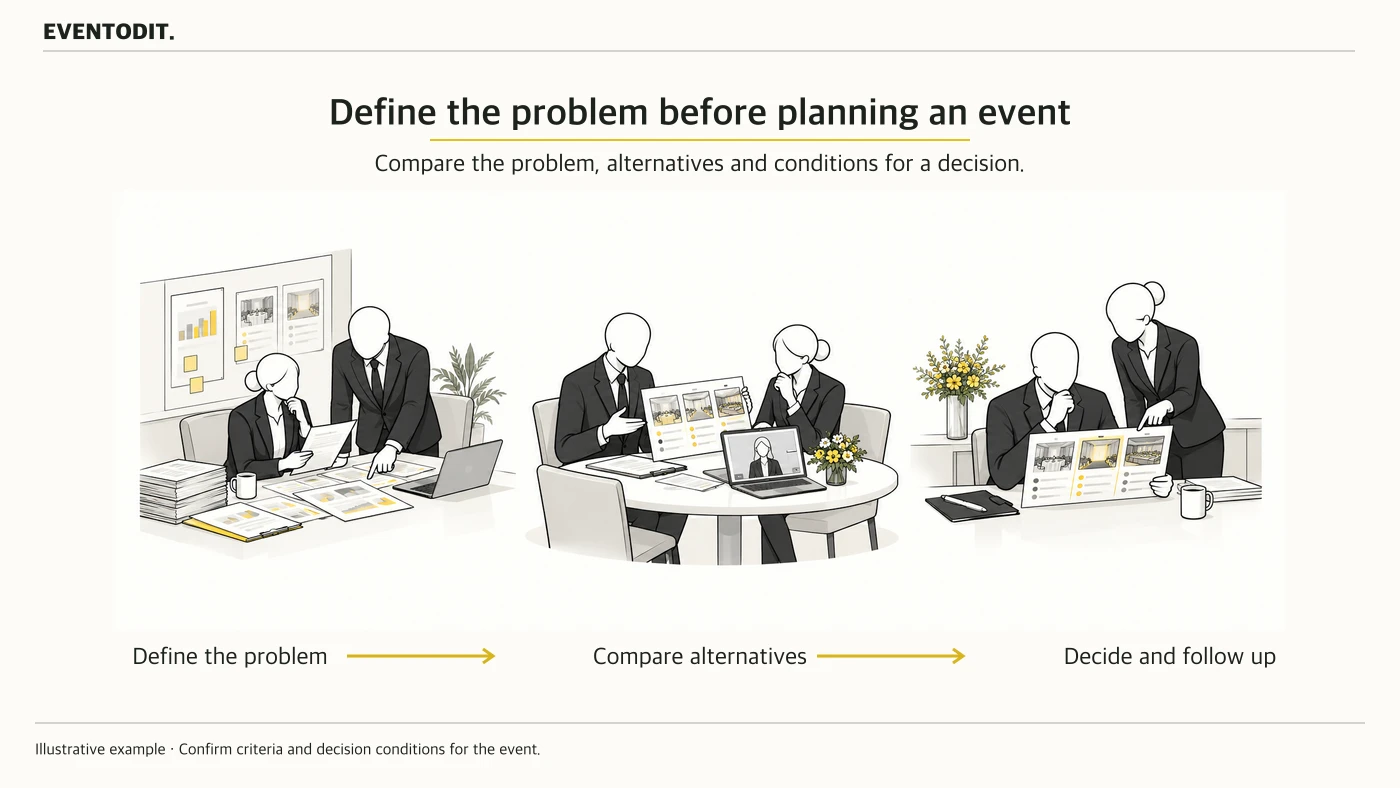
Defining the problem and assessing options before event planning
Clarify the request and underlying problem, then compare business as usual with feasible alternatives.
Read guideHave a correction or additional evidence? Request a correction