AI gains a route into event operating functions
Eventus announced its MCP connection on its official blog on 15 October. According to the company, users can ask AI to retrieve event information, create events, send notices or emails, and change participant status to approved, waiting or cancelled. The scope has expanded from copying an AI answer into another screen to requesting functions of a connected service through AI.
MCP is a standard for connecting AI with work tools. However, a platform supporting MCP does not mean that every function of that platform can be used through AI. The relevant scope here is the functionality and conditions Eventus has published.
Agency services need to define the outcomes beyond screen-based work
If repetitive tasks within a platform can be requested through AI, agencies need to explain again which parts they will provide as a separate service. Creating a page or transferring a registration list has a different scope from defining information and participation conditions around a client’s event objectives and delivering the actual operations.
This does not mean existing production work disappears immediately. Someone still needs to determine whether client materials have been assembled, whether schedules and speaker information are current, and whether the proposed participation format is supported by the platform. The person reviewing the output, the number of revisions and time spent waiting for client replies also form part of the service cost. Costing only the time spent generating an output can easily omit this work.
One approach is to separate work that platform functions can handle from work for which people remain responsible, such as planning, content review, connecting client systems and onsite response, when preparing a quotation. Any savings must then be established against the actual workload and contract conditions.
Checks before execution and corrections after failure also have costs
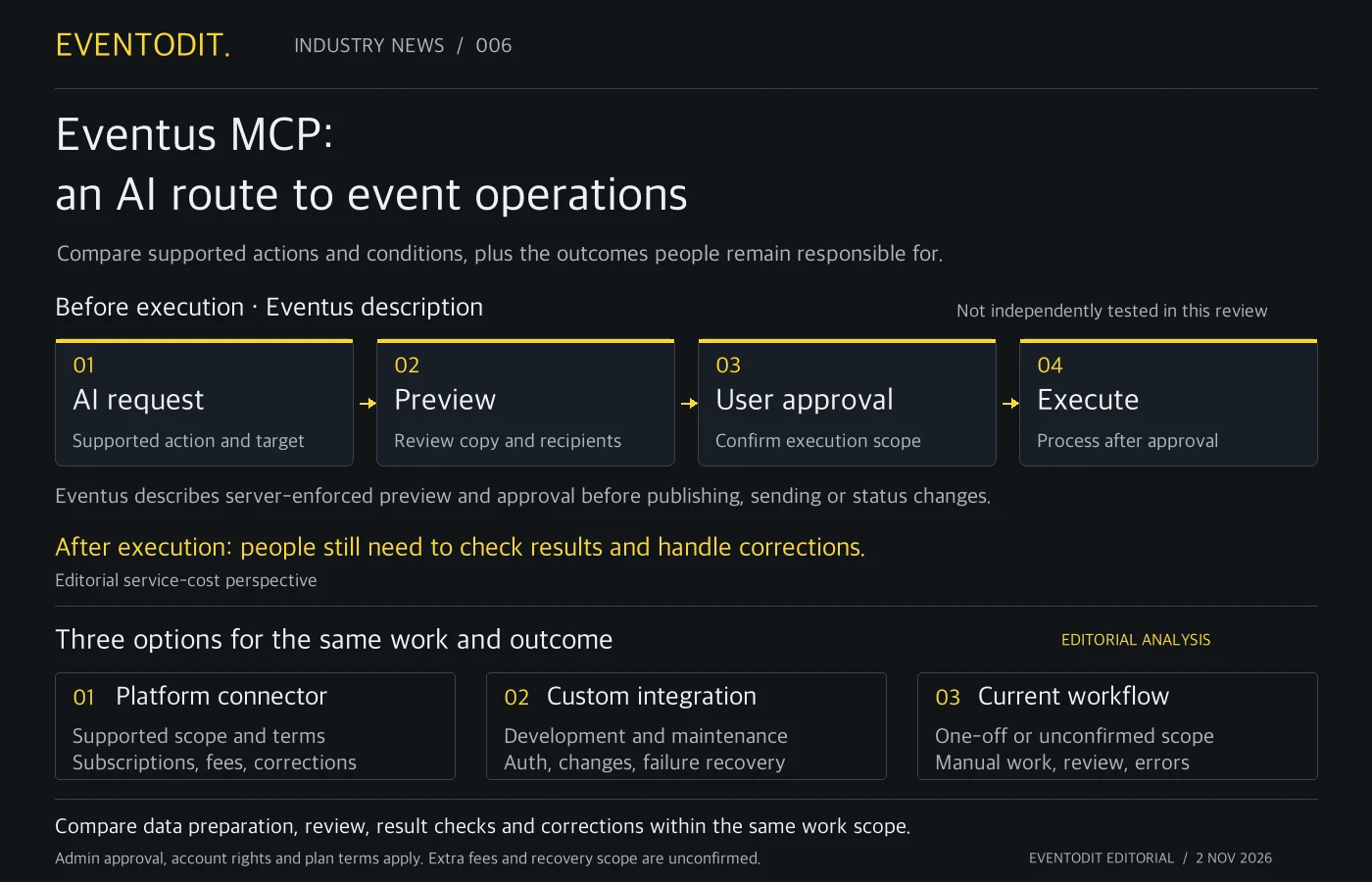
Eventus says it shows a preview before publishing, sending messages or changing status, executes only after the user approves, and enforces this process on the server. This is the supplier’s description, rather than a claim independently tested and verified.
For a business, the preview is where human review takes place. It must decide who will check that the confirmed event and target are correct, that the recipient scope and count are appropriate, and that public wording contains no unconfirmed conditions. As AI requests several steps in sequence, the scope of work covered by a single approval also needs to be clear.
Someone must also check whether the requested state matches the actual result after execution. When a task that stopped midway is requested again, not knowing which parts have already been processed can lead to duplicate notices or incorrect status changes. This does not mean such errors have been reported at Eventus; these are failure scenarios to examine when comparing connected services. The public guide did not establish the extent of message cancellation, data restoration, retries or processing history. Before checking these functions, it is difficult to reduce recovery staffing on the assumption that every change can be reversed.
Account permissions and data preparation define the service scope
According to Eventus’s guide, completing the connection requires approval from an Eventus administrator, and users can work only with channels and events where they are registered as a host or co-operator. Adding a connection does not provide access to all of a client company’s event data. An agency’s proposed scope must also be based on the accounts and events it actually handles.
Data preparation also has a cost. If registration, admission and cancellation records are held in separate materials, or a client uses a separate system, being able to ask AI questions does not reconcile the data into one consistent set. Someone must be responsible for deciding which values are current, how the same participant is identified and how results will be used in client reporting. This work is a separate cost from fees for using the connection.
Businesses also need to check what information is passed to external AI services. Anthropic says remote custom connectors access servers from its cloud, while connected services process data under their own terms. A business must decide how much client information to pass on in light of its contracts and actual materials. If an agency connects a client account, it must first specify the work authorised by the client and the materials to be transferred in order to explain its service scope accurately.
Connection conditions and fees need to be assessed together
Eventus’s guide explains that using MCP for channel functions offered on paid plans, such as AI Builder and deposits, requires a plan upgrade. Image uploads are supported only in Claude Code, while settlement and payment settings and the channel’s own settings are outside the supported scope. Assuming that the connection can handle the whole event workflow in the same environment can distort a quotation.
Anthropic’s help page says Free users can use one remote custom connector. Eventus’s guide lists Claude Pro or higher as a prerequisite. These are different conditions: the availability of general-purpose connectors does not guarantee an Eventus connection or access to paid functions. Each service’s connection conditions and the AI application’s plan must be checked separately.
A cost comparison must include the AI application subscription, the necessary event-platform functions, data preparation, review staff and correction response. The public materials reviewed here do not state whether Eventus MCP incurs additional charges or usage-based costs. Unknown costs must not be treated as zero when comparing it with custom development or existing agency services.
Compare buying a connection and building an integration on the same work conditions
It is difficult to distinguish the options simply by whether they use AI. Using an existing event platform’s connection, building a separate integration for a client’s workflow and retaining the current approach need to be compared against the same tasks and outcomes.
An existing platform connection is suitable when the required data and tasks fall within its supported functions and account and client usage conditions are met. Its assessment must include subscription and feature fees, data preparation, execution checks, unsupported work and correction response.
A separate integration is worth considering when recurring client workflows or connections to internal systems are required and someone can take responsibility for development and maintenance. The assessment must also cover actual API usage conditions, responses to changes, authentication management, result reconciliation and failure-recovery costs.
Retaining the current approach is suitable for one-off work or when the connection’s permitted scope and recovery conditions have not been established. Recording manual work and review time, along with the cost of transfer errors, can provide a basis for later comparison.
Supporting a standard does not by itself secure the required functions or rights. The differences between these three options emerge from the work a company repeatedly undertakes and the capabilities it can maintain.
The next proposal should describe the work retained after automation
Eventus’s MCP release is significant because it presents a specific route for AI to request operating functions in a Korean event SaaS platform. Opportunities for agencies and suppliers extend beyond substituting for screen interactions. How they make client data ready for operations, verify the results of messages and notices, and provide corrections when exceptions arise also becomes important.
When comparing adoption options, it is useful to define the same scope for a task, from preparing its data to checking results and correcting errors. Measure the time taken, the manual work that remains and the client’s review burden within that scope before deciding prices and staffing. Rather than promising unmeasured savings first, explaining which requests are automated and which outcomes remain a human responsibility provides a basis for offering the connection as a sustainable service.
Conditions for applying this elsewhere
This article describes functions in Eventus’s public guide of 15 October 2026. Actual connection requires administrator approval, account permissions and plan conditions. Anthropic’s general-purpose connector availability does not guarantee a particular service connection or access to paid functions.
Information not established
Additional MCP charges and usage criteria, actual usage, productivity and cost savings, and the scope of message cancellation, data restoration, retries and processing history were not established. Security and server-enforced approval procedures are company descriptions and were not directly tested in this review. Retention and model-training conditions for materials passed to external models under client contracts were also not established.
Reference material
Have a correction or additional evidence? Request a correction