The policy horizon extends beyond a single edition
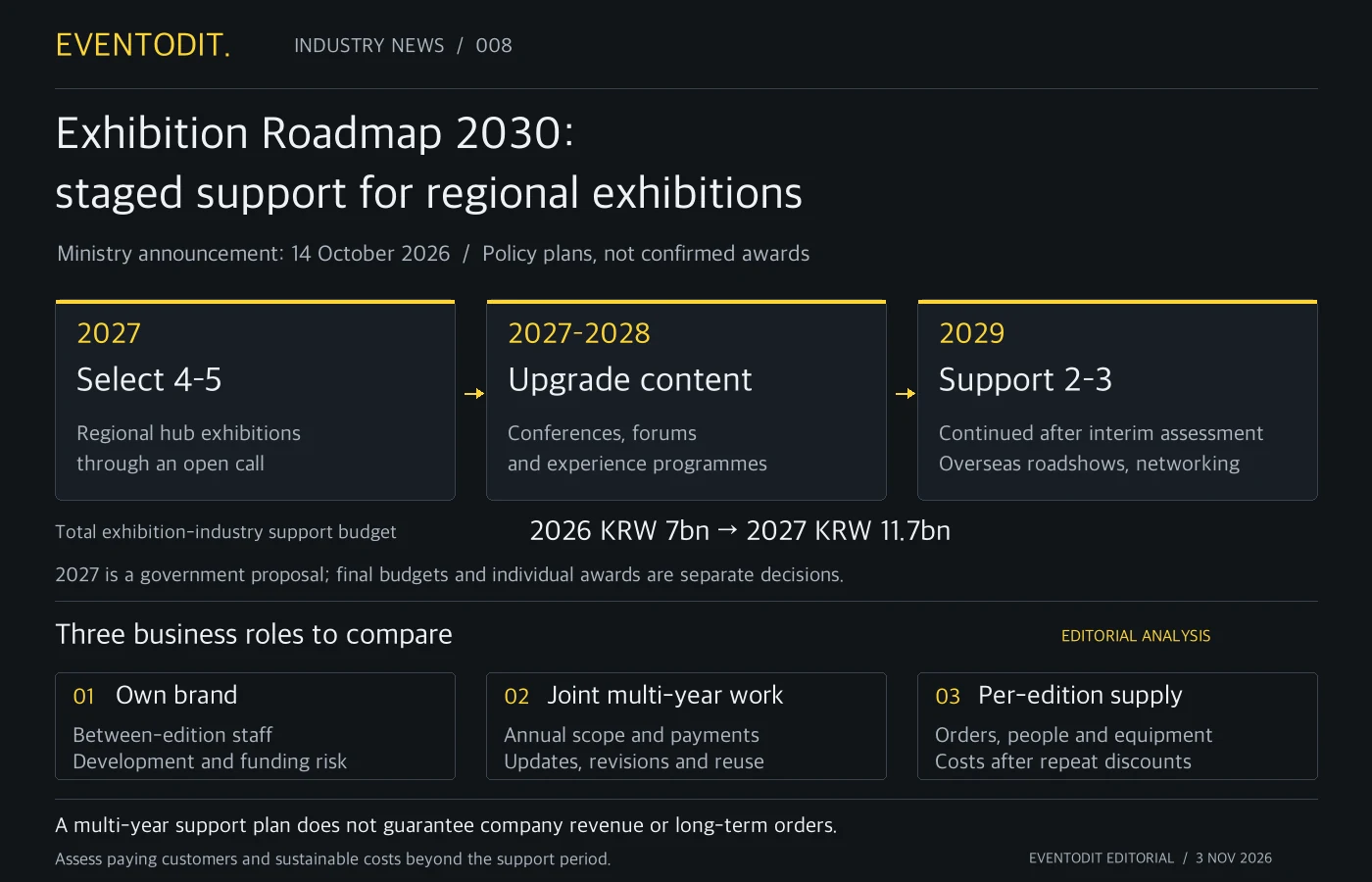
The roadmap divides regional exhibition development into stages. An open call will select four or five exhibitions in 2027. In 2027–2028, the focus will be on developing content such as conferences, forums and hands-on experiences. Following an interim assessment in 2029, two or three exhibitions will continue to receive support, with greater emphasis from that point on globalisation, including overseas roadshows and networking with diplomatic missions.
Selection criteria are links to regional growth engines, a specific growth strategy, exhibition infrastructure and scale, and local governments’ commitment to support. The government also said it would establish regional exhibition alliances bringing together regional exhibition operators, businesses and small merchants, and pursue the designation of exhibition-industry development districts. These are policy plans, however, rather than confirmation that individual exhibitions have already been selected or companies have secured multi-year revenue.
The editorial team reads this plan less as an opportunity to increase the number of events than as a shift that asks how knowledge, programmes and customer relationships built through one exhibition can carry into its next edition.
Multi-year support is different from multi-year revenue
The Ministry of Trade, Industry and Resources said it had drawn up a government proposal to increase exhibition-industry support from KRW7 billion in 2026 to KRW11.7 billion in 2027. This is an increase in the overall support budget, rather than an amount to be paid to one regional exhibition or individual company. Drawing up a government proposal, finalising the budget and deciding individual support awards are different stages.
If an agency hires dedicated staff or an organiser promises several years of content production, it must also consider costs if support does not continue. Research, speaker recruitment and new programme development incur costs before the next edition opens. Treating future support as confirmed income obscures how much the company can afford in salaries, external fees and customer-acquisition costs.
The support period is also different from the period over which a product is sold to customers. Staffing needs differ depending on whether this year’s sessions will be sold again unchanged next year, or updated industry information and new participant experiences will be provided. The economics of a multi-year plan emerge from what must be renewed each year and who bears that cost, more than from the total amount of support.
Event delivery and accumulating content require different capabilities
An edition-specific delivery contract may end once production, registration and event operations have been completed within an agreed period. Continuing to develop a specialist exhibition’s content, by contrast, requires tracking industry changes and customer questions, and discussing future topics with speakers and exhibitors between editions. Adding this work to the same team does not create a dedicated capability.
Whether an organiser retains this function internally or shares it over the long term with an agency or specialist institution is a business choice. Keeping it internally can build customer context, but requires carrying fixed staffing and learning costs. Outsourcing can provide expertise, but the contract must cover information updates, changes of personnel and the scope of use of materials for the next edition.
The distinction also matters for suppliers. Proposals for equipment, spaces and materials used across repeated editions need prices that cover changes, storage and rights to reuse materials. Promising repeated use while comparing only the initial production cost makes it difficult to explain the work that remains.
Regional links bring different customers and costs together
The press release set out a direction of stimulating regional economies by combining regional exhibitions with cultural, tourism and local-commerce programmes. But not everyone visiting an exhibition buys a tourism product, and not every tourist becomes an exhibitor’s customer. Participants seeking specialist business transactions and accompanying visitors seeking a city experience may choose the same itinerary for different reasons.
The structure of a regional programme therefore depends on whether it is a product sold by the organiser, a public programme provided by local government, or an optional product sold by a separate business. Partners’ revenues and burdens vary with who handles transport, bookings, customer enquiries and the cost of changes. A free linked programme does not eliminate the cost of delivering it.
There must be evidence that customers will return
The government said its assessment would consider links to regional industry, growth strategy, exhibition infrastructure and local governments’ commitment to support. The customer and cost perspective presented here is an analysis of business viability. It does not replace application scoring or performance-assessment methods.
Companies need to distinguish the fact that they developed this year’s programme from the reasons customers would pay for the next edition. Which industry questions led participants or exhibitors to choose the event, and what content will they need next time? These provide a basis for renewing content. Promotional exposure or growth in city visitor numbers alone makes it difficult to judge an individual agency’s recurring income.
Someone must also organise customer feedback and reflect it in the next plan. Companies need to identify materials that can be shared and their terms of use, and allow time to check commitments made in the previous edition. Treating the cost of submitting a report once and the cost of maintaining customer relationships throughout the year as the same post-event administration can omit work needed for an ongoing business.
Companies have more than one role to choose from
The following comparison is the editorial team’s business analysis, rather than an official classification of policy support. Developing a proprietary brand and providing specialist services to several organisers have different revenue and risk structures. The appropriate choice depends on the company’s customer base and the capabilities it can maintain.
The first option is to develop an organiser brand and content directly. This can establish a business base of returning exhibitors and participants and distinctive programmes, but the company must first carry planning and sales staff between editions, development costs and exposure if support stops.
The second option is to deliver multi-year content and operational services jointly. This can build a contractual base for specialist planning, updates and customer service. However, annual scope and payment, revisions and reuse conditions must be clear, while dependence on partners also increases.
The third option is to focus on edition-specific specialist supply. This can build technical, production and operational capabilities to offer across several events, but actual order scope, staff and equipment availability must be checked. The company must also assess whether costs remain manageable after repeat-order discounts.
A long-term relationship does not confirm the next edition’s order volume or prices. If a supplier must reserve equipment and staff in advance, the cost of the period before orders are confirmed also needs to be discussed. A policy’s multi-year plan does not guarantee long-term orders for an individual supplier.
Check whether paying customers will remain after support ends
An exhibition’s public purpose of supporting industrial exchange and the regional economy is connected to how a company recovers its costs, but the two are different. Increased local spending does not necessarily increase an organiser’s income. Nor does producing a good conference establish customer agreement to higher exhibitor fees.
Organisers need a basis for explaining what they will actually sell through exhibitor fees, admission and sponsorship, and the prices customers will bear. Agencies can distinguish event operations, content development and update services in their proposals. Regional service businesses need to identify where their work increases and who is responsible for settlement when they are included in a bundled product.
Companies must also decide in advance what to do if support is reduced or they are not selected for the next stage. Whether to reduce content and focus on core customers, provide services to other organisers or stop new development will vary by company. Without considering services already promised to customers alongside costs already incurred, a business can overlook burdens that do not disappear when support ends.
Define the business to retain to make the policy opportunity concrete
The roadmap aims to develop regional exhibitions over a longer horizon than the delivery record of a single edition. The question for companies is less which support they can receive than which income will sustain the content capabilities and customer relationships they maintain between editions.
Policy and budget proposals indicate a direction, but do not confirm customers, contracts or cash. When organisers, agencies and service businesses each define the business they intend to retain and the period they can afford to carry, they can assess the multi-year development proposal in terms of a sustainable service scope and prices.
Conditions for applying this elsewhere
This article covers the regional exhibition development proposal in Korea’s roadmap announced on 14 October 2026. The stages, assessment and support are plans, rather than confirmation of individual exhibition selections, multi-year contracts or payments.
Information not established
Eligibility and scoring for individual calls, payment and settlement conditions, the final budget and selection results, company-level costs and revenue, and the effects of support were not established. The distinctions between roles and costs in the article are editorial analysis, rather than findings from field research or a business experiment.
Reference material
Have a correction or additional evidence? Request a correction