Updates for event, MICE and PCO professionals, including industry announcements and changes in Korea and worldwide.
Industry news covers changes in companies, markets, policy, technology, workforce and operations; schedules, registration and attendance for individual events belong in Event News.
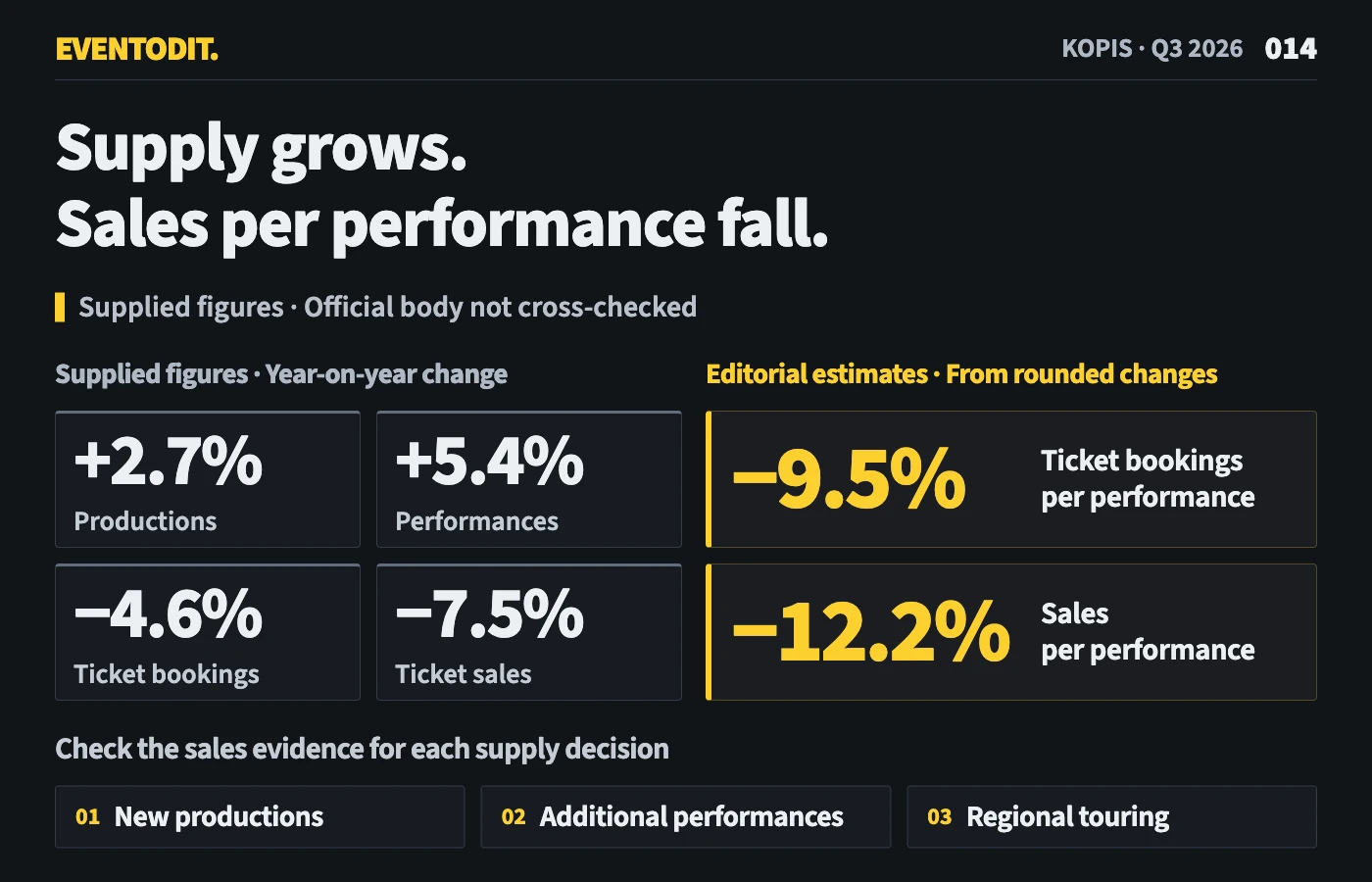
Supplied year-on-year rates: productions +2.7%, performances +5.4%, bookings −4.6% and ticket sales −7.5%. Editorial estimates per performance: bookings approximately −9.5%, sales approximately −12.2%. The official KOPIS body was not cross-checked.
Article summaryThe KOPIS third-quarter material shows more productions and performances, but fewer ticket bookings and lower ticket revenue. Measured per performance, the sales decline is larger than the increase in supply. For producers and promoters, this is a signal to examine the sales evidence for additional performances and new productions more closely, rather than assuming that staging more is the answer.
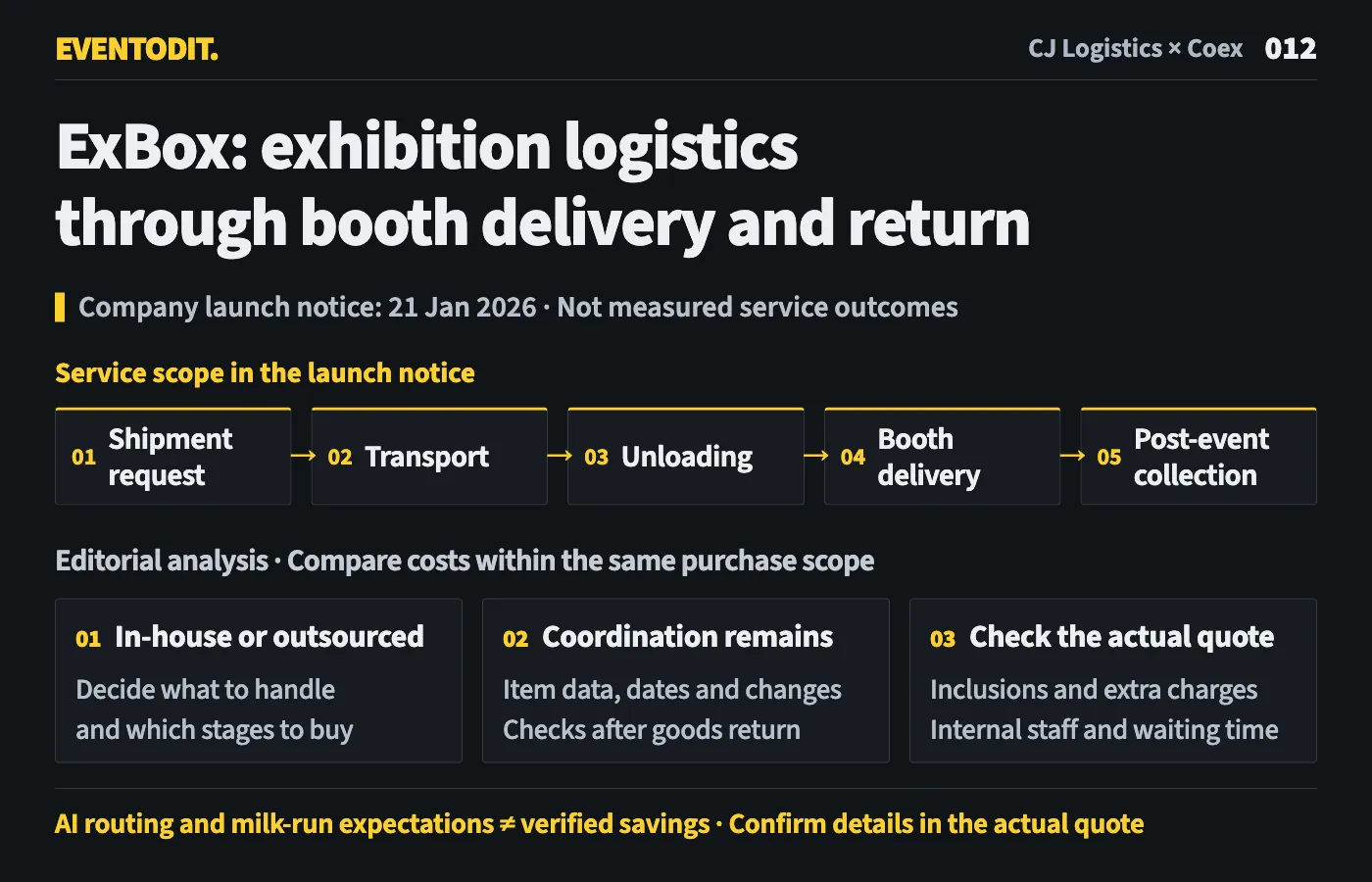
Separate the service scope in the 21 January 2026 launch notice from editorial cost questions. Confirm fees and operating procedures in actual order terms. Expected AI routing and milk-run benefits are not verified savings.
Article summaryCJ Logistics and Coex officially launched the AI-based exhibition logistics service ExBox on 21 January. It aims to bring goods intake, transport, unloading, booth delivery and collection after the event into one service. Businesses need to decide which stages to outsource and which to handle themselves, then compare costs over the same scope.
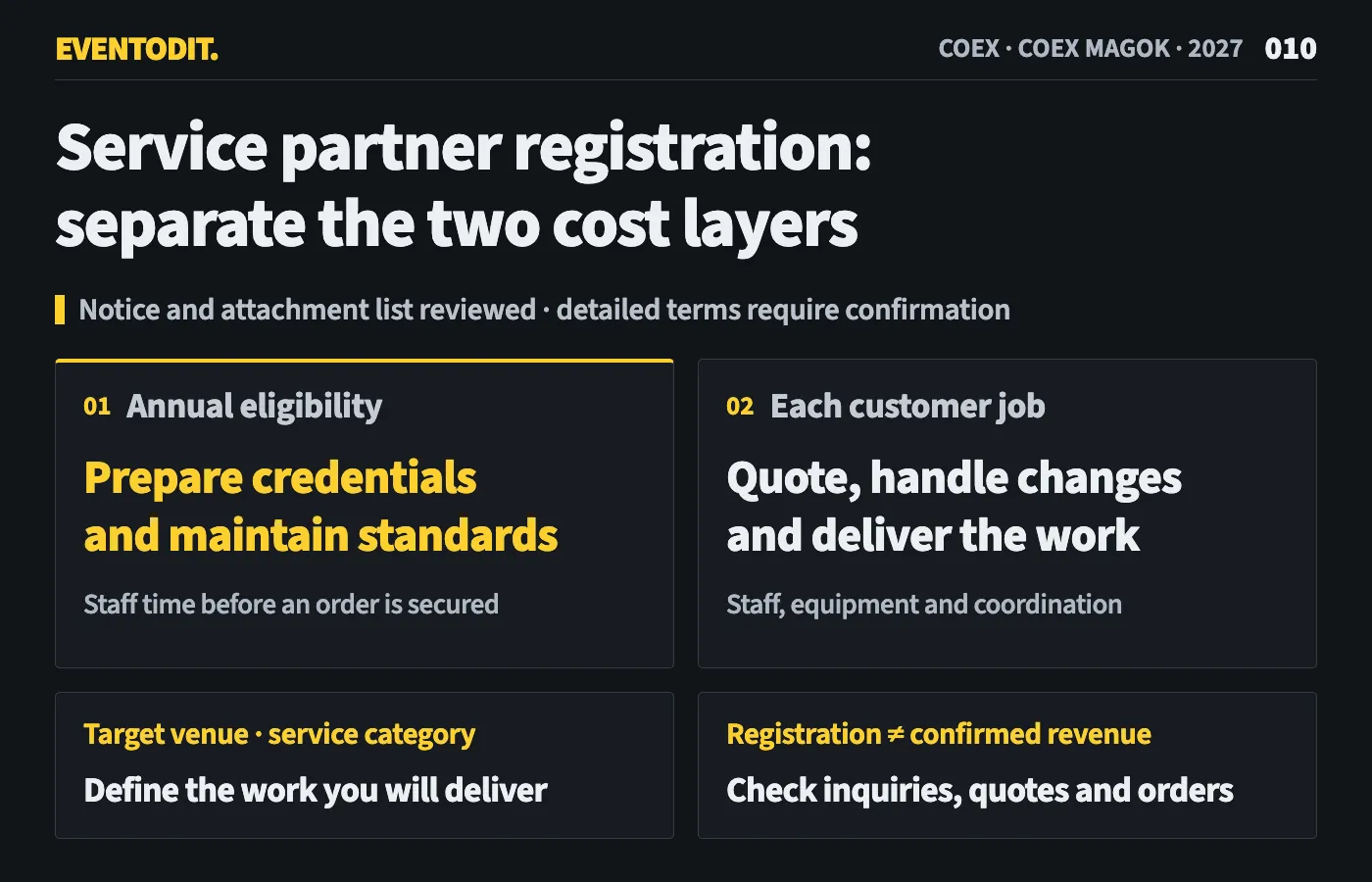
Separate annual eligibility preparation and upkeep from work for each customer. This editorial analysis compares target venues, registration categories, in-house scope and evidence of orders. Detailed attachment terms and schedules require direct checking.
Article summaryCoex and Coex Magok have issued notices recruiting service partners for their exhibition venues in 2027. Becoming eligible to register also takes time and money, so suppliers need to distinguish the cost of maintaining eligibility from the cost of carrying out work for actual customers.
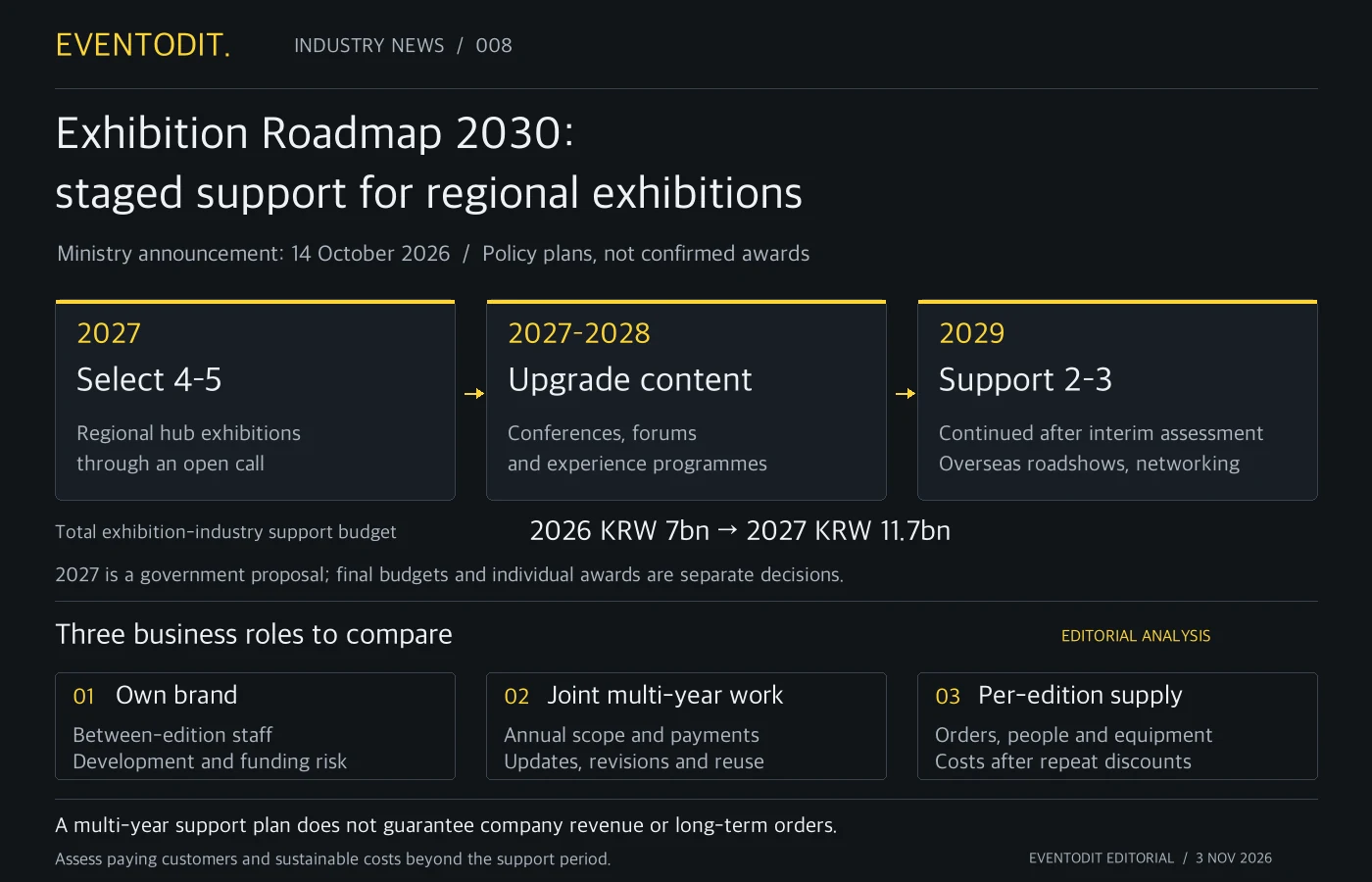
Original chart separating policy stages and the total draft support budget from editorial business-role analysis. Plans do not confirm individual selections, contracts or revenue.
Article summaryOn 14 October, Korea’s Ministry of Trade, Industry and Resources announced its Exhibition Industry Roadmap 2030 and plans to develop leading regional exhibitions in stages. The structure prioritises content development in 2027–2028, followed by overseas expansion support for exhibitions that pass an interim assessment in 2029. Organisers, agencies and service businesses still need to consider staffing and costs between editions, alongside income after support ends.
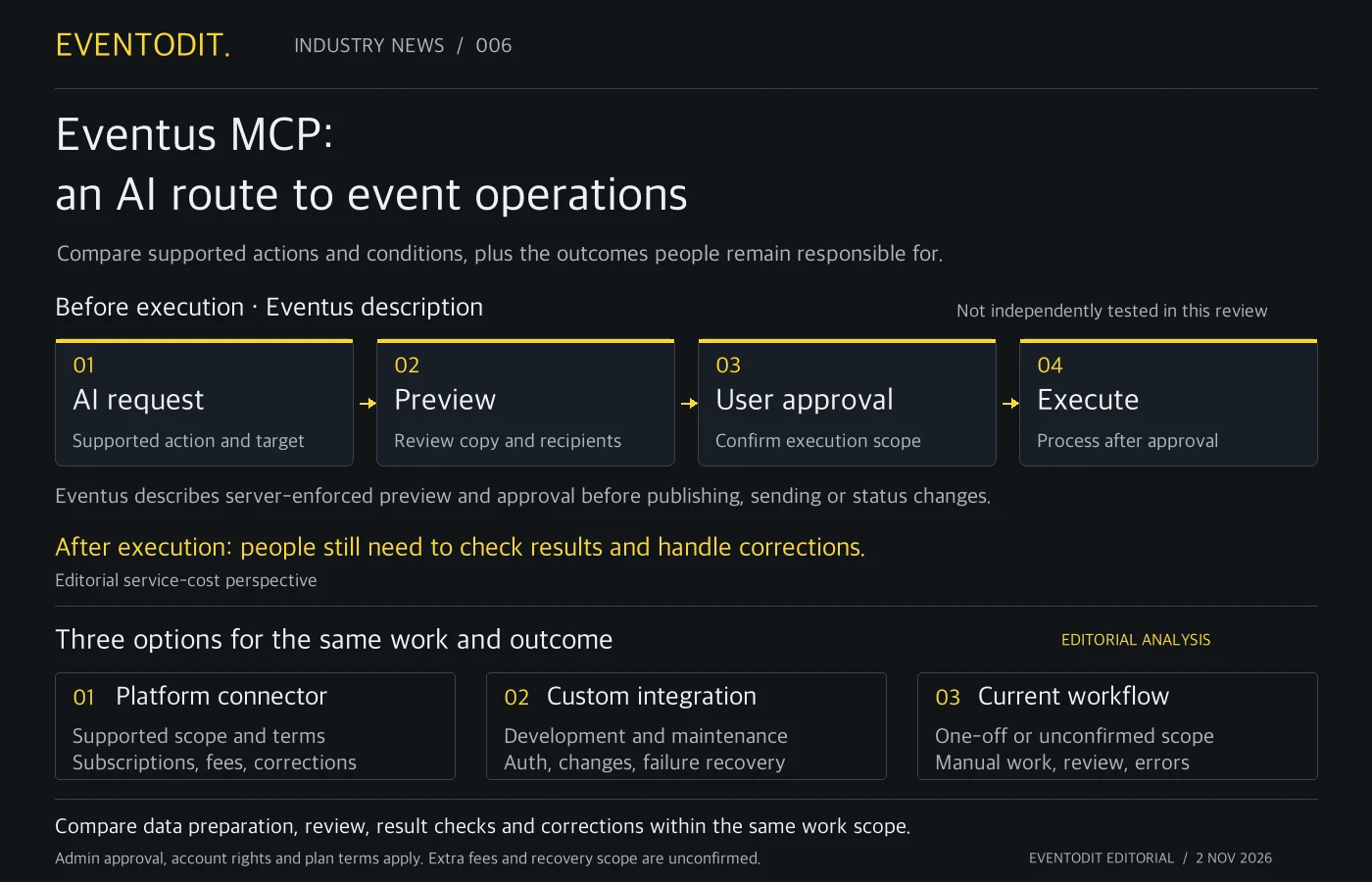
Provider-described execution is separated from editorial service-cost analysis. Compare data preparation, review and correction costs; this is not a test of live access, recovery features or savings.
Article summaryEventus has released an MCP connection for querying event data and requesting operational functions through AI, including publishing, messaging and changes to participant status. Agencies and organisers need to assess more than generation speed. Service costs must also include review, data preparation and error correction.
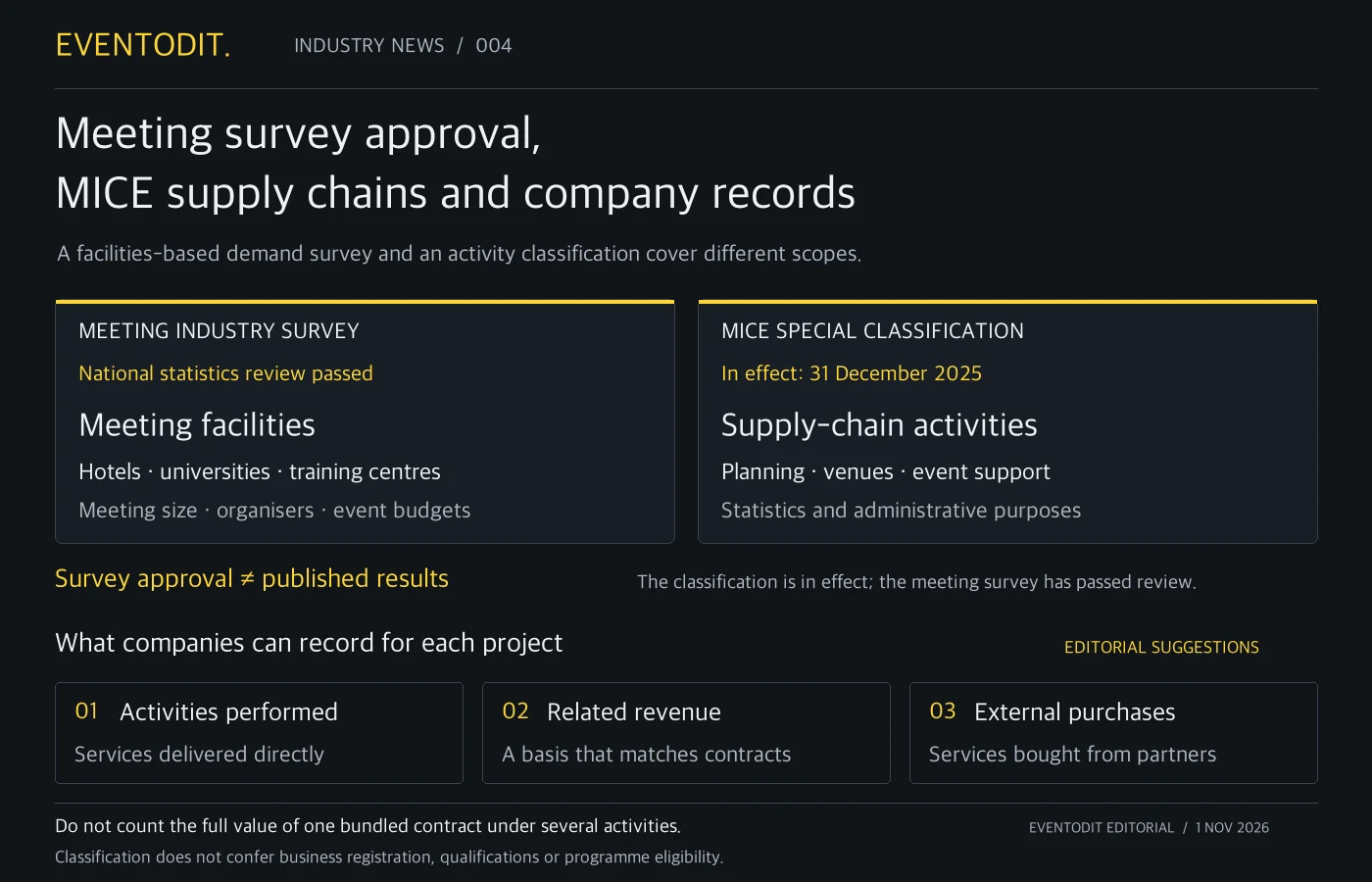
Survey approval, classification taking effect and published results are different stages. Project-record suggestions are editorial analysis.
Article summaryThe MICE special industrial classification took effect on 31 December 2025. The Korea Tourism Organization’s Meeting Industry Survey has since passed the review for nationally approved statistics. The two sources cover different scopes: one examines meeting demand through the facilities that host meetings, while the other classifies activities in the event supply chain. Suppliers need to understand the distinction and decide what evidence to keep to explain their own activities.
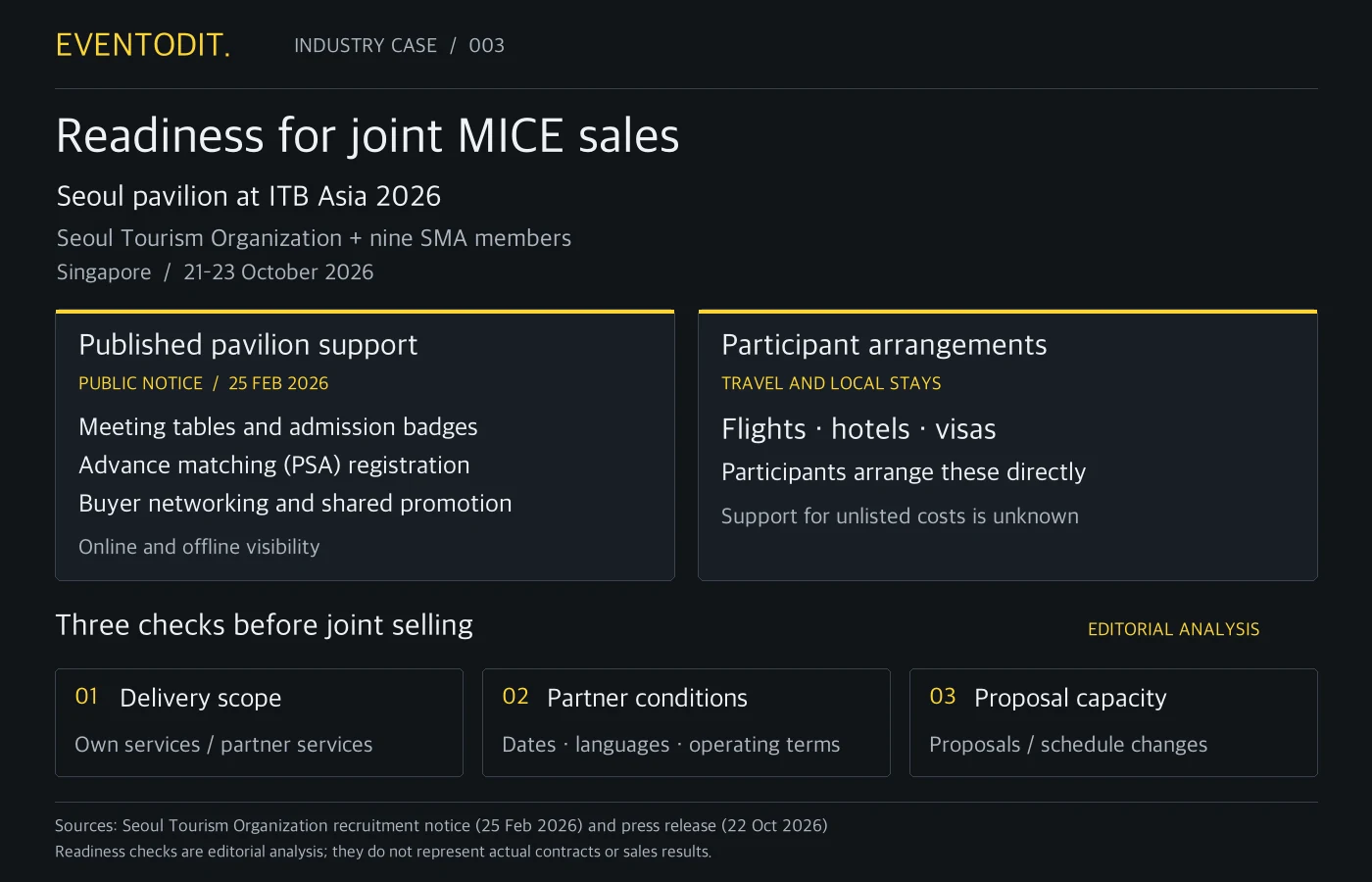
Editorial diagram in English based on Seoul Tourism Organization materials. The support and participant-arrangement panels reflect the published scope; the three company-readiness checks are editorial analysis and do not show actual contracts or sales results.
Article summarySeoul Tourism Organization carried out joint destination marketing at ITB Asia 2026 with nine members of the Seoul MICE Alliance (SMA). The published support terms show how the opportunity to promote a city together differs from the products and people each company must prepare.
Editorial publishing target
Our daily target, including weekends, is one Korea article and one global article, with editorial work starting at 08:50 KST. Publication is held when sources or applicable conditions cannot be sufficiently verified.
Topics we follow
We examine official announcements and applicable conditions before publishing on these subjects.
PCOs & agencies · Business and partnership models
Venue operations · Changes in exhibition and event venue operations
Technology & AI · Adoption cases, availability and operating conditions
Workforce & costs · Staffing, costs and contract conditions