Nine companies introducing the same city
On 22 October, Seoul Tourism Organization said it was promoting Seoul for corporate meetings and incentive travel at the ITB Asia 2026 Seoul pavilion with nine members of the Seoul MICE Alliance (SMA). The exhibition took place in Singapore from 21 to 23 October.
This participation also included collaboration with Gyeongsangbuk-do. Gyeongbuk was introduced as a new PLUS CITIES partner for 2026, and joint Seoul–Gyeongbuk advertising appeared at the exhibition. A linked activity offered souvenirs to visitors who went to both the Seoul pavilion and the Gyeongju Hwabaek Convention Center booth. Bringing several companies together in one city pavilion and combining resources from another region illustrates the scope of what companies can propose together.
Seoul’s competitiveness as a destination provides further context. According to the press release, Seoul ranked first in Asia and third worldwide for the number of international meetings under Union of International Associations (UIA) criteria, and had won Global Traveler’s Best MICE City award for 11 consecutive years.
What a shared pavilion provides and what companies must prepare
The 2026 joint-participation recruitment notice targeted active SMA members, with selection subject to the foundation’s internal criteria. Members could participate in only one of the three specified exhibitions—IMEX Frankfurt, IMEX America and ITB Asia—and could not also participate in another organisation’s pavilion. These were the conditions for the February–March recruitment round.
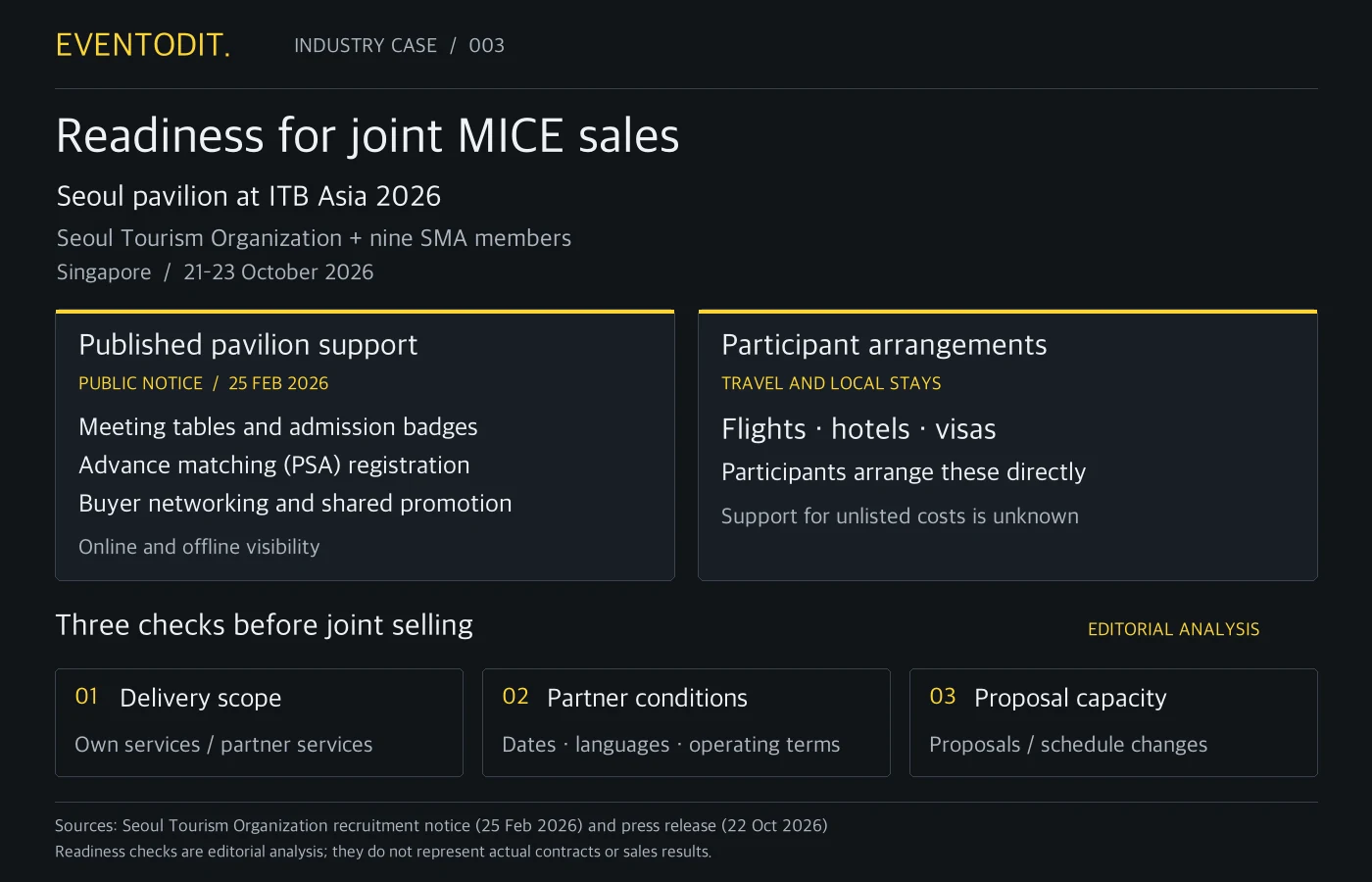
Published support included a consultation table inside the pavilion, registration in the advance matching (PSA) system and admission badges, buyer networking opportunities, and online and offline exposure for joint exhibitors’ promotional materials. In contrast, selected participants had to arrange their own travel and local stays, including flights, hotels and visas. Public materials do not establish whether costs absent from the notice were covered. Companies need to distinguish what is actually provided from what they must prepare themselves.
Between a city’s appeal and the services a company sells
This section is the editorial team’s analysis of the published support terms. A shared pavilion provides a city-level introduction and contacts that an individual company would find difficult to create alone. However, an overseas client planning a corporate meeting needs more than a city introduction: it needs a specific service proposal suited to its schedule and group size.
For example, a company proposing accommodation or a sightseeing programme that also connects another company’s services first needs to know that supplier’s available dates, languages and operating conditions. Listing several companies’ promotional materials and building one itinerary with compatible conditions require different preparation.
Overseas destination programmes connect partners’ services
The Singapore Tourism Board (STB) guidance page was updated on 8 May 2026. It introduces two programmes developed by the Singapore Exhibition & Convention Bureau (SECB) with tourism industry partners. SHINE works with hotels: its 22 partner hotels account for up to 25% of total hotel rooms and offer special room rates and additional benefits to event organisers and attendees. The other programme, SMAP, works with tourism partners to support event operations and offer benefits to participants in the relevant events.
These programmes cannot be treated as the same initiative as Seoul’s joint pavilion. There is nevertheless a useful comparison in the way destination-level marketing connects with companies’ actual services. Korean companies can learn from how an offer clearly explains who provides each service and under what conditions it is available, rather than directly importing overseas discount rates.
Proposal staff are needed beyond the booth
Companies considering a shared pavilion need to account for the staff time required to prepare proposals before and after meetings, alongside booth costs and travel expenses. If the salesperson handling meetings on site and the colleague checking schedules and operational availability are different people, they need to agree in advance what information to exchange and when.
Even with product materials ready, slow answers about availability on specific dates or additional requests can narrow the options a company can offer. For a small business, clearly separating its own responsibilities from matters that partners must confirm may be more practical than owning every service. Staffing and costs differ between companies; public materials do not establish the actual resources committed by this group of exhibitors.
Operating conditions become part of an offer across regions
When promoting several regions together, as Seoul and Gyeongbuk did, companies can go a step beyond listing each city’s attractions. A proposal adding a tourism programme in another region after a corporate meeting needs to consider travel time, accommodation schedules, available languages and local operating partners together.
To offer this as an actual product, companies need to decide in advance who will respond first to the client, who will confirm other suppliers’ conditions, and who will coordinate schedule changes. Client contact details and individual quotations should be shared only with the people who need them, through appropriate channels and in line with each organisation’s information-management standards.
Three checks before joint selling
This case suggests three checks for companies:
- Service scope: Have you distinguished the services your company provides directly from those provided through partners?
- Partner confirmation: Who will confirm dates, languages and operating conditions, and by when?
- Proposal staff: Is someone assigned to prepare proposals after meetings and respond to schedule changes?
Opportunities created by joint promotion are more likely to lead to sales results when these three elements are in place. Simply adding more regions and services to a proposal is not a solution.
Unconfirmed information
SMA exhibitors’ actual costs, contracts, revenue, sales conversion results and internal division of work were not disclosed. Discussion of company preparation, costs and staffing is the editorial team’s analysis of the published support terms.
Reference material
- Seoul Tourism Organization · “Seoul pavilion in morning yellow attracts global MICE buyers at ITB Asia in Singapore” · press release, 22 October 2026
- Seoul Tourism Organization · “2026 global MICE exhibitions: recruitment of SMA joint exhibitors for the Seoul pavilion” · recruitment notice, 25 February 2026
- Singapore Tourism Board · MICE Experience Programmes · updated 8 May 2026
Have a correction or additional evidence? Request a correction