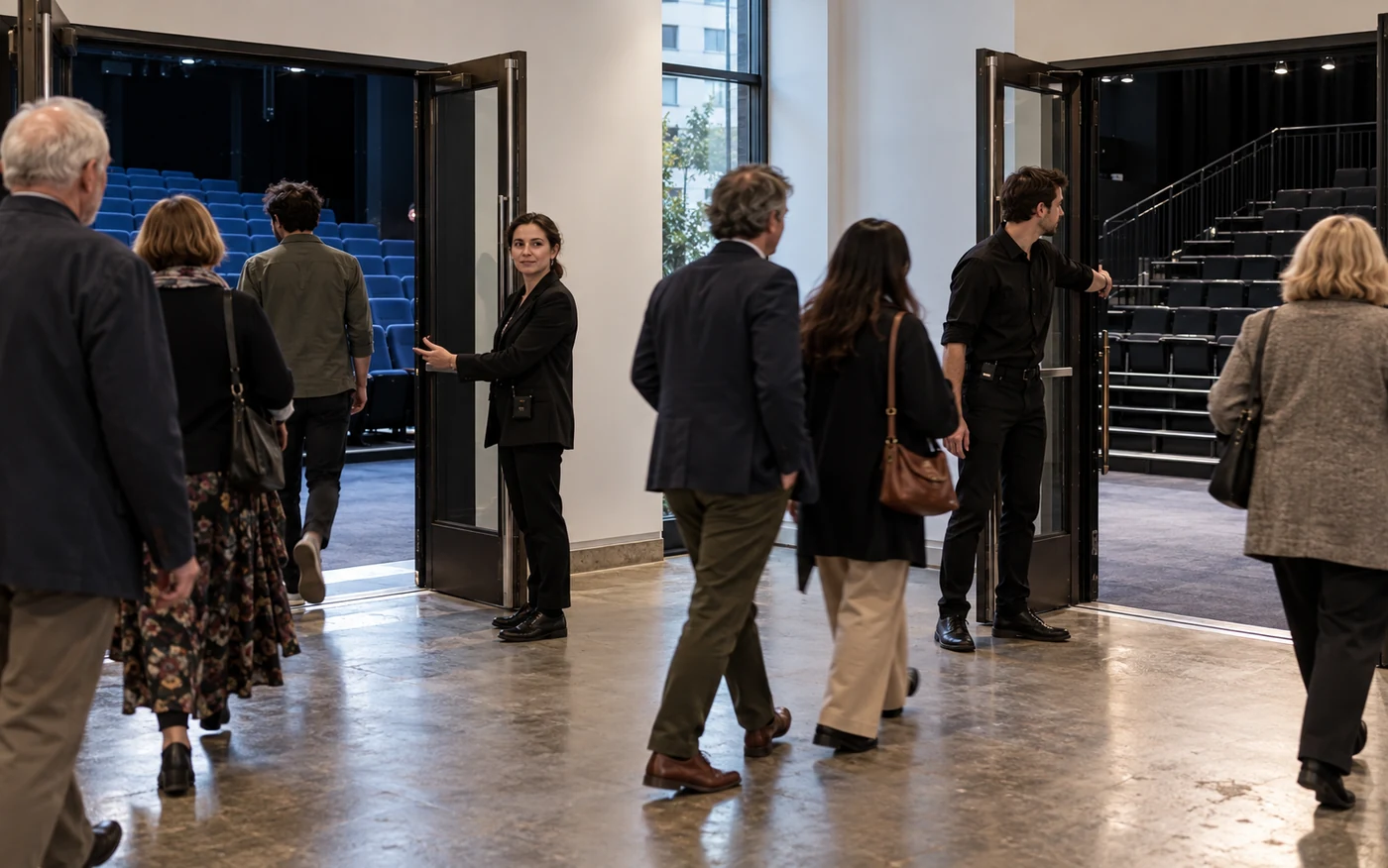
More productions are breaking down the boundary between stage and audience to deepen immersion. The play Frankenstein, performed at Seoul Arts Center in 2024, presented unconventional staging that completely reversed viewing areas between Parts 1 and 2. At intermission, everyone in the first-floor auditorium had to move to seating on the stage, while everyone seated on the stage moved to the first-floor auditorium.
Artistically, this is a fresh approach. For practical planners, however, taking hundreds of people out at once and moving them into another area is a difficult Turnaround mission requiring enormous safety control and Back-end route design. Without meticulous R&R interlocking the planning, house and stage-technical teams, intermission can instantly become a Bottleneck overwhelmed by audience complaints.
1. Decouple the rules: separate individual departures from operational movement
The first task is to remove contradictions in the messages given to the audience.
- Prevent clashing notices: declaring no re-entry after leaving during a performance to protect immersion, while also instructing everyone to exit and re-enter at intermission, confuses audiences. Planners must clearly Decouple an individual’s unexpected departure from an organiser-controlled group move in their guidance.
- Name zones intuitively: if Parts 1 and 2 have different seats, ticket zone names and the names used by on-site staff must match without a single character of discrepancy. Clear wording that helps visitors recognize their destination themselves is the first line of defence against confusion.
2. Intermission is not a break: handing signals between house and stage
The 20-minute intermission for exchanging audiences is not simply time to use the toilet. It is a major stage-setup changeover.
- R&R-based admission Sign-off: after the house lead confirms every visitor has left, the stage lead quickly prepares the next set and checks safety. Only when the stage returns a Clear signal authorizing entry may the house begin readmission. Admitting audiences at will without this strict radio Hand-over between the two teams causes safety incidents large and small.
3. Consider the hidden Logistics of visitors with limited mobility
Changing areas may be a short walk for non-disabled visitors, but it is an entirely different matter for wheelchair users or people with limited mobility.
- A dedicated movement-support protocol: during a whole-audience move, a wheelchair user making their way through a narrow corridor’s crowd to the opposite side faces extreme discomfort and danger. House managers must establish in advance how many visitors need support and assign dedicated staff to guide them to new seats through priority exit or a separate, comfortable Bypass, avoiding entanglement with the crowd.
4. A four-stage Audience Exchange operating protocol for practitioners
When planning staging that substantially changes audience positions, refer to these four-stage criteria.
| Stage | Work criteria |
|---|---|
| [Stage 1: Clarify the guidance Rule-set] | Give advance notice on booking pages and ticket fronts, clearly separating in bold the no-individual-re-entry rule during the performance from the mandatory intermission zone-change rule. |
| [Stage 2: Secure a Holding Area] | Install physical Tensa barriers or guide lines to separate routes so toilet queues and Part 2 readmission queues do not tangle when the entire audience pours into the lobby. |
| [Stage 3: Stage–house Cross-check] | Open house gates only after the intermission stage change is complete and the stage manager gives clear safety Sign-off. |
| [Stage 4: Sequential readmission and seating checks] | Have gate staff and internal Ushers double-check Part 2 ticket zones and help people sit, preventing them returning to their former seats in confusion. |
A planner’s note: unconventional staging depends on rigorous, invisible order
Reversing stage and audience gives visitors an unforgettable artistic experience. Yet the force that lets hundreds find new seats within a short time without the slightest error is not artistic inspiration. It comes from the meticulous routes and cool-headed manuals drawn up by planners and on-site staff.
Excellent on-site planning stays behind spectacular staging, turning the invisible Turnaround clockwork precisely so audiences can enjoy the next act without confusion.
Conditions for applying this elsewhere
Apply to productions that change audience positions; check seating, movement assistance and stage-work conditions together.
Information not established
Actual transition time, congestion, staff numbers, audience feedback and internal operating schedules were not verified. Suggested staffing and work sequences are editorial applications of the public case, not verified records of the event’s internal procedures.
Reference material
Next tasks and related resources
Part-one/two seating zones; exit, holding and re-entry routes; handover between stage clearance and admission approval
Related templates
Cue Sheet Change & Reapproval Register — Excel
A record of the request, retest, approval and withdrawal of old cue sheets.
Use this for: Use when running order, media, speech or entrances change after rehearsal approval. Keep the earlier version.
Instructions, examples & downloadsRelated practical guides
Event Cue Sheet Changes and Reapproval
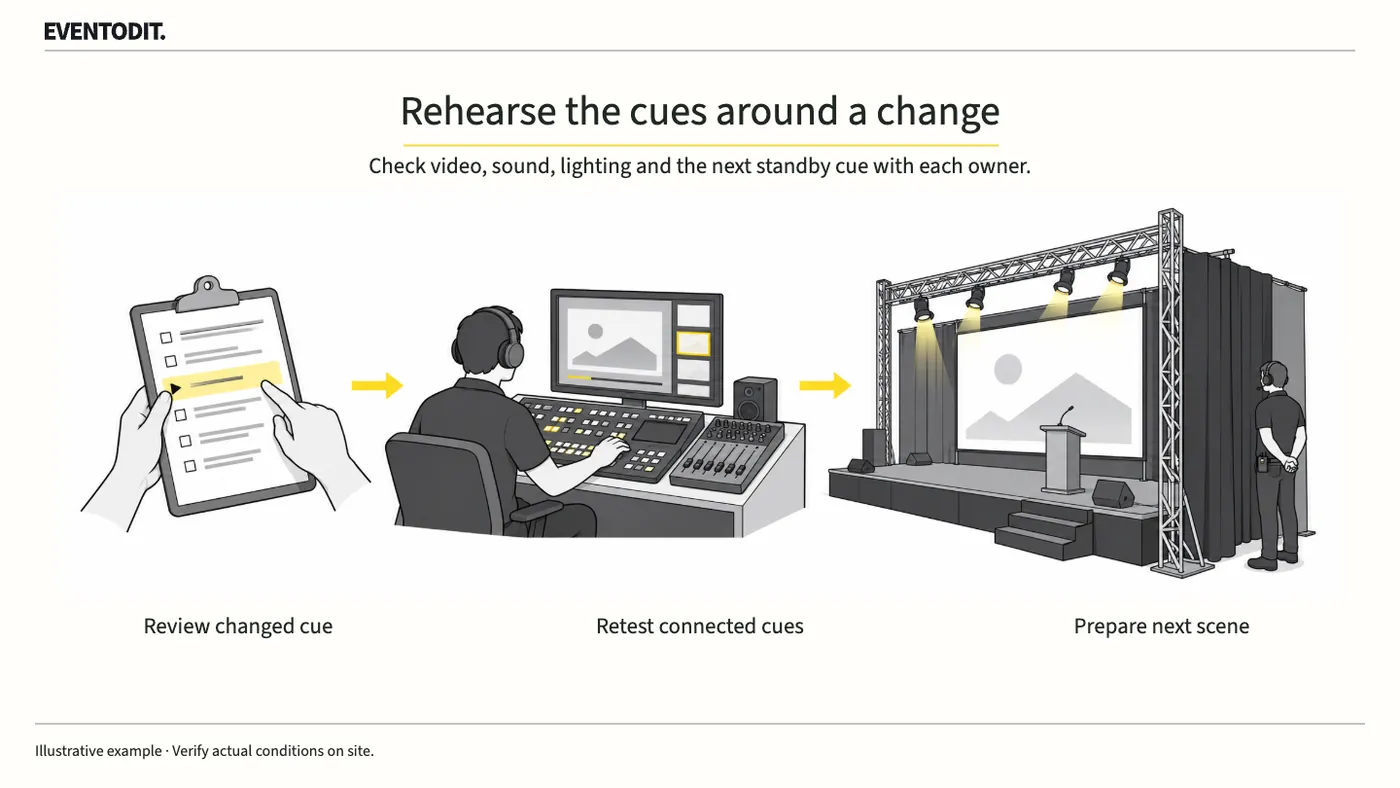
Changing a video’s length or a performer’s order can affect sound, lighting and standby calls. Ask the affected teams to check, rehearse the transitions around the revised scene, then distribute the approved cue sheet.
Read guideHave a correction or additional evidence? Request a correction